
UNITED STATES
SECURITIES AND EXCHANGE COMMISSION
Washington, D.C. 20549
____________________________________________________________________________
Form 10-K
____________________________________________________________________________
(Mark One)
| ANNUAL REPORT PURSUANT TO SECTION 13 OR 15(d) OF THE SECURITIES EXCHANGE ACT OF 1934 | |||||
For the fiscal year ended December 31, 2025
OR
| ¨ | TRANSITION REPORT PURSUANT TO SECTION 13 OR 15(d) OF THE SECURITIES EXCHANGE ACT OF 1934 | ||||
For the transition period from to
Commission file number 1-31234
____________________________________________________________________________
(Exact name of registrant as specified in its charter)
____________________________________________________________________________
(State or other jurisdiction of incorporation or organization) | (I.R.S. Employer Identification No.) | ||||||||||
| (Address of principal executive offices) | (Zip Code) | ||||||||||
Registrant’s telephone number, including area code: (214) 756-6900
SECURITIES REGISTERED PURSUANT TO SECTION 12(b) OF THE ACT:
| Title of each class: | Trading Symbol: | Name of each exchange on which registered: | ||||||
SECURITIES REGISTERED PURSUANT TO SECTION 12(g) OF THE ACT:
None
____________________________________________________________________________
Indicate by check mark if registrant is a well-known seasoned issuer, as defined in Rule 405 of the Securities Act. Yes ¨ No ý
Indicate by check mark if the registrant is not required to file reports pursuant to Section 13 or Section 15(d) of the Exchange Act. Yes ¨ No ý
Indicate by check mark whether the registrant (1) has filed all reports required to be filed by Section 13 or 15(d) of the Securities Exchange Act of 1934 during the preceding 12 months (or for such shorter period that the registrant was required to file such reports), and (2) has been subject to such filing requirements for the past 90 days. Yes ý No ¨
Indicate by check mark whether the registrant has submitted electronically every Interactive Data File required to be submitted pursuant to Rule 405 of Regulation S-T during the preceding 12 months (or for such shorter period that the registrant was required to submit and post such files). Yes ý No ¨
Indicate by check mark whether the registrant is a large accelerated filer, an accelerated filer, a non-accelerated filer, a smaller reporting company, or emerging growth company. See the definitions of “large accelerated filer”, “accelerated filer”, “smaller reporting company”, and “emerging growth company” in Rule 12b-2 of the Exchange Act.
| Large accelerated filer | ¨ | Accelerated filer | ¨ | |||||||||||||||||
| ý | Smaller reporting company | ý | ||||||||||||||||||
| Emerging growth company | ¨ | |||||||||||||||||||
If an emerging growth company, indicate by check mark if the registrant has elected not to use the extended transition period for complying with any new or revised financial accounting standards provided pursuant to Section 13(a) of the Exchange Act. ¨
Indicate by check mark whether the registrant has filed a report on and attestation to its management’s assessment of the effectiveness of its internal control over financial reporting under Section 404(b) of the Sarbanes-Oxley Act (15 U.S.C. 7262(b)) by the registered public accounting firm that prepared or issued its audit report. Yes ¨
If securities are registered pursuant to Section 12(b) of the Act, indicate by check mark whether the financial statements of the registrant included in the filing reflect the correction of an error to previously issued financial statements. ¨
Indicate by check mark whether any of those error corrections are restatements that required a recovery analysis of incentive-based compensation received by any of the registrant’s executive officers during the relevant recovery period pursuant to §240.10D-1(b). ¨
Indicate by check mark whether the registrant is a shell company (as defined in Rule 12b-2 of the Exchange Act). Yes ¨ No ý
The aggregate market value on June 30, 2025 of the voting and non-voting common equity held by non-affiliates of the registrant was $98,480,184 . For purposes of this calculation, the registrant has assumed that stockholders that are not officers or directors of the registrant are not affiliates of the registrant.
The number of shares of registrant’s Common Stock, par value $0.01 per share, outstanding as of February 27, 2026: 9,484,473 .
DOCUMENTS INCORPORATED BY REFERENCE
Selected portions of the registrant’s definitive Proxy Statement for the 2026 Annual Meeting of Stockholders, which will be filed with the U.S. Securities and Exchange Commission within 120 days after the end of the fiscal year to which this report relates, are incorporated by reference into Part III hereof.
WESTWOOD HOLDINGS GROUP, INC.
Index
| PAGE | ||||||||
i
PART I
Item 1. Business.
Unless the context otherwise requires, the term “we,” “us,” “our,” “Westwood,” or “Westwood Holdings Group” when used in this Form 10-K (“Report”) and in the Annual Report to the Stockholders refers to Westwood Holdings Group, Inc., a Delaware corporation, and its consolidated subsidiaries taken as a whole. This Report contains some forward-looking statements within the meaning of the federal securities laws. Actual results and the timing of some events could differ materially from those projected in or contemplated by the forward-looking statements due to a number of factors including, without limitation, those set forth under “Item 7. Management’s Discussion and Analysis of Financial Condition and Results of Operations” and “Item 1A. Risk Factors.”
General
We manage investment assets and provide services for our clients through our subsidiaries, Westwood Management Corp., Westwood Advisors, L.L.C., Salient Advisors, L.P. ("Salient Advisors") and Broadmark Asset Management LLC ("Broadmark"), (each of which is a registered investment adviser ("RIA") registered with the Securities and Exchange Commission ("SEC"), and Salient Capital, L.P., ("SCLP") an SEC-registered broker-dealer and Financial Industry Regulatory Authority ("FINRA") member, collectively referred to hereinafter together as "Westwood Management") and Westwood Trust. Westwood Holdings Group, founded in 1983, through Westwood Management, provides investment advisory services to institutional investors, a family of mutual funds called the Westwood Funds®, other mutual funds, individual investors and clients of Westwood Trust. Westwood Trust, founded as a state-chartered trust company in 1974, provides trust, custodial and investment management services through the use of commingled funds and individual securities to institutions and high net worth individuals.
Broadmark is a San Francisco-based RIA managing and/or sub-advising mutual funds, retail and institutional separately-managed accounts. SCLP serves as a sub-placement agent for private placements. Salient Advisors is an SEC-registered investment adviser, a Commodity Futures Trading Commission ("CFTC") registered Commodity Pool Operator ("CPO") and a National Futures Association ("NFA") member. Salient Advisors is an advisor to the Westwood Salient Tactical Plus Fund, which is sub-advised by Broadmark. In January 2023 we acquired an additional 32% interest in Broadmark, increasing our ownership of Broadmark to approximately 80%, which represents a controlling interest for financial statement consolidation purposes (the "Broadmark Acquisition").
Our revenues are generally derived from fees based on a percentage of assets under management ("AUM") and assets under advisement ("AUA"). Westwood Management and Westwood Trust collectively had AUM of approximately $16.5 billion and AUA of approximately $0.9 billion at December 31, 2025.
We were incorporated under the laws of the State of Delaware on December 12, 2001. Our common stock is listed on the New York Stock Exchange under the ticker symbol "WHG." We are a holding company whose principal assets consist of the capital stock and ownership interests of our operating subsidiaries, primarily Westwood Management and Westwood Trust.
The success of our business is dependent on client, institutional investment consultant and intermediary relationships. In addition to offering attractive investment opportunities and investment performance, we believe that client service is of paramount importance in the asset management business. Accordingly, a major business focus for us is to build strong relationships with clients to enhance our ability to anticipate their needs and satisfy their investment objectives. Our team approach is designed to deliver efficient, responsive service to our clients, while innovating investment strategies and product alternatives.
Our operating structure can support a larger business and we believe we are able to accommodate growth by acquisition, product innovation and internal growth within our client base. We have developed investment strategies that we expect to be attractive in our target institutional, wealth management and intermediary markets. Developing new investment strategies and building the organization to support these strategies can result in incurring expenses before significant offsetting revenues are realized. We continue to evaluate new strategies and resources in terms of meeting actual and potential investor needs.
Strategic Investments
Over the past several years we have made a number of strategic investments, including investments in Vista Bancshares, Inc. ("Vista"), Westwood Hospitality Fund I, LLC ("Westwood Hospitality"), the TXSE Group Inc. ("TXSE") and WEBs Investments Inc. ("WEBs").
Vista offers traditional banking services and provides clients of Westwood Trust efficient access to lines of credit secured by their investment portfolios. Our partnership enables Vista to refer its clients needing more complex financial planning and investment services to Westwood Trust.
Westwood Hospitality is a private investment fund seeded via our investment that we offer to clients of Westwood Trust.
1
TXSE is a private company that is the parent company of the Texas Stock Exchange, a national securities exchange built and headquartered in Dallas, Texas.
For a discussion of our investment in WEBs, see "Growth Strategy" below.
Available Information
We maintain a website at westwoodgroup.com. Information contained on, or connected to, our website is not incorporated by reference into this Report and should not be considered part of this Report or any other filing that we make with the SEC. All of our filings with the SEC, including our annual report on Form 10-K, quarterly reports on Form 10-Q, current reports on Form 8-K and any amendments to those reports filed or furnished pursuant to Sections 13(a) or 15(d) of the Securities Exchange Act of 1934, as amended (the "Exchange Act"), are available free of charge on our website. Our Code of Business Conduct, Corporate Governance Guidelines and Audit Committee, Compensation and Human Capital, and Governance/Nominating Committee Charters are available without charge on our website. Stockholders may also obtain print copies of these documents free of charge by submitting a written request to Murray Forbes III, our Chief Financial Officer and Treasurer, at the address set forth on the front of this Report. The public can also obtain access to any public document we file with the SEC at www.sec.gov.
Advisory
General
Our advisory business encompasses six distinct investment capabilities — United States ("U.S.") Value Equity, Multi-Asset, Energy and Real Assets, Tactical Absolute Return, Income Alternatives and Managed Investment Solutions ("MIS").
Westwood Management provides investment advisory services to large institutions, including corporate retirement plans, public retirement plans, endowments and foundations. Institutional separate account minimums vary by investment strategy and generally range from $10 million to $25 million. Westwood Management also provides advisory services to financial advisors, individuals, the Westwood Funds® mutual funds, Westwood ETFs, and private capital funds, as well as sub-advisory services to other mutual funds and pooled investment vehicles.
Investment Strategies
We offer high-conviction equity, outcome-oriented solutions and liquid alternatives to address a wide range of investment objectives, including five strategies each having AUM exceeding $1 billion: LargeCap Value, Income Opportunity, SmallCap Value, MLP & Energy Infrastructure and SMidCap Value.
U.S. Value Equity
The U.S. Value Equity team employs a value-oriented approach to identify undervalued, high-quality businesses capable of generating superior risk-adjusted returns, using a fundamental, bottom-up, investment process. Our team seeks well-run businesses with conservative balance sheets and strong free cash flow that can expand enterprise value by funding growth initiatives or by returning capital to shareholders. Identifying undervalued companies with strong fundamentals, where the outlook for future earnings growth is underestimated by the market, offers us the potential for asymmetric returns. This investment approach is intended to preserve capital during unfavorable periods and provide superior real returns over the long term. We have established a track record of producing competitive risk adjusted and real returns for our clients. The principal investment strategies currently managed by the U.S. Value Equity team are as follows:
AllCap Value: Investments in equity securities of approximately 40 to 60 companies benchmarked to the Russell 3000 Value Index.
LargeCap Value: Investments in equity securities of approximately 40 to 60 companies benchmarked to the Russell 1000 Value Index.
MidCap Value: Investments in equity securities of approximately 50 to 80 companies benchmarked to the Russell 1000 Value Index.
SmallCap Value: Investments in equity securities of approximately 50 to 70 companies benchmarked to the Russell 2000 Value Index.
SMidCap Value: Investments in equity securities of approximately 50 to 70 companies benchmarked to the Russell 2500 Value Index.
Multi-Asset
The Multi-Asset team employs an investment process that applies top-down views across asset classes along with bottom-up security selection, utilizing quantitative and fundamental tools to evaluate macro, micro and technical conditions
2
across a range of asset classes. Our outcome-oriented solutions utilize strategic and tactical allocations as well as a disciplined focus on managing downside risks.
The team draws on the proprietary fundamental research of Westwood’s experienced investment team members to identify securities with attractive risk-adjusted return profiles across a broad spectrum of income-producing securities. The principal investment strategies managed by the Multi-Asset team are as follows:
Income Opportunity: Tactical asset allocation strategy that invests across multiple fixed income sectors, convertibles and equity securities with an income generation bias. Typically invests in a range of asset types with an overall moderate risk profile.
Multi-Asset Income: Tactical asset allocation strategy that invests across multiple fixed income sectors, convertibles and income-producing equity securities. Typically invests in a range of asset types with an overall conservative risk profile.
Energy and Real Assets
Our Energy and Real Assets team employs an investment approach designed to provide access to a broad universe of energy companies with an emphasis on energy infrastructure. Energy infrastructure companies include Master Limited Partnerships ("MLPs") and midstream corporations as well as other companies involved with infrastructure connected to the production, transportation or distribution of energy. The team has the potential to take advantage of a range of energy opportunities. Our portfolio managers consider primary risk factors for midstream energy infrastructure companies to be economic conditions, equity markets, high yield spreads, volume throughput, energy demand, commodity prices and interest rates. The team monitors and discusses changes in these risk factors on a daily basis. In addition to fundamental analyses, the team utilizes quantitative models to measure valuations, momentum and other risk attributes. The investment team monitors key risk factors for each company and the overall market and positions portfolios accordingly to align with their portfolio management philosophy. The principal investment strategy currently managed by the Energy and Real Assets team is:
MLP & Energy Infrastructure: Provides access to a universe of energy infrastructure, MLPs and MLP-related companies with the potential to diversify a traditional stock/bond portfolio along with income and inflation protection.
Tactical Absolute Return
Our Tactical Absolute Return strategies are sub-advised by Broadmark. These strategies seek to deliver positive absolute returns through market cycles. We believe that tactical portfolio allocation can actively manage market exposure by adapting to economic conditions and internal market momentum. These strategies appeal to clients unwilling to be fully invested in equities during periods of intense speculation and monetary tightening within an overvalued market. We also look for market environments in which we believe investors should be fully invested or should even overweight higher beta sectors and indices. Our goal is to be in concert with the overall economic/business cycle.
Broadmark’s investment process is grounded in four pillars. The first three pillars – valuation, monetary policy and investor sentiment — are qualitative in nature. The fourth pillar is a quantitative assessment of market volume and breadth-based momentum. Using a combination of these qualitative and quantitative metrics, Broadmark seeks to manage risk and enhance alpha by tactically phasing into and out of major equity cycles. Broadmark invests primarily in a diversified portfolio of ETFs and instruments providing exposure to indices, sectors and industries based on its four-pillar process. The investment team may tactically deploy leveraged investment techniques as well as short positions that allow a net exposure ranging from net long to net short depending on the strategy.
Tactical Growth: Strategy that actively manages equity market exposure via the use of ETFs and other index-based instruments. Seeks to produce above-average, risk-adjusted returns in all market environments, while exhibiting less downside volatility than the S&P 500® Index. Designed to help investors sidestep market downturns while attempting to participate in market upsides via continuous active management of portfolio market exposure.
Tactical Plus: Strategy that actively manages equity market exposure primarily by investing in equity-based futures, ETFs and options. Seeks to produce above-average, risk-adjusted returns in any market environment while exhibiting less downside volatility than the S&P 500® Index by investing mainly in a diversified portfolio of instruments with exposure to U.S. and non-U.S. equity securities. Designed to help investors sidestep market downturns while attempting to participate in market upsides via continuous active management of portfolio market exposure.
Income Alternatives
Our Multi-Asset team manages our Alternative Income strategy, and our Real Estate team manages our Real Estate Income strategy. We believe alternative approaches to income investing can provide diversified sources of risk and return and can potentially reduce volatility. Absolute return-oriented and yield-focused strategies for investing in securities not typically found in traditional fixed income portfolios can help investors produce returns from non-traditional sources with low correlation and enhanced portfolio diversification.
3
Alternative Income: We believe that a market-neutral approach utilizing convertible arbitrage and opportunistic fixed income can serve as a complement to bond allocations. Our framework consists of three primary sources of return that aim to neutralize systematic risk. We employ a multi-strategy process seeking to generate positive absolute returns through a short duration yield portfolio of global fixed income securities, convertible arbitrage and macro-hedging, with a focus on convertible arbitrage for reduced correlation and market exposure.
Real Estate Income: A sector-based approach that seeks to produce a substantial income profile and attractive risk-adjusted total returns by investing across the capital stack of publicly-traded real estate investment trusts ("REITs") and other real estate-related companies. Our differentiated strategy has historically emphasized a significant exposure to preferred securities issued by REITs, however our portfolio construction routinely includes high dividend paying REIT common stocks as well as debt securities issued by REITs.
Managed Investment Solutions: Our MIS team joined us in late 2023 and focuses on tailoring investment solutions to a diverse array of individual institutional risk/reward tolerances and investment approaches. We believe that creating customized investment portfolios for clients, using a consultative approach to identify their unique needs, goals and investment objectives, can potentially lead to better outcomes over the long term. The MIS approach combines the following attributes:
•Active Design – Design, construct and implement index methodologies in consultation with clients
•Rules-Based – Systematic approach to achieving client objectives, targeting intended exposures
•Transparent – End-to-end transparency across methodology, construction and implementation
•Outcome-Oriented – Create custom portfolio solutions based on specific client goals, beliefs and objectives
•Adaptive – Implementation and construction that evolves with changing client beliefs and objectives
•Independent – Freedom to choose tools and data sources that are best-suited to help clients achieve their outcomes
Prospective clients for MIS include public plans, sovereign wealth funds, corporate pension plans, defined contribution plans, endowments, foundations, consultant groups and wealth investors.
Exchange-Traded Funds: We launched two ETFs in 2025 - Westwood Enhanced Income Opportunity ETF (YLDW) and Westwood LBRTY Global Equity ETF (BFRE). YLDW seeks to provide current income and capital appreciation from a variety of asset classes including equities, investment grade corporate bonds, high yield bonds, convertible bonds, preferred securities and other income-oriented assets with enhanced yield from option premiums. BFRE seeks to track the TOBAM LBRTY® All World Equity Index. The approach is grounded in academic research highlighting the economic advantages of democratic nations.
Our ability to grow AUM is primarily dependent on our competitive investment performance and success in building strong relationships with clients, investment consulting firms, financial intermediaries and RIAs. We continually seek to expand AUM by organically growing our current investment strategies and by adding new products as we did via our Salient Acquisition in 2022 (the "Salient Acquisition"), the acquisition of a controlling interest in Broadmark in 2023, the addition of our MIS team in 2023, and the launch of ETFs in 2024 and 2025. We will continue to focus on organic product initiatives to grow our investment strategies while considering new investment strategies via acquisitions or from third parties, as discussed under "Growth Strategy" below. Our growth strategy provides clients with more investment opportunities and diversifies our AUM and revenue sources, thereby reducing risk in any one area of investment and increasing our ability to attract new clients. Our ten largest clients accounted for approximately 20 % of our fee revenues for the year ended December 31, 2025. The loss of some or all of these large clients could have a material adverse effect on our business and our results of operations.
Advisory and Sub-advisory Agreements
Westwood Management manages client accounts under investment advisory and sub-advisory agreements. Typical of the asset management industry, these agreements are usually terminable upon short notice by either party and provide for revenues based on the market value of client AUM. Advisory fees are paid quarterly in advance based on AUM on the last day of the preceding quarter, quarterly in arrears based on AUM on the last day of the quarter just ended or based on a daily or monthly average of AUM for the stated period. Some clients have contractual performance-based fee arrangements, which generate additional revenues if we outperform a specified index over a specific period of time. Revenue for performance-based fees is recorded at the end of the measurement period. Revenue from advance payments is deferred and recognized over the period that services are performed. Pursuant to these agreements, Westwood provides overall investment management services, including directing investments in conformity with client-established investment objectives and restrictions. Unless otherwise directed in writing by clients, Westwood has the authority to vote all proxies with respect to securities in client portfolios.
Westwood Management is party to sub-advisory agreements with other investment advisers under which it performs similar services under advisory agreements. Our sub-advisory fees are generally computed based upon the average daily AUM and are payable on a monthly basis.
4
Westwood Management provides investment advisory services to the Westwood Funds® family of mutual funds:
| ● | Westwood Alternative Income (WMNIX) | ● | Westwood Quality MidCap (WWMCX)* | ||||||||
| ● | Westwood Broadmark Tactical Plus (SBTIX) | ● | Westwood Quality SmallCap (WHGSX) | ||||||||
| ● | Westwood Broadmark Tactical Growth (FTGWX) | ● | Westwood Quality SMidCap (WHGMX) | ||||||||
| ● | Westwood Multi-Asset Income (WHGHX) | ● | Westwood Quality Value (WHGLX) | ||||||||
| ● | Westwood Income Opportunity (WHGIX) | ● | Westwood MLP & Energy Infrastructure (SMLPX) | ||||||||
| ● | Westwood Quality AllCap (WQAIX)* | ● | Westwood Real Estate Income (KIFYX) | ||||||||
Westwood Management provides investment advisory services to the Westwood ETFs:
| ● | Westwood Enhanced Income Opportunity ETF (YLDW) | ● | Westwood LBRTY Global Equity ETF (BFRE)* | ||||||||
| ● | Westwood Salient Enhanced Midstream Income ETF (MDST) | ● | Westwood Salient Enhanced Energy Income ETF (WEEI) | ||||||||
As of December 31, 2025, AUM in the Westwood Funds® totaled $3.9 billion and AUM in the Westwood ETFs totaled $0.2 billion.
* Following our assessment of the commercial viability of Westwood Quality AllCap (WQAIX), Westwood Quality MidCap (WWMCX), and Westwood LBRTY Global Equity ETF (BFRE), we determined that closing and liquidating these funds was in the best interests of the funds and their shareholders. WQAIX and WWMCX were liquidated on February 24, 2026, and BFRE will be liquidated on March 6, 2026.
Trust
General
Westwood Trust provides fiduciary and investment services to high net worth individuals and families, non-profit endowments and foundations, public and private retirement plans and individual retirement accounts. Westwood Trust is chartered and regulated by the Texas Department of Banking. Fees charged by Westwood Trust are separately negotiated with each client and are typically based on AUM. Clients generally have at least $1 million in investable assets.
Fiduciary Services
Westwood Trust’s fiduciary services include but are not limited to - financial planning, wealth transfer planning, customizable trust services, trust administration and estate settlement. Westwood Trust also provides custodial services, tax reporting, accounting of trust income and principal, beneficiary and retiree distributions and safekeeping of assets.
Investment Services
Westwood Trust utilizes a consultative approach in developing a portfolio asset allocation for individual clients. Our approach involves examining clients' financial situations, including their current investment portfolio, and advising clients on ways to reduce risk, enhance investment returns and strengthen their financial position based on each client’s unique objectives and constraints. Westwood Trust seeks to define and improve the risk/return profiles of client investment portfolios by offering a comprehensive investment solution or by enhancing clients’ existing investment strategies. Westwood Trust manages separate portfolios of equity and fixed income securities for certain agency and trust clients. Equity portfolios are generally patterned after the institutional strategies offered by Westwood Management or developed by our internal investment teams. Fixed income portfolios consist of taxable and tax-exempt portfolios with a high credit quality and intermediate duration bias.
Westwood Trust also sponsors a range of commingled funds in which client assets are commingled to achieve economies of scale. Westwood Trust’s commingled funds fall within two basic categories: personal trusts (common trust funds) and employee benefit trusts (collective investment funds). Westwood Trust sponsors commingled funds for several of the investment strategies managed by Westwood Management.
Westwood Trust also develops asset allocation models for certain clients utilizing its commingled funds, mutual funds managed by Westwood Management and non-affiliated mutual funds.
Enhanced Balanced® Portfolios
Westwood Trust is a strong proponent of asset class diversification and offers its clients the ability to diversify among many different asset classes. Westwood Trust Enhanced Balanced® portfolios allocate assets among these asset classes into a customizable portfolio for clients seeking to maximize return for a given level of risk. Periodic adjustments are made to asset class weightings in Enhanced Balanced® portfolios based on historical returns, risk and correlation data, and our current capital markets outlook.
5
Select Equity Strategy
The Westwood Select Equity strategy aims to provide low-frequency turnover and tax efficiency to high net worth individuals. The offering allows individuals to own a diversified portfolio representing our best ideas from across Westwood's investment teams. These portfolios include value and growth stocks, along with small-, mid- and large-capitalization stocks. Westwood Select Equity is also available without the tax efficiency overlay.
Dividend Select Strategy
The Westwood Dividend Select strategy aims to provide dividend income to investors. The offering allows investors to own a diversified portfolio of dividend-producing equity securities. These portfolios primarily include value stocks, along with mid- and large-capitalization stocks.
Thematic Innovation and Growth
The Thematic Innovation and Growth strategy aims to provide long-term appreciation to investors. The offering allows investors to own a concentrated portfolio of securities to provide higher returns commensurate with higher volatility. These portfolios primarily include growth stocks in the mid- to large-capitalization range.
Distribution Channels
Westwood Management investment funds and advisory services are distributed through two primary market channels - Institutional and Intermediary. Our Distribution sales and support infrastructure supports dedicated marketing and client service in both channels. Westwood Trust provides wealth and investment management solutions primarily to individuals and utilizes both Westwood Management and external investment management services.
Institutional
The institutional team markets Westwood mutual funds, collective investment trusts, separate accounts and managed investment solutions, as well as advisory and sub-advisory services to defined benefit and defined contribution corporate and public plan sponsors, foundations and endowments, financial institutions and investment consultants. We maintain strong relationships with many global, national and regional investment consulting firms, which have contributed to our being considered and hired by their clients. By leveraging these relationships, we can offer our investment strategies within select defined contribution and other retirement plans in which clients utilize mutual fund and collective investment trusts vehicles. Sub-advising funds of other financial institutions allows us to extend our marketing reach via other firms' distribution systems.
Intermediary and Retail
In the intermediary and retail channel, our team directly markets our investment services, including the Westwood Funds®, Westwood ETFs and private capital funds to financial intermediaries, RIAs, broker-dealers, and turnkey asset management programs. We also focus on expanding our relationships with financial intermediaries that manage discretionary mutual fund and ETF models.
Managed accounts are similar to sub-advisory relationships in that a third-party financial institution, such as a broker-dealer or RIA, trades securities using our model. The typical managed account client is a high net worth individual or small institution. In these arrangements, the third-party financial institution is responsible to the end client for client service, operations and accounting.
Wealth Management
In our wealth management channel, we generate awareness of our trust fiduciary and investment services through investment consultants, centers of influence, community involvement, and targeted direct marketing to high net worth individuals, families and small to medium-sized institutions. We also seek asset growth generated by referrals from existing clients.
Growth Strategy
We believe we have established a strong platform to support future growth, deriving strength from the experience and capabilities of our management team and our skilled investment, distribution and client service professionals. We believe opportunities for future growth will come from our ability to:
•generate growth in our investment management platform from new and existing clients and consultant relationships;
•attract and retain key employees;
•grow assets in our existing investment strategies;
•foster continued growth of the wealth management platform and distribution channel;
6
•expand and enhance intermediary distribution;
•innovate to bring newly developed investment capabilities and vehicles to market;
•pursue strategic corporate development opportunities;
•continue to strengthen our brand name; and
•develop or acquire new investment strategies.
Generate growth from new and existing clients and consultant relationships. A primary business objective is to maintain and enhance existing relationships with clients, investment consultants and intermediaries by providing value-added investment opportunities, performance and excellent client service. We pursue growth via targeted sales and marketing efforts that showcase our boutique, innovative offerings across our product platform. New institutional client accounts are sourced from investment consultants or from our direct sales efforts. The Salient Acquisition, the addition of our MIS team, the launch of several ETFs and the launch of our Energy Secondaries private capital platform have significantly expanded our product range and distribution capabilities. We plan to leverage our increased scale and broader product availability to enhance offerings to institutional, intermediary and wealth management clients. We believe a key factor for our being considered for new client mandates and platform placements is our firm’s in-depth knowledge, our people, our processes and our agility to innovate to meet our client needs with new products and services.
Attract and retain key employees. We have created a workplace environment in which motivated, performance-driven and client-oriented individuals can thrive. As a public company, we offer certain employees a compensation program that includes strong equity incentives to align their success with that of our clients and stockholders. We believe these factors are critical to maintaining a stable, client-focused environment to support future growth.
Grow assets in our existing investment strategies. We have significant capacity to manage additional assets across our investment management platform. We have considerably expanded our range of investment strategies and capabilities through the Salient Acquisition, the addition of MIS and the launch of our Energy Secondaries private capital platform, further enhancing our growth opportunities.
Foster continued growth of the wealth management platform and distribution channel. Westwood Trust serves high net worth and ultra-high net worth individuals and families as well as small to medium-sized institutions. Our location within the Texas Triangle, comprised of Dallas-Fort Worth, Houston, San Antonio, and Austin, provides significant opportunities for future growth. The Texas Triangle is experiencing rapid growth in population and jobs and, in aggregate, represents the 8th largest economy in the world. We anticipate continued interest from clients and prospective clients in our holistic wealth management approach, which leverages our long history and deep experience as a trust company and investment management firm. A significant percentage of Westwood Trust’s asset inflows stems from referrals along with gathering additional assets from existing clients, trends we see continuing.
Expand and enhance intermediary distribution. The Intermediary distribution channel is a key component of our efforts to grow our AUM, primarily with respect to mutual funds, ETFs, separately managed accounts ("SMA"), model-delivery SMA and private capital funds. We continue to seek ways to enhance the effectiveness of our intermediary distribution efforts through the utilization of technology and addition of experienced sales personnel. In recent years we have added a Head of ETF Distribution and an ETF Sales Specialist. We believe our efforts to expand and enhance intermediary distribution enable us to pursue AUM growth in the defined contribution and retirement marketplaces as well as with RIAs and select broker-dealers.
Innovate to bring newly developed investment capabilities and vehicles to market. Being a small, boutique investment manager, we have the agility to bring innovative investment strategies and products to all of our target markets. We have recently expanded our range of investment strategies, capabilities, and vehicles through the following strategic initiatives that will provide future growth opportunities:
•Addition of our MIS team in the fourth quarter of 2023 – our MIS team focuses on tailoring investment solutions to a diverse array of institutional risk/reward tolerances and investment approaches. We have built a proprietary portfolio management system to take the team’s custom solutions capabilities to market. We increased our proactive sales efforts throughout 2025 with well-received road shows focused on consultants and institutional plan sponsors.
•Energy Secondaries private capital – we continue to see attractive opportunities to acquire limited partnership interests in energy private equity funds. Many institutional investors are divesting energy holdings for liquidity purposes as well as environmental, social and governance ("ESG") and other non-fundamental reasons, thereby creating a large supply and demand imbalance. We can provide needed liquidity to these investors in energy private equity funds via our own private capital funds which offer our clients the opportunity to participate in the funds' acquisition of limited partnership interests, generally at discounts to net asset value ranging from approximately 20% to 40%. We have also seen an increase in general partner-led continuation vehicles and co-investment opportunities, which provide our clients with exposure to single or a small number of mature assets with established operating histories.
7
•Building our ETF platform – we launched our first two actively-managed ETFs in 2024 and added two more in 2025: Westwood Enhanced Income Opportunity ETF (YLDW) and Westwood LBRTY Global Equity ETF (BFRE). Westwood Enhanced Income Opportunity ETF (YLDW), along with Westwood Salient Enhanced Midstream Income ETF (MDST) and Westwood Salient Enhanced Energy Income ETF (WEEI), comprise our Enhanced Income SeriesTM ETFs. These Enhanced Income SeriesTM funds are designed to provide advisors and investors with a robust solution for generating high distributable monthly income, combining dividend yield and options premiums from covered calls, while offering the potential for equity appreciation across multiple asset classes. We have deployed an ETF ecosystem with top-tier partners, which can serve as a platform for future ETF launches.
•Partnership with WEBs Investments Inc. – in late 2024 we partnered with a newly launched firm, WEBs Investments Inc., to develop and launch innovative investment strategies for investors and advisors. Westwood provided the initial capital to launch WEBs and provides distribution resources and administrative support, with an option to buy the entity subject to achievement of certain growth milestones.
Pursue strategic corporate development opportunities. We continually evaluate strategic corporate development opportunities to augment our organic growth. These may include acquisitions of asset management firms, investment funds, wealth management firms or other financial institutions, as well as hiring investment professionals or teams. We consider opportunities that can enhance our existing operations, expand our range of investment strategies and services, or further develop our distribution capabilities. Acquiring investment firms or hiring investment professionals or teams with investment strategies outside our current areas of expertise can help us attract new clients and provides existing clients with a broader array of investment strategies. We may consider forging alliances with other financial services or technology firms to leverage our core competency of developing and managing investment strategies and obtain enhanced distribution capabilities or additional service offerings.
Continue to strengthen our brand name. We believe that the strength of our brand name has been a key component to our long-term success in the investment industry and will be instrumental to our future success. We have developed a strong brand name largely thanks to our investment performance and attentive client service approach, coupled with high-profile coverage in investment publications and electronic media. Many of our investment professionals have been prominent in print and electronic media, and we will continue to seek creative approaches to strengthen our brand name and reputation in our target markets.
Develop or acquire new investment strategies. We continuously seek opportunities to expand our range of investment strategies available to existing and prospective clients. We consider internally developed strategies to extend our existing investment process to new markets, asset classes or strategies and we may consider externally acquired investment strategies. An expanded range of investment strategies offers more ways to serve our client base, generating diversified revenue streams and underpinning asset and revenue growth.
Competition
We are subject to substantial and growing competition in all aspects of our business. Barriers to entry in the asset management business are relatively low and we expect more competitors in the future. Many asset managers are larger, better known and have greater resources than we do.
We compete with other asset management firms on the basis of investment strategies, investment performance in absolute terms and relative to peer groups, quality of service, the levels of fees charged, attractive compensation offered to key employees and the way in which investment strategies are marketed. Many of our competitors offer more investment strategies and services than we do and many have substantially greater AUM.
We compete against numerous investment dealers, banks, insurance companies, mutual fund companies, ETFs, brokerage and investment firms and others that sell equity funds, taxable income funds, tax-free investments and other investment products. The allocation of assets by many investors from active equity investing has enhanced the ability of firms offering passive equity management to compete more effectively with us. The demand for passive strategies with low-fee structures has rapidly increased and investors frequently demand customized and personalized strategies to fit their investment needs. This shift in the marketplace may benefit competitors offering certain investment vehicles that we do not offer. In summary, our competitive landscape is intense and dynamic, which may affect our ability to compete successfully.
Most prospective clients perform a thorough review of an investment manager’s background, investment policies and performance before committing assets and many prospective clients invite competing firms to make presentations. The process of obtaining a new client typically takes twelve to eighteen months from the time of initial contact. While we have achieved success in competing for clients, we dedicate significant resources to this process over an extended period of time with no certainty of winning client mandates.
Regulation
8
Virtually all aspects of our business are subject to federal, state and other non-U.S. jurisdictions' laws and regulations. These laws and regulations are primarily intended to protect investment advisory clients. Under such laws and regulations, agencies that regulate investment advisers have broad administrative powers, including the power to limit, restrict or prohibit advisers from carrying on their business if they fail to comply with such laws and regulations. Possible sanctions include suspension of individual employees, limitations on engaging in certain lines of business for specified periods of time, revocation of investment adviser and other registrations, censures and fines. We believe that we are in compliance with all material laws and regulations.
Westwood Management
Our business is subject to regulation at federal and state levels by the SEC and other regulatory bodies. Westwood Management Corp. and Westwood Advisors, L.L.C. are registered with the SEC under the Investment Advisers Act of 1940, as amended (the "Investment Advisers Act") and under the laws of various states. As RIAs, Westwood Management Corp. and Westwood Advisors, L.L.C. are regulated and subject to examination by the SEC. The Investment Advisers Act imposes numerous obligations on RIAs, including fiduciary duties, record keeping, operational and marketing requirements and disclosure obligations. Westwood Management Corp. also acts as adviser to the Westwood Funds®, a family of mutual funds and Westwood ETFs registered with the SEC under the Investment Company Act of 1940, as amended (the “Investment Company Act”). As an adviser to a registered investment company, Westwood Management Corp. must comply with the Investment Company Act and related regulations. The Investment Company Act imposes numerous obligations on registered investment companies, including requirements relating to operations, fees charged, sales, accounting, record keeping, disclosure, governance, and restrictions on transactions with affiliates. Under SEC rules and regulations promulgated pursuant to the federal securities laws, we are subject to periodic SEC examinations. The SEC can institute proceedings and impose sanctions for violations of the Investment Advisers Act and the Investment Company Act, ranging from censure to termination of an investment adviser’s registration. The failure of Westwood Management Corp. and Westwood Advisors, L.L.C. to comply with SEC requirements could have a material adverse effect on Westwood. We are also required to comply with anti-money laundering laws and regulations, including the USA PATRIOT Act of 2001, as subsequently amended and reauthorized (the "Patriot Act"). We believe that we are in compliance with the regulations under the Investment Advisers Act, the Investment Company Act and the Patriot Act.
As an investment adviser, we have a fiduciary duty to our clients. The SEC has interpreted that duty to impose standards, requirements and limitations on, among other things: trading of client accounts, allocation of investment opportunities among clients, use of soft dollars, execution of transactions and recommendations to clients. We manage accounts for our clients with the authority to buy and sell securities, select broker-dealers to execute trades and negotiate brokerage commission rates. We receive soft dollar credits from certain broker-dealers that are used to pay for brokerage and research-related products, which reduces certain company operating expenses. We intend to use soft dollars to pay only for brokerage and research-related products and services that fall within the safe harbor provisions of the Exchange Act. If our ability to use soft dollars were reduced or eliminated as a result of the implementation of statutory amendments or new regulations, our operating expenses would increase.
Westwood Trust
Westwood Trust operates in a highly regulated environment and is subject to extensive supervision and examination. As a Texas chartered trust company, Westwood Trust is subject to the Texas Finance Code (the "Finance Code"), the rules and regulations promulgated under the Finance Code and supervision by the Texas Department of Banking. These laws are intended primarily for the protection of Westwood Trust’s clients and creditors rather than for the benefit of investors. The Finance Code provides for and regulates a variety of matters, such as:
•minimum capital maintenance requirements;
•restrictions on dividends;
•restrictions on investments of restricted capital;
•lending and borrowing limitations;
•prohibitions against engaging in certain activities;
•periodic fiduciary and information technology examinations by the Texas Department of Banking Commissioner;
•furnishing periodic financial statements to the Texas Department of Banking Commissioner;
•fiduciary record keeping requirements; and
•prior regulatory approval for certain corporate events (mergers, sale or purchase of all or substantially all trust company assets, and transactions transferring control of a trust company).
9
The Finance Code gives the Texas Department of Banking Commissioner broad regulatory powers (including penalties and civil and administrative actions) if the trust company violates certain provisions of the Finance Code, including implementing conservatorship or closure if Westwood Trust is determined to be in a "hazardous condition" (as defined by applicable law). Westwood Trust’s failure to comply with the Finance Code could have a material adverse effect on Westwood.
Westwood Trust is limited by the Finance Code in the payment of dividends to undivided profits, which is described as that part of equity capital equal to the balance of net profits, income, gains and losses since formation minus subsequent distributions to stockholders and transfers to surplus or capital under share dividends or appropriate board resolutions. At the discretion of its Board of Directors (the "Board"), Westwood Trust has made quarterly and special dividend payments, and other distributions, to Westwood Holdings Group, Inc. out of undivided profits.
SEC Broker‑Dealer Registration / FINRA Regulation
SCLP is subject to regulation by the SEC, FINRA and various states. In addition, certain of our employees are registered with FINRA and various states and are subject to SEC, state and FINRA regulation. The failure of the company and/or employees to comply with relevant regulation could have a material adverse effect on our business.
Employee Retirement Income Security Act of 1974
We are subject to the Employee Retirement Income Security Act of 1974, as amended ("ERISA"), and to its related regulations insofar as we are a fiduciary under ERISA with respect to some clients. ERISA and applicable provisions of the Internal Revenue Code impose certain duties on fiduciaries under ERISA or on entities that provide services to ERISA plan clients and prohibit certain transactions involving ERISA plan clients.
Human Capital Resources
Health and Safety
The health and safety of our employees is a high priority, consistent with our operating philosophy of focusing on transparency, effective corporate governance, life principles and giving back to the communities in which we live and work.
Diversity and Inclusion
We believe that our culture of diversity and inclusion enables us to develop and fully utilize the strengths of our people. As of December 31, 2025, approximately 41% of our workforce was female and minorities represented approximately 31% of our workforce.
Employees
At December 31, 2025, we had 148 full-time employees, all located in the U.S. No employees are represented by a labor union, and we believe our employee relations are favorable. As of December 31, 2025, approximately 14% of our employees held the Chartered Financial Analyst designation.
Environmental, Social and Governance
ESG Core Principles
Since inception, we have fostered a corporate culture focused on a set of core values. We have found inspiration in Coach John Wooden’s Pyramid of Success™ which helps us aspire to and maintain a culture of teamwork, integrity and putting client interests ahead of our own.
Our ESG focus is guided by the following six pillars:
1.Environmental impact;
2.Diversity and inclusion;
3.Community;
4.Responsible investing;
5.Privacy and data protection; and
6.Governance.
We include ESG pillars in conducting our business and measure ourselves against them because they make good sense. It improves our ability to create an environment that values true diversity, inclusiveness and transparency and ultimately supports long-term employee growth. Our focus on transparency, corporate governance, life principles, ethical conduct and giving back to the communities in which we operate is central to our values.
Governance
10
Westwood is committed to the successful integration and promotion of ESG at the corporate level and the investment level. We have separate governing structures to ensure that we have the necessary leadership to create and sustain a clear corporate strategy across our business. The separation of responsibilities among these governing structures ensures proper accountability across our firm.
Westwood’s Board plays an important role to ensure that the interests of shareholders are represented and that Westwood is fulfilling its fiduciary duties. The Board regularly interacts with management to ensure that stakeholder interests are properly considered. Management regularly updates the Board on our ESG efforts and collaboration between the Board and those responsible for ESG is key to our implementation strategy. Our Board benefits from deep industry experience and a majority of its members are independent which enables strong oversight of our business.
Westwood’s ESG Steering Committee is responsible for ensuring effective execution of our overall ESG strategy. Along with our CEO, this group sets the strategic direction for our ESG agenda, oversees its implementation, and reviews our ESG strategy with our Board.
Responsible Investment / ESG Integration
Our responsible investment commitment is evident in our overall investment approach where we take a fundamental approach to identifying high-quality companies and sound businesses around the world. As an active asset manager, ESG issues are directly considered in our bottom-up, fundamental assessment of companies. Our fundamental, financial materiality-based approach to identifying high-quality companies and businesses around the world leads our investment team to consider these issues in their fundamental analyses of the merits of a company's strategy, downside risk and valuation. As ESG integration and evaluation techniques evolve we will adapt to ensure compliance with our fiduciary responsibilities.
Westwood is a signatory of the United Nations Principles for Responsible Investment ("UNPRI") and is committed to adopting and implementing responsible investment principles in a manner consistent with our fiduciary duties to clients. We support the UNPRI and recognize the importance of considering ESG issues as an element in our overall investment process.
Engagement
As part of our fundamental investment research process, our analysts conduct meetings with target company management and investor relations to understand strategy, execution and financial strength throughout the life of our investment. Meetings inform our investment analysis and amplify our understanding of a business’s ability to adapt to changing business environments. Meetings can take place in person, during investment conferences or video calls, and they often build on long-standing relationships. Our understanding of material issues affecting the company is shared with the team in our valuation analyses and recommendations made by our research analysts.
Westwood does not set and track engagement objectives. We engage on specific topics on a case-by-case basis and when ESG or other issues are of specific concern, our team seeks to understand how the company plans to address relevant issues and then tracks them over time. Our engagement is generally conducted via direct dialogue between our investment professionals and company managements which is a more constructive approach toward understanding issues and encouraging solutions that provide value to stakeholders.
Proxy Voting
Westwood views proxy voting rights as valuable portfolio assets. Our overarching principle is to exercise voting responsibilities solely in the best interests of our clients. We use proxy voting as a means of addressing corporate governance issues and identifying corporate actions that enhance shareholder value. Our process benefits from multiple inputs and directly involves our investment professionals.
Westwood uses guidelines from a third-party proxy research service, Glass, Lewis & Co. ("Glass Lewis"), that we believe create value for our clients and cover most proxy issues. The Investment Operations Team, including the head of data governance, oversees the implementation of our proxy voting policy. Westwood’s Corporate Responsibility Committee, together with our investment team’s bi-monthly review of ballots, evaluates the alignment of Glass-Lewis proxy voting guidelines on environmental and social issues with our financial-materiality-based view of ESG integration. The Glass Lewis policy states that it will vote in favor when there is a clear link between the proposal and value enhancement or risk mitigation. Our goal is to vote all proxies and we generally follow the recommendations of our proxy research service however our Research Analysts occasionally recommend a vote that differs from Glass Lewis. We vote against recommendations when we believe that it serves our clients’ best interests. An annual summary of voting is sent to each client for whom proxies are voted.
Social Impact and Corporate Giving
Westwood has a long history of community involvement and support of local charitable causes. This involvement is a cornerstone of our culture, drives employee engagement and makes employees proud to work at Westwood. In honoring Westwood’s history of community involvement and support of local charitable causes, Westwood supports and partners with
11
organizations that embrace activities that align with Westwood’s core values of teamwork, excellence, integrity and placement of client and stakeholder interests above our own. Every year, Westwood supports a number of charitable organizations financially and via employee volunteer efforts focused on issues like education, children’s needs, homelessness, food insecurity and disaster relief.
Environment
At Westwood, we embrace caring for our communities and work hard to take care of the world around us. Westwood is committed to the responsible use, and protection of, our natural environment through conservation and sustainable practices that enhance ecosystem resilience, human well-being and ultimately our company’s strength and resiliency. Through our initiative to calculate our travel-related carbon footprint and buy offset carbon credits, we measure and offset greenhouse gas emissions. We are committed to offsetting our carbon emissions generated through air travel which makes up a substantial portion of our carbon emissions.
Diversity and Inclusion
Diversity is an important part of our culture and identity; approximately 41% of our employees are women — many in senior positions — and approximately 31% of our employees self-identify as members of minority communities.
Diversity and inclusion concepts are an integral part of our history, culture and identity. Westwood was founded by a woman in 1983, when the finance industry had only a small percentage of women in the workforce. We embrace opportunity for individuals from all backgrounds and are committed to fostering unique ideas, perspectives and experiences. We encourage an environment where our employees feel valued, involved and empowered to do their best work, deliver the best possible service to our clients and meet their full potential.
Item 1A. Risk Factors.
We believe these represent the material risks currently facing our business. Our business, financial condition or results of operations could be materially adversely affected by these risks. The trading price of our common stock could decline due to any of these risks, and you may lose all or part of your investment. You should carefully consider the risks described below before making an investment decision. You should also refer to the other information included or incorporated by reference in this Report, including our financial statements and related notes.
Risks Related to the Investment Industry
Our results of operations depend upon the market value and composition of AUM and AUA, which can fluctuate significantly based on various factors, some of which are beyond our control.
Our revenues are primarily generated from fees derived as a percentage of AUM and AUA. The value of our AUM and AUA can be negatively impacted by several factors, including:
•Market performance: Performance of the securities markets could be impacted by a number of factors beyond our control, including, among others, general economic downturns, political uncertainty, acts of terrorism or natural disasters. Negative performance within the securities markets or short-term volatility within the securities markets could result in investors withdrawing assets, decreasing their rates of investment or shifting assets to cash or other asset classes or strategies that we do not manage, all of which could reduce our revenues. In addition, during periods of slowing growth or declining revenues, profits and profit margins are adversely affected because certain expenses remain relatively fixed.
•Investment performance: Because we compete with many asset management firms based on our investment strategies, the maintenance and growth of AUM and AUA is largely dependent on the investment performance of the assets that we manage. Poor performance may result in the loss or reduction of client accounts, which decreases revenues. Underperformance relative to peer groups and/or relevant benchmarks for our various investment strategies could adversely affect our results of operations, especially if such underperformance continues for an extended period of time. The historical returns of our strategies and the ratings and rankings we, or the mutual funds that we advise, have generated should not be considered indicative of the future results of these strategies or of any other strategies that we may develop. The investment performance we achieve for our customers varies over time and variances can be wide. Certain of our investment strategies have capacity constraints because there may be a limit to the number of securities available for certain strategies to operate effectively. In those instances, we may choose to limit access to new or existing investors.
The investment management and wealth management industry is highly competitive and innovative.
12
The investment management and wealth management industry is highly competitive based on factors such as investment performance, fee rates, continuity of investment professionals and client relationships, the quality of client service, corporate positioning, business reputation and differentiated products. Several factors increase competitive risks, including the following:
•Potential competitors have a relatively low cost of entering the investment management industry;
•Many competitors have greater financial, technological, marketing and other resources, more comprehensive name recognition and more personnel;
•The continuing trend toward consolidation in the investment management industry, and the securities business in general, has served to increase the size and strength of some of our competitors;
•Recent changes in consumer demand for technological capabilities, including the enhanced ability for firms to offer lower fees for passive management strategies, have increased competition;
•Shifts in demand for alternative investment styles, asset classes and distribution vehicles may cause our competitors to be perceived as more attractive;
•Other industry participants, hedge funds and alternative asset managers may seek to recruit our investment professionals;
•Some competitors charge lower fees for their investment management services;
•Some competitors may provide more comprehensive client services, including banking, financial planning and tax planning at levels beyond those we currently provide; and
•Some competitors may have more sophisticated, innovative or advanced distribution networks.
We have faced significant competition from competitors with lower fee, passive investment strategies. Investment advisors emphasizing passive products have gained, and may continue to gain, significant market share from active managers like us, which could have a material adverse effect on our business. If we are unable to compete effectively, our earnings could be reduced and our business could be adversely affected.
In addition, the use of various technologies based on artificial intelligence ("AI") is expanding rapidly in our industry. Our competitors may have access to more advanced technology, including AI, which might enable our competitors to innovate better and more quickly, or to compete more effectively on quality and price, which could impact our profitability.
Interest in AI may increase competition and lower barriers to entry in the industry, and we may be unable to compete with the products or services offered by new competitors, resulting in lower earnings or the ability to operate sustainably.
Some of our strategies invest in the securities of non-U.S. companies, which involve foreign currency exchange, tax, political, social and economic uncertainties and risks.
Some of our strategies offer access to global markets with exposure to non-U.S. companies. Fluctuations in foreign currency exchange rates could negatively affect the returns of clients invested in these strategies. Investments in non-U.S. issuers may also be affected by tax policies in countries or regions in which we are invested, as well as political, social and economic uncertainty or other diplomatic developments. Many financial markets are less developed or efficient than U.S. financial markets with limited liquidity and higher price volatility and may also lack an established regulatory framework. Liquidity and price volatility may be adversely affected by political or economic events, government policies and social or civil unrest within a particular country. These risks, among others, could adversely affect the performance of our strategies invested in securities of non-U.S. issuers and may be particularly acute in emerging or less developed markets. As a result, we may be unable to attract or retain client investments in these strategies, and assets invested in these strategies may experience significant declines in value and our results of operations may be negatively affected.
Legal and Regulatory Risks
Our business is subject to extensive regulation, which is subject to frequent change, with attendant compliance costs and serious consequences for violations; expansion into international markets and introduction of new products and services increases our regulatory and operational risks.
Virtually all aspects of our business are subject to laws and regulations, including the Investment Advisers Act, the Investment Company Act, the Patriot Act, the Finance Code and anti-money laundering laws. These laws and regulations generally grant regulatory agencies broad administrative powers, including the power to limit or restrict us from operating our business, as well as powers to place us under conservatorship or closure if we fail to comply with such laws and regulations. Violations of such laws or regulations could subject us or our employees to disciplinary proceedings and civil or criminal liability, including revocation of licenses, censures, fines or temporary suspensions, permanent barring from the conduct of business, conservatorship or closure. Any such proceeding or liability could have a material adverse effect upon our business, financial condition, results of operations and business prospects.
13
The regulatory environment in which we operate is subject to change. We may be adversely affected as a result of new or revised legislation or regulations or by changes in the interpretation or enforcement of existing laws and regulations.
The Dodd-Frank Act of 2010 significantly increased and revised the federal rules and regulations governing the financial services industry and has generally resulted in increased compliance and administrative requirements. For example, the SEC’s adoption of Form PF and revisions to Form ADV impose additional reporting requirements for SEC-registered investment advisors. ERISA Section 408(b)(2) and related regulations require additional information to be provided to ERISA-governed retirement plans. We believe that changes in laws, rules and regulations, including those discussed above, have increased our administrative and compliance costs however we are unable to quantify the increased costs attributable to such changes. See "Item 1. Business — Regulation."
We engage in product offerings and international business activities through our global multi-asset securities product offerings that are available to our international and domestic clients. As of December 31, 2025, approximately 1% of our AUM is managed for clients who are domiciled outside the U. S. As a result, we face increased operational, regulatory, compliance, marketing, client service, reputational and foreign exchange rate risks. Rapid regulatory change is occurring internationally with respect to financial institutions. The failure of our compliance and internal control systems to properly identify and mitigate such additional risks, or of our operating infrastructure to support international activities, could result in operational failures and actions by regulatory agencies, which could have a material adverse effect on our business.
We devote considerable time and resources to both domestic and international compliance; however, we may fail to timely and properly identify regulatory requirements or modify our compliance procedures for changes in our regulatory environment, which may subject us to legal proceedings, domestic and foreign government investigations, penalties and fines.
Our business involves risks of being engaged in litigation and liability that could increase our expenses and reduce our results of operations. Many aspects of our business involve substantial risks of liability. We could be named as defendants or co-defendants in lawsuits or could be involved in disputes that involve the threat of lawsuits seeking substantial damages. As an SEC-RIA, mutual fund adviser, trustee to certain Trust clients and publicly traded entity, we are subject to governmental and self-regulatory organization examinations, investigations and proceedings. Our investment strategies could be subject to actual or threatened lawsuits and governmental and self-regulatory organization investigations and proceedings, any of which could harm the investment returns or reputation of the applicable fund or result in our being liable for any resulting damages. There has been an increased incidence recently of litigation and regulatory investigations in the asset management industry, including customer claims and class action suits seeking substantial damages. While customers do not have legal recourse against us solely on the basis of poor investment results, if our investment strategies perform poorly or we provide poor financial advice, we are more likely to become subject to litigation brought by dissatisfied clients. In addition, to the extent customers are successful in claiming that their losses resulted from fraud, negligence, willful misconduct, breach of contract or other similar misconduct, these clients may have remedies against us, the mutual funds and other funds we advise or our investment professionals under the federal securities laws or state law. See the discussion of legal proceedings in Item 3. "Legal Proceedings."
Business and Operational Risks
Due to the substantial cost and time required to introduce new investment strategies or expand the market for current strategies, we may not be able to successfully introduce investment strategies in a timely manner, or at all.
We have incurred significant costs to develop new investment strategies, launch ETFs and other investment vehicles, and upgrade our business infrastructure. We expect to continue to incur significant costs related to such improvements.
The development of new investment strategies, whether through acquisition or internal development, requires a substantial amount of time and significant financial resources, including expenses related to compensation, sales and marketing, information technology, legal counsel and other professional services. Our ability to market and sell a new investment strategy depends on our financial resources, the investment performance of the specific strategy, the timing of the offering, the timing of regulatory approvals and our marketing strategies. Once an investment strategy is developed, we must effectively introduce the strategy to existing and prospective clients, as well as consultants. Our ability to sell new investment strategies to existing and prospective clients may depend on our ability to meet or exceed the performance of our competitors offering the same or a similar strategy. We may not be able to manage the assets within a given investment strategy profitably, and it may take years before we produce the kind of results that will attract clients. If we are unable to realize the benefits of the costs and expenses incurred in developing new investment strategies, we may experience losses as a result of our management of these investment strategies, and our ability to introduce further new investment strategies and compete in our industry may be hampered.
To introduce new investment strategies, we may seek to add new investment teams. To the extent we are unable to recruit and retain investment teams to complement our existing business model, we may not be successful in diversifying and increasing our investment strategies and client assets, which could have a material adverse effect on our business and future prospects. The addition of a new team using an investment strategy with which we may have limited or no experience may
14
require additional resources to update our operational platform and could strain our operational resources and increase the possibility of operational errors. Additional investments may be required to improve our operational platform. If any new teams or strategies perform poorly and fail to attract sufficient assets, our results of operations and reputation may be adversely affected.
Damage to our reputation could harm our business and have a material adverse effect on our results of operations.
Our brand is a valuable intangible asset that could be vulnerable to threats that can be difficult or impossible to anticipate or control. Regulatory inquiries and rumors could damage our reputation, even if they are unfounded or satisfactorily addressed. Our reputation could also be negatively affected by employees and third parties acting on our behalf, who may circumvent our controls or act in a manner inconsistent with our policies and procedures. Public perception of our brand could be negatively affected by decreases in our profitability, AUM or stock price. Damage to our brand could impede our ability to attract and retain customers and key employees and could reduce our AUM, which could have a material adverse effect on our results of operations.
Our success depends on certain key employees and our ability to attract and develop new, talented professionals. Our inability to attract and retain key employees could compromise our future success.
Our future success depends upon our ability to attract and retain professional and executive employees, including investment, marketing, client service and management personnel. There is substantial competition for skilled personnel within the asset management business, and failure to attract, develop, retain and motivate qualified personnel could negatively impact our business, financial condition, results of operations and future prospects. In order to retain or replace key personnel, we may be required to increase compensation, which would decrease net income. Investment and sales professionals often maintain strong relationships with their clients, and their departure may cause us to lose client accounts, which could have a material impact on our revenues and results of operations.
Failure to perform operational tasks or the misrepresentation of products and services could have an adverse effect on our reputation and our business, financial condition and results of operations.
Our operations are complex, and our failure to properly perform portfolio responsibilities, including security pricing, corporate actions, investment restrictions compliance, daily net asset value calculations, account reconciliations, tax reporting, investment performance calculations and portfolio oversight could result in reputational harm or subject us to regulatory sanctions, fines, penalties and litigation.
We use advertising materials, public relations information and other external communications to market and sell our investment products. Failure to accurately calculate and present investment performance data within established guidelines and regulations could result in reputational harm or subject us to regulatory sanctions, fines, penalties and litigation.
Damage to our reputation could impede our ability to attract and retain customers and key employees and could reduce our AUM, which could have a material adverse effect on our results of operations. Significant regulatory sanctions, fines, penalties, and litigation could also materially adversely affect our financial condition and results of operations.
Failure to select appropriate third-party vendors and apply appropriate oversight of third-party vendors could disrupt our operations and have a material adverse effect on our business, financial condition and results of operations.
We rely on third-party vendors to perform important portions of our operations, and there is no assurance that our third-party vendors will properly perform or follow our processes, policies and procedures. There is no assurance that our plans for transition or delegation to a third-party vendor will be successful or that there will not be interruptions in service from these third parties. A third-party vendor's failure to accurately perform important operations or follow our processes, policies and procedures could result in the loss of clients, significant regulatory sanctions, fines, penalties and litigation, which could have a material adverse effect on our business, financial condition and results of operations.
We are a holding company dependent on the operations and funds of our subsidiaries.
We are a holding company, with no revenue-generating operations or assets other than our ownership interests in Westwood Management and Westwood Trust. Accordingly, we are dependent on the cash flow generated by these operating subsidiaries and rely on dividends or other intercompany transfers from our operating subsidiaries to generate the funds necessary to meet our obligations.
Technology and Privacy Risks
Failure to implement and maintain effective cybersecurity controls could disrupt our operations and have a material adverse effect on our results of operations, reputation and stock price.
15
Our business is dependent on information technology systems and the cybersecurity controls we and our third party vendors have in place to protect those systems and the information contained therein. Despite the implementation of protective measures and endeavoring to modify them as circumstances warrant, our computer systems, software, networks and vendors may be vulnerable to human error, natural disasters, power loss, spam attacks, unauthorized access, distributed denial of service attacks, computer viruses and other malicious code, and other events that could result in significant liability and damage to our reputation, and have an ongoing impact on the security and stability of our operations. The techniques used in these attacks are increasingly sophisticated, change frequently and are often not recognized until launched. A failure of our controls or our third party vendors' controls to protect our information technology from an external or internal attack or to prevent a breach of confidential client or competitive information could materially interrupt our operations and expose us to regulatory and legal actions, which could have a material adverse effect on our operating results, reputation and stock price. As attempted attacks continue to evolve in scope and sophistication, we may be required to expend substantial additional resources to modify or enhance our protective measures, to investigate and remediate vulnerabilities or other exposures or to communicate about cyber attacks to our customers.
As a public company, we have controls and procedures that relate to cybersecurity disclosure and are required under the federal securities laws to disclose information relating to certain cyber attacks or other information security breaches. Successful cyber attacks at other asset management companies or other market participants, whether or not we are affected, could lead to a general loss of customer confidence in the industry that could negatively affect us, including harming the market perception of the effectiveness of our security measures, which could result in a loss of business.
Our business is vulnerable to systems failures that could have a material adverse effect on our business, financial condition and results of operations.
Any delays or inaccuracies in securities pricing information or information processing could give rise to claims that could have a material adverse effect on our business, financial condition and results of operations. We are highly dependent on information systems and third-party vendors for securities pricing information, information processing and updates for certain software. We, or our third-party vendors, may suffer a systems failure or interruption, whether caused by an earthquake, fire, other natural disaster, power or telecommunications failure, unauthorized access, force majeure, act of war or otherwise, and our back-up procedures and capabilities may be inadequate to prevent the risk of extended interruptions in operations.
Misuse of assets and information in the possession of our employees and third-party vendors could damage our reputation and result in costly litigation and liability for our clients and us.
Our employees and certain third-party vendors handle significant amounts of assets along with financial and personal information for our clients. Our employees or third party vendors could misuse or improperly disclose such information, either inadvertently or intentionally, which could harm our reputation. We have implemented a system of controls to minimize the risk of fraudulent use of assets and information; however, our controls may be insufficient to prevent fraudulent actions by employees or third party vendors. If our controls are ineffective, we could be subject to costly litigation, which could consume financial resources, distract management, damage our reputation and result in regulatory sanctions. Such fraudulent actions could also adversely affect clients, causing them to seek redress.
Risks Related to Ownership of Stock and Corporate Governance
Our stock is thinly traded and may be subject to volatility.
Although our common stock is traded on the New York Stock Exchange, it may be relatively illiquid, or "thinly traded," which can increase share price volatility and make it difficult for larger investors to buy or sell shares in the public market without affecting the share price. Investors may be unable to buy or sell a certain quantity of our shares in the public market within one or more trading days. If any such limited trading in our stock continues, it may be difficult for holders to sell their shares in the public market at any given time at prevailing prices.
The prevailing market price of our common stock may fluctuate significantly in response to a number of factors, some of which are beyond our control, including actual or anticipated fluctuations in operating results; changes in market valuations of other similar companies; additions or departures of key personnel; future sales of common stock; deviations in net revenues or in losses from levels expected by the investment community; and trading volume fluctuations.
Distributions to our common stockholders have included and may in the future include a return of capital.
Future distributions to our common stockholders may include a return of capital. To the extent that we distribute amounts that exceed our accumulated earnings, these distributions would constitute a return of capital to the extent of the common stockholder’s adjusted tax basis in its shares of our common stock. A return of capital represents a return of a common stockholder’s original investment in shares of our common stock and should not be confused with a distribution from earnings. Although return of capital distributions may not be taxable, such distributions may increase an investor’s tax liability for capital gains upon the sale of our common stock by reducing the investor’s tax basis in its shares of our common stock. Such returns of
16
capital reduce our asset base and could result in future needs for debt or capital infusions, which could have a material adverse impact on our business.
Actions of activist stockholders could cause us to incur substantial costs, divert the attention and resources of our management and the Board of Directors, and have an adverse effect on our business and stock price.
We have been and may continue to be subject to proposals by stockholders urging us to take certain corporate actions or seeking to acquire control over the Company. If activist stockholder activities continue or new activities arise, our business could be adversely affected as responding to actions by activist stockholders can be costly and time-consuming, disrupt our operations, and divert the attention of management and our Board of Directors, all of which could interfere with our ability to execute our strategic plan. We have retained, and may be required to continue to retain, the services of various professionals to advise us on activist stockholder matters, including legal, financial and communications advisors, the costs of which may adversely affect our financial results. In addition, the perceived uncertainties as to our future direction, strategy or leadership created as a consequence of activist stockholder initiatives may result in the loss of potential business opportunities, result in the loss of key personnel, harm our ability to attract new investors, clients and employees, and cause our stock price to experience periods of volatility or stagnation.
Risks Related to our Clients
Competitive fee pressures could reduce revenues and profit margins.
To the extent we have to compete on the basis of price, we may not be able to maintain a profitable fee structure. In recent years, there has been a trend toward lower fees in the investment management industry driven in large part by low-cost, passive strategies, and we are actively marketing lower fee structures to stay competitive. We cannot be assured that we will succeed in providing investment returns and service levels that will allow us to maintain a profitable fee structure. Continued fee reductions on existing or future new business could have an adverse effect on our profit margins and results of operations.
In addition, we have performance fee agreements with certain clients who pay a fee if we outperform a specified index over predetermined periods of time. We may not be able to outperform such indexes, and failure to do so would cause us to earn none or only part of those potential revenues, which could have a material adverse effect on our revenues and results of operations. Our revenues from performance-based fees can fluctuate significantly between measurement periods, depending on how we perform relative to the indexes specified in these agreements. For example, we earned performance fees of $1.1 million in 2025, $1.9 million in 2024 and $1.6 million in 2023.
Our business is dependent on investment advisory, sub-advisory, and trust agreements that are subject to termination or non-renewal and investments we manage under such agreements may be redeemed. As a result, we could lose clients on very short notice.
Substantially all of our revenues are derived pursuant to investment advisory, sub-advisory and trust agreements with our clients that are subject to termination without advance notice. Investors in funds that we advise or sub-advise may redeem their investments at any time without prior notice, thereby reducing our AUM. These investors may redeem for any reason, including general financial market conditions, our absolute or relative investment performance or their own financial condition and requirements. In a declining stock market, the pace of redemptions could accelerate. Substantial additional redemptions or a termination or failure to renew a material number of these agreements would adversely affect our revenues and have a material adverse effect on our earnings and financial condition.
A small number of clients account for a substantial portion of our business, and a reduction or loss of business with any of these clients could have a material adverse effect on our business, financial condition and results of operations.
We are dependent to a significant degree on our ability to maintain our relationships with clients, consultants, managed account platforms and other intermediaries. Our ten largest clients accounted for approximately 20 %, 20 % and 21 % of our fee revenues for the years ended December 31, 2025, 2024 and 2023, respectively. There can be no assurance that we will be successful in maintaining existing relationships, securing additional relationships or achieving the superior investment performance necessary to earn performance-based advisory fees. Our failure to retain one or more of these large relationships or to establish additional profitable relationships could have a material adverse effect on our business, financial condition and results of operations.
General Risk Factors
We have made and may continue to make business combinations as a part of our business strategy, which may present risks and uncertainties.
We may continue to seek business acquisitions as a means of broadening our offerings and capturing additional opportunities. However, there is no guarantee that we will be successful in identifying target companies that meet our criteria
17
for acquisition. Additionally, future acquisitions may require us to obtain additional equity or debt financing, which may not be available on attractive terms, if at all.
The success of our historical and future business combinations also depends on our ability to integrate the operations of the acquired businesses efficiently and effectively with our existing operations and realize the anticipated benefits from them. The potential risks associated with successful integration and realization of benefits include, but are not limited to the following:
•our due diligence may not identify or fully assess valuation issues, potential liabilities or other acquisition risks;
•acquired entities may not achieve anticipated revenue targets, cost savings or other synergies or benefits, or acquisitions may not result in improved operating performance, which could adversely affect our earnings, and we may be unable to recover investments in any such acquisitions;
•we may have difficulty integrating acquired businesses, resulting in unforeseen difficulties and greater expenses than expected;
•we may have difficulty entering into new markets in an efficient and cost-effective manner while maintaining adequate standards, controls and procedures;
•key personnel within an acquired organization may resign from their related positions resulting in a significant loss to our strategic and operational efficiency associated with the acquired company;
•the effectiveness of our daily operations may be reduced by the redirection of employees and other resources to acquisition and integration activities;
•we may assume liabilities of an acquired business (including litigation, tax liabilities, and other contingent liabilities), including liabilities that were unknown at the time of the acquisition, that pose future risks to our working capital needs, cash flows and the profitability of related operations;
•we may assume unprofitable projects that pose future risks to our working capital needs, cash flows and the profitability of related operations; or
•business acquisitions may include substantial transactional costs to complete the acquisition that exceed the estimated financial and operational benefit.
Failure to effectively execute our strategic growth plan could result in damage to our reputation and could have a material adverse effect on our business, financial condition and results of operations.
We believe that we have established a strong platform to support future growth but there is no assurance that we will appropriately execute our strategic plans, including but not limited to acquisitions, divestitures or other strategic transactions.
As part of our long-term business strategy, we may pursue corporate development transactions including the acquisition of asset management firms, mutual funds, wealth management firms and investment professionals or teams. Acquisitions involve inherent risks that could compromise the success of the combined business and dilute the holdings of current stockholders. See “Item 1. Business — Growth Strategy.” If we are incorrect when assessing the value, strengths, weaknesses, liabilities and potential profitability of such transactions, or if we fail to adequately integrate the acquired businesses or individuals, the success of the combined business could be compromised. Business acquisitions are subject to the risks commonly associated with such transactions including, among others, potential exposure to unknown liabilities of acquired companies and to acquisition costs and expenses, the difficulty and expense of integrating the operations and personnel of the acquired companies, potential disruptions to the business of the combined company and potential diversion of management’s time and attention, the impairment of relationships with and the possible loss of key employees and clients as a result of changes in management, potential litigation or other legal risks, potential write-downs related to goodwill impairments in connection with acquisitions and dilution to the stockholders of the combined company if the acquisition is made for stock of the combined company. In addition, investment strategies, technologies or businesses of acquired companies may not be effectively assimilated into our business or may have a negative effect on the combined company’s revenues or earnings. The combined company may also incur significant expenses to complete acquisitions and support acquired investment strategies and businesses. Further, any such acquisitions may be funded with cash, debt or equity, which could dilute the holdings or limit the rights of stockholders. Finally, we may not be successful in identifying attractive acquisition candidates or completing acquisitions on favorable terms.
Divestitures involve inherent risks that could compromise the success of our business. Risks related to divestitures can include difficulties in the separation of the divested business, loss of clients, retention or obligation to indemnify certain liabilities, the failure of counterparties to satisfy payment obligations, unfavorable market conditions that may impact any earnout or contingency payment due to us, unexpected difficulties in losing employees of the divested business or asset impairments.
18
As consumer demand for digital interaction with investment advisors and portfolios continues to grow, we are exploring opportunities to develop digital solutions to enhance services to our clients. If we are incorrect in assessing the value, strengths, weaknesses and potential profitability of such solutions, or if we fail to adequately integrate the solutions, the success of our overall business could be compromised. The initial investment in the necessary technological capabilities and the potential diversion of management’s time and attention could have a material impact to our business, financial condition and results of operations.
There is no assurance that we will be successful in overcoming these or other risks encountered with acquisitions, divestitures and other strategic transactions. These risks may prevent us from realizing the expected benefits from acquisitions or divestitures and could result in the failure to realize the full economic value of a strategic transaction.
Various factors may hinder the declaration and payment of dividends.
We have historically paid a quarterly dividend; however, payment of future dividends is subject to the discretion of our Board, and various factors may impact our ability to maintain the current dividend or pay dividends at all. Such factors include our financial position, capital requirements and liquidity, tax regulations, stock repurchase plans, state corporate and banking law restrictions, results of operations and other factors that our Board may consider relevant. As a holding company, our ability to pay dividends is dependent on the dividends and income we receive from our subsidiaries. Currently, our primary source of cash consists of dividends from Westwood Management or Westwood Trust. The payment of dividends by Westwood Trust is subject to the discretion of its Board and compliance with applicable laws, including the provisions of the Finance Code applicable to Westwood Trust. See “Item 7. Management’s Discussion and Analysis of Financial Condition and Results of Operations.”
We may not be able to fund future capital requirements on favorable terms, if at all.
We cannot be certain that financing to fund our working capital or other cash requirements, if needed, will be available on favorable terms, if at all. Our capital requirements may vary greatly from quarter to quarter depending on, among other things, capital expenditures, technological investments and fluctuations in our operating results and financing activities. If financing becomes necessary, we may or may not be able to obtain financing on favorable terms, if at all. Further, any future equity financings could dilute the relative percentage ownership of then existing common stockholders, and any future debt financings could involve restrictive covenants that limit our ability to take certain actions.
Failure to properly identify and address conflicts of interest could harm our reputation or cause clients to withdraw funds, which could adversely affect our business and results of operations.
The SEC and other regulators have increased their scrutiny of potential conflicts of interest, and we have implemented procedures and controls that we believe are reasonably designed to address these issues. However, appropriately dealing with conflicts of interest is complex, and if we fail, or appear to fail, to deal appropriately with conflicts of interest, we could face reputational damage, litigation or regulatory proceedings, any of which may adversely affect our results of operations.
As we expand the scope of our business and our client base, we must also continue to monitor and address any potential new conflicts between the interests of our stockholders and those of our clients. Our clients may withdraw funds if they perceive conflicts of interest between the investment decisions we make for strategies in which they have invested and our obligations to our stockholders. For example, we may limit the growth of assets in or close strategies or otherwise take action to slow the flow of assets when we believe it is in the best interest of our clients, even though our AUM and investment management fees may be negatively impacted. Similarly, we may establish or add new investment teams or expand operations into other geographic areas or jurisdictions if we believe such actions are in the best interest of our clients, even though our results of operations may be adversely affected in the short term. Although we believe such actions enable us to retain client assets and maintain our profit margins, if clients perceive a change in our investment or operational decisions favors a strategy to maximize short term results, they may withdraw funds, which could adversely affect our revenues and results of operations.
Insurance coverage may be inadequate to cover legal and regulatory proceedings.
We maintain insurance coverage in amounts and on terms we believe appropriate to cover legal and regulatory matters and potential cybersecurity attacks; however, we can make no assurance that there will be adequate coverage or that a specific claim will be covered by our insurance policies. Additionally, insurance premiums may rise for substantially the same coverage amounts and terms, which will increase our expenses and reduce net income.
Failure to maintain effective internal controls could have a material adverse effect on our business and stock price.
Effective internal controls are necessary to provide reliable financial reports. If we cannot provide reliable financial reports, our brand and operating results could be harmed. All internal control systems, no matter how well designed, contain inherent limitations, and systems determined to be effective can provide only reasonable assurance with respect to financial statement preparation and presentation.
19
We cannot be certain that the measures we take to evaluate and improve our internal controls will ensure that we implement and maintain adequate controls over our financial processes and reporting. Any failure to implement required new or improved controls, or difficulties encountered in their implementation, could harm our operating results or cause us to fail to meet our reporting obligations. If we fail to maintain the adequacy of our internal controls, as such standards are modified, supplemented or amended, we may not be able to ensure that we can conclude that we have effective internal control over financial reporting in accordance with Section 404 of the Sarbanes-Oxley Act of 2002. Failure to achieve and maintain an effective internal control environment could cause investors to lose confidence in our reported financial information, which could have a material adverse effect on our stock price.
Item 1B. Unresolved Staff Comments.
None.
Item 1C. Cybersecurity.
We have invested significantly over the past several years to enhance our cybersecurity governance. We have expanded our control access to data and systems, invested in firewalls and security systems, elevated internal awareness through trainings and exercises, and upgraded our systems, programs and intrusion monitoring.
We conduct periodic vulnerability assessments based on our use of technology, third party vendor relationships and reported changes in cybercrime methodologies, and in response to any attempted cyber incident, among other circumstances.
Our goal is to protect all the assets of our clients and safeguard the proprietary and confidential information of Westwood and its employees, which is a fundamental responsibility of every Westwood employee. Westwood is responsible for distributing our policies and procedures to employees and conducting appropriate employee training to ensure employees’ adherence to our policies and procedures. Repeated or serious violations of our policies by employees or independent contractors may result in disciplinary action against such persons, which may include restricted permissions or prohibitions and/or termination.
Our President and Chief Operating Officer is responsible for reviewing, maintaining and enforcing our policies and procedures to ensure we meet our overall cybersecurity goals and objectives, while at a minimum, ensuring compliance with applicable federal and state laws and regulations.
We have designed procedures to implement our cybersecurity policy, minimize cybersecurity threats to our clients and conduct reviews to monitor and ensure our policy is observed, properly implemented and updated as necessary, including cybersecurity oversight, periodic risk assessments and external consultant reviews, access restrictions, ongoing training, governance policies and procedures, authentication protocols, secure access measures, and policies for elevating suspicious activities.
Westwood has an established vendor management policy, which considers risks related to new or existing vendors, defines new vendor selection, vendor renewal, vendor monitoring and vendor risk assessment. The review of vendors is led by our Chief Compliance Officer and each vendor relationship owner, and involves reviewing System and Organization Controls reports, Statement on Standards for Attestation Engagements number 18 reports, and other reviews of internal controls.
Westwood’s Board is responsible for overseeing the effective execution of our overall cybersecurity programs. Along with management, our Board reviews our cybersecurity efforts and programs and is informed of cybersecurity risks primarily through discussions with management, educational sessions and exercises.
Our Board’s responsibilities include, but are not limited to:
a.Overseeing effective implementation of cybersecurity initiatives and alignment with our policies and strategies;
b.Oversight of the continued and consistent implementation of our cybersecurity policies and procedures; and
c.Promoting overall corporate commitment to cybersecurity.
Westwood management is responsible for the execution of the framework for the management of our information security. These responsibilities include, but are not limited to:
a.Designing, implementing and executing our framework for information security management;
b.Reviewing and updating our policies and procedures annually;
c.Assigning all data within Westwood to an appropriate owner, and ensuring data owners have knowledge of such data and have an information classification selected for that data;
20
d.Ensuring annual compliance with our information security management policies and procedures;
e.Application and execution of our risk management framework in the event of a potential issue; and
f.Development and execution of an action plan for each potential issue to address risks via remediating, mitigating, accepting or closing the issue.
Our management members, specifically our Chief Executive Officer, Chief Financial Officer, President and Chief Operating Officer, Information Security Officer and Chief Compliance Officer, have cybersecurity expertise gained through years of training, internal and external discussions, numerous learning exercises, and development, execution and evaluation of our cybersecurity policies.
If a potential cybersecurity breach were to be identified, management would implement its incident response plan. This plan, which provides for a quick, effective and orderly response to information security incidents relies on our Incident Response Team (“IRT”) to report findings to management and the appropriate authorities as necessary. The IRT, comprised of various cross-functional subject matter experts, is also responsible for:
a.detecting and analyzing suspicious events that might indicate a breach has occurred; and
b.containing, eradicating and restoring normal operations through quick responses, isolating and preserving evidence to aid in remediation and assisting investigators, isolating additional systems from being impacted by the situation being remediated, tracking issues, communicating a strategy and protocol to follow to maintain control of information and confidentiality and to ensure members of the IRT and Westwood management are kept informed of issues as the incident develops and is resolved, and developing and implementing strategies for ensuring the integrity of impacted information systems and critical information hosted on those systems.
In the event of a cybersecurity breach Westwood management would notify our Board as soon as practicable, along with other affected parties including clients, regulatory bodies, third parties and employees, as necessary and required by applicable laws and regulations.
Item 2. Properties.
Westwood, Westwood Management and Westwood Trust conduct their principal operations using approximately 30,000 square feet of leased office space in Dallas, Texas pursuant to a lease with an initial term that expires in 2036. In addition, we lease approximately 11,000 square feet of office space in Houston, Texas pursuant to a lease that expires in September 2029. We lease a limited amount of office space in Chicago, Illinois.
We monitor these facilities to ensure their adequacy to serve our anticipated business needs.
Item 3. Legal Proceedings.
We are subject from time to time to certain claims and legal proceedings arising in the ordinary course of our business.
Item 4. Mine Safety Disclosures.
Not applicable.
21
PART II
Item 5. Market for Registrant's Common Equity, Related Stockholder Matters and Issuer Purchases of Equity Securities.
Market Information
Our common stock trades on the New York Stock Exchange under the symbol "WHG." At December 31, 2025, there were approximately 130 record holders of our common stock, although we believe that the number of beneficial owners of our common stock is substantially greater.
Dividends
Declarations of cash dividends is at the discretion of the Board of Directors and is subject to limitations under the Delaware General Corporation Law.
Westwood Holdings Group is the sole beneficial owner of Westwood Management and Westwood Trust. Westwood Trust is limited in the payment of dividends under applicable Texas law to the amount of undivided profits, which is defined as that part of equity capital equal to the balance of net profits, income, gains and losses since formation minus subsequent distributions to stockholders and transfers to surplus or capital under share dividends or appropriate Board resolutions.
Issuer Purchases of Equity Securities
On July 20, 2012, our Board of Directors authorized management to repurchase up to $10.0 million of our outstanding common stock on the open market or in privately negotiated transactions. The Board authorized an additional $5.0 million of repurchases under the share repurchase program in July 2016, an additional $10.0 million in February 2020, an additional $10.0 million in April 2020, and an additional $5.0 million in April 2025. The share repurchase program has no expiration date and may be discontinued at any time by the Board of Directors.
As of December 31, 2025, $5.5 million of shares may yet be repurchased under our share repurchase plan.
The Company did not repurchase any shares of its common stock during the year ended December 31, 2025.
22
Performance Graph
The following graph compares total stockholder returns of Westwood since December 31, 2020 with the total return of the Russell 2000 Index and the S&P U.S. BMI Asset Management & Custody Banks Index, a composite of various publicly-traded asset management companies.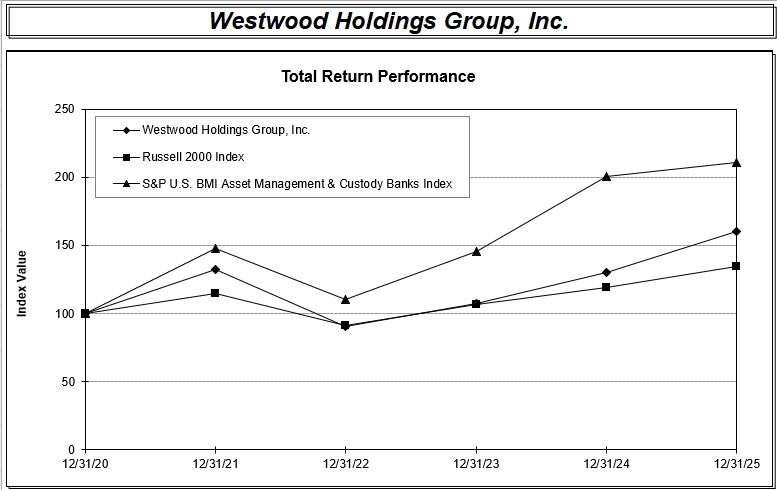
| Index | Period ended December 31, | Cumulative Five-Year Total Return | ||||||||||||||||||||||||||||||||||||||||||
| 2020 | 2021 | 2022 | 2023 | 2024 | 2025 | |||||||||||||||||||||||||||||||||||||||
| Westwood Holdings Group, Inc. | $ | 100.00 | $ | 132.00 | $ | 90.52 | $ | 107.72 | $ | 130.20 | $ | 160.26 | 60.26 | % | ||||||||||||||||||||||||||||||
| Russell 2000 Index | 100.00 | 114.82 | 91.35 | 106.82 | 119.14 | 134.40 | 34.40 | % | ||||||||||||||||||||||||||||||||||||
| S&P U.S. BMI Asset Management & Custody Banks Index | 100.00 | 147.62 | 110.59 | 145.36 | 200.58 | 211.25 | 111.25 | % | ||||||||||||||||||||||||||||||||||||
The total return for our stock and for each index assumes $100 invested on December 31, 2020 in our common stock, the Russell 2000 Index, and the S&P U.S. BMI Asset Management & Custody Banks Index, including reinvestment of dividends.
The closing price of our common stock on the last trading day of the year ended December 31, 2025 was $17.21 per share. Historical stock price performance is not necessarily indicative of future price performance.
Item 6. Reserved.
23
Item 7. Management’s Discussion and Analysis of Financial Condition and Results of Operations.
You should read the following discussion and analysis in conjunction with our Consolidated Financial Statements and related notes thereto appearing elsewhere in this Report.
Forward-Looking Statements
Statements in this Report and the Annual Report to Stockholders that are not purely historical facts, including, without limitation, statements about our expected future financial position, results of operations or cash flows, as well as other statements including, without limitation, words such as “anticipate,” “forecast”, “explore,” “believe,” “plan,” “estimate,” “expect,” “intend,” “should,” "potentially," “could,” “goal,” “may,” “target,” “designed” and other similar expressions, constitute forward-looking statements within the meaning of Section 27A of the Securities Act of 1933, as amended, and Section 21E of the Exchange Act. Because forward-looking statements relate to the future, they are subject to inherent uncertainties, risks and changes in circumstances that are difficult to predict and many of which are outside of our control. Actual results, our financial condition, and the timing of some events could differ materially from those projected in or contemplated by the forward-looking statements. Therefore, you should not rely on any of these forward-looking statements. Important factors that could cause our actual results and financial condition to differ materially from those indicated in the forward-looking statements include, among others:
•the composition and market value of our AUM and AUA;
•our ability to maintain our fee structure in light of competitive fee pressures;
•risks associated with actions of activist stockholders;
•distributions to our common stockholders have included and may in the future include a return of capital;
•inclusion of foreign company investments in our AUM;
•regulations adversely affecting the financial services industry;
•our ability to maintain effective cybersecurity;
•litigation risks;
•our ability to develop and market new investment strategies successfully;
•our reputation and our relationships with current and potential customers;
•our ability to attract and retain qualified personnel;
•our ability to perform operational tasks;
•our ability to select and oversee third-party vendors;
•our dependence on the operations and funds of our subsidiaries;
•our ability to maintain effective information systems;
•our ability to prevent misuse of assets and information in the possession of our employees and third-party vendors, which could damage our reputation and result in costly litigation and liability for our clients and us;
•our stock is thinly traded and may be subject to volatility;
•competition in the investment management industry;
•our ability to avoid termination of client agreements and the related investment redemptions;
•the significant concentration of our revenues in a small number of customers;
•we have made and may continue to make business combinations as a part of our business strategy, which may present certain risks and uncertainties;
•our relationships with investment consulting firms;
•our ability to identify and execute on our strategic initiatives;
•our ability to declare and pay dividends;
•our ability to fund future capital requirements on favorable terms;
•our ability to properly address conflicts of interest;
•our ability to maintain adequate insurance coverage; and
24
•our ability to maintain an effective system of internal controls.
Additional factors that could cause our actual results and financial condition to differ materially from those indicated in the forward-looking statements are discussed under the section entitled “Item 1A. Risk Factors” and elsewhere in this Report. The forward-looking statements are based only on currently available information and speak only as of the date of this Report. We are not obligated and do not undertake an obligation to publicly release any revisions to these forward-looking statements to reflect events or circumstances occurring after the date of this Report or to reflect the occurrence of unanticipated events or otherwise.
Overview
We manage investment assets and provide services for our clients through our subsidiaries, Westwood Management Corp., Westwood Advisors, L.L.C., Salient Advisors, L.P. ("Salient Advisors") and Broadmark Asset Management LLC ("Broadmark"), (each of which is a registered investment adviser ("RIA") registered with the Securities and Exchange Commission ("SEC"), and Salient Capital, L.P., ("SCLP") an SEC-registered broker-dealer and Financial Industry Regulatory Authority ("FINRA") member, collectively referred to hereinafter together as "Westwood Management") and Westwood Trust.
Westwood Management provides investment advisory services to institutional investors, a family of mutual funds called the Westwood Funds®, Westwood ETFs, other mutual funds, individuals, private capital funds and clients of Westwood Trust.
Westwood Trust provides trust and custodial services and participation in common trust funds to high net worth individuals and families, and institutions. Our revenues are generally derived from fees based on a percentage of AUM.
SCLP serves as a sub-placement agent for private placements.
Our revenues are generally derived from fees based on a percentage of AUM and AUA, and Westwood Management and Westwood Trust collectively had AUM of approximately $16.5 billion and AUA of approximately $0.9 billion at December 31, 2025. We have established a track record of delivering competitive, risk-adjusted returns for our clients.
With respect to most of our AUM, we utilize a “value” investment style focused on achieving superior long-term, risk-adjusted returns by investing in companies with high levels of free cash flow, improving returns on equity and strengthening balance sheets that are well positioned for growth but whose value is not fully recognized in the marketplace. This investment approach is designed to limit downside during unfavorable periods and provide superior real returns over the long term. Our investment teams have significant industry experience. Our investment team members have average investment experience of over twenty years.
We have built a foundation in terms of personnel and infrastructure to support a much larger business and we have developed investment strategies that we believe will be sought after within our target institutional, wealth management and intermediary markets. Developing new products and growing the organization has resulted in our incurring expenses that, in some cases, have not yet generated significant offsetting revenues. We develop new products that we believe will be in demand by clients and investors, thereby generating new revenue streams for us; however, there is no guarantee that new products will be successful in generating demand and incremental revenues.
2025 Highlights
The following items were reported for the year ended December 31, 2025:
•Launched Westwood Enhanced Income Opportunity ETF (YLDW).
•AUM as of December 31, 2025 was $16.5 billion, consistent with December 31, 2024. Quarterly average AUM increased 5% to $17.1 billion for 2025 versus 2024, which, along with higher revenues from our ETFs and private energy secondaries funds, contributed to a 3% increase in total revenue from 2024.
•Our MLP Total Return, Income Opportunity, Multi-Asset Income, Alternative Income, Credit Opportunities, Westwood Salient Enhanced Midstream Income ETF and Westwood Salient Enhanced Energy Income ETF strategies performed strongly by beating their primary benchmarks for the year.
•We paid $5.4 million of dividends to our common stockholders.
•Our financial position remains strong with liquid cash and investments of $44.1 million and no debt as of December 31, 2025.
Revenues
We derive our revenues from investment advisory fees, trust fees and other revenues. Our advisory fees are generated by Westwood Management, which manages client accounts under investment advisory and sub-advisory agreements. Advisory fees are typically calculated based on a percentage of AUM and AUA and are paid in accordance with the terms of the agreements. Advisory fees are paid quarterly in advance based on AUM on the last day of the preceding quarter, quarterly in
25
arrears based on AUM on the last day of the quarter just ended or are based on a daily or monthly analysis of AUM for the stated period. We recognize advisory fee revenues as services are rendered. Certain of our clients have a contractual performance-based fee component in their contracts, which generates additional revenues if we outperform a specified index over a specific period of time. We record revenue for performance-based fees at the end of the measurement period. Since our advance paying clients’ billing periods coincide with the calendar quarter to which such payments relate, revenue is recognized within the quarter, and our Consolidated Financial Statements contain no deferred advisory fee revenues.
Our trust fees are generated by Westwood Trust pursuant to trust or custodial agreements. Trust fees are separately negotiated with each client and are generally based on a percentage of AUM. Westwood Trust also provides trust services to a small number of clients on a fixed fee basis. Trust fees are primarily calculated quarterly in arrears based on a daily average of AUM for the quarter. Since billing periods for most of Westwood Trust's clients coincide with the calendar quarter, revenue is fully recognized within the quarter, and our Consolidated Financial Statements contain no deferred advisory fee revenues.
Our other revenues primarily consist of investment income from seed money investments into new investment strategies.
Employee Compensation and Benefits
Employee compensation and benefits costs generally consist of salaries, sales commissions, incentive compensation, stock-based compensation expense and benefits.
Sales and Marketing
Sales and marketing costs relate to our marketing efforts, including travel and entertainment, direct marketing and advertising costs.
Westwood Funds
Expenses for Westwood funds relate to our marketing, distribution and administration of the Westwood Funds® mutual funds and Westwood ETFs.
Information Technology
Information technology expenses include costs associated with proprietary investment research tools, maintenance and support, computing hardware, software licenses, telecommunications and other related costs.
Professional Services
Professional services expenses generally consist of costs associated with sub-advisory fees, audit, legal and other professional services.
General and Administrative
General and administrative expenses generally consist of costs associated with the lease of office space, amortization, depreciation, insurance, custody expense, Directors' fees, investor relations, licenses and fees, office supplies and other miscellaneous expenses.
(Gain) loss from change in fair value of contingent consideration
(Gain) loss from change in fair value of contingent consideration consists of fair value adjustments related to contingent consideration from the Salient Acquisition, with gains representing reductions in value and losses representing increases in value.
Acquisition expenses
Acquisition expenses consist of costs related to the Salient Acquisition.
Net Change in Unrealized Appreciation on Private Investments
Net change in unrealized appreciation on private investments includes changes in the value of our private equity investments.
Net Investment Income
Net investment income primarily includes interest and dividend income on fixed income securities and money market funds.
Other Income
Other income primarily consists of income from the sublease of a portion of our corporate offices and the receipt of life insurance proceeds.
26
Firm-wide Assets Under Management
Firm-wide assets under management of $17.4 billion at December 31, 2025 consisted of $16.5 billion of AUM and $0.9 billion of AUA.
AUM of $16.5 billion at December 31, 2025 was consistent with $16.6 billion at December 31, 2024. Quarterly average AUM increased $0.7 billion, up 5%, to $17.1 billion compared with $16.3 billion for 2024. The increase in average AUM was primarily due to the timing of both $1.0 billion of market appreciation in 2025 and inflows.
AUM increased $1.1 billion, or 7%, to $16.6 billion at December 31, 2024 compared to $15.5 billion at December 31, 2023. Quarterly average AUM increased $1.4 billion, up 9%, to $16.3 billion compared with $15.0 billion for 2023. The increase in average AUM was primarily due to $1.9 billion of market appreciation in 2024.
The following table presents our AUM (in millions, except percentages):
| As of December 31, | |||||||||||||||||||||||||||||
| 2025 | Change | 2024 | Change | 2023 | |||||||||||||||||||||||||
Institutional(1) | $ | 8,332 | — | % | $ | 8,301 | 15 | % | $ | 7,215 | |||||||||||||||||||
Wealth Management(2) | 4,317 | (2) | % | 4,391 | 6 | % | 4,140 | ||||||||||||||||||||||
Mutual Funds & ETFs(3) | 3,890 | (1) | % | 3,915 | (5) | % | 4,104 | ||||||||||||||||||||||
| Total AUM | $ | 16,539 | — | % | $ | 16,607 | 7 | % | $ | 15,459 | |||||||||||||||||||
(1)Institutional includes (i) separate accounts of corporate pension and profit sharing plans, public employee retirement funds, Taft-Hartley plans, endowments, foundations and individuals; (ii) sub-advisory relationships where Westwood provides investment management services for funds offered by other financial institutions; (iii) pooled investment vehicles, including collective investment trusts; and (iv) managed account relationships with brokerage firms and other registered investment advisors that offer Westwood products to their customers.
(2)Wealth Management includes assets for which Westwood Trust provides trust and custodial services and participation in common trust funds that it sponsors to institutions and high net worth individuals pursuant to trust or agency agreements and assets for which Westwood Advisors, L.L.C. provides advisory services to high net worth individuals. Investment sub-advisory services are provided for the common trust funds by Westwood Management. For certain assets in this category Westwood Trust provides limited custodial services for a minimal or no fee, viewing these assets as potentially converting to fee-generating managed assets in the future.
(3)Mutual Funds & ETFs include the Westwood Funds®, a family of mutual funds and Westwood ETFs, for which Westwood Management or Salient Advisors serves as advisor. These funds are available to individual investors, institutional investors and wealth management accounts.
Roll-Forward of Assets Under Management
| Year Ended December 31, 2025 | |||||||||||||||||||||||
| AUM (in millions) | Institutional | Wealth Management | Mutual Funds & ETFs | Total | |||||||||||||||||||
| Beginning of period assets | $ | 8,301 | $ | 4,391 | $ | 3,915 | $ | 16,607 | |||||||||||||||
| Client flows: | |||||||||||||||||||||||
| Inflows | 1,457 | 329 | 696 | 2,482 | |||||||||||||||||||
| Outflows | (1,929) | (729) | (864) | (3,522) | |||||||||||||||||||
| Net client flows | (472) | (400) | (168) | (1,040) | |||||||||||||||||||
| Market appreciation (depreciation) | 503 | 326 | 143 | 972 | |||||||||||||||||||
| Net change | 31 | (74) | (25) | (68) | |||||||||||||||||||
| End of period assets | $ | 8,332 | $ | 4,317 | $ | 3,890 | $ | 16,539 | |||||||||||||||
The decrease in AUM for the year ended December 31, 2025 was due to net outflows of $1.0 billion offset by market appreciation of $1.0 billion. Net outflows were primarily related to our LargeCap Value strategy.
27
| Year Ended December 31, 2024 | |||||||||||||||||||||||
| AUM (in millions) | Institutional | Wealth Management | Mutual Funds & ETFs | Total | |||||||||||||||||||
| Beginning of period assets | $ | 7,215 | $ | 4,140 | $ | 4,104 | $ | 15,459 | |||||||||||||||
| Client flows: | |||||||||||||||||||||||
| Inflows | 1,070 | 338 | 663 | 2,071 | |||||||||||||||||||
| Outflows | (966) | (524) | (1,353) | (2,843) | |||||||||||||||||||
| Net client flows | 104 | (186) | (690) | (772) | |||||||||||||||||||
| Market appreciation (depreciation) | 982 | 437 | 501 | 1,920 | |||||||||||||||||||
| Net change | 1,086 | 251 | (189) | 1,148 | |||||||||||||||||||
| End of period assets | $ | 8,301 | $ | 4,391 | $ | 3,915 | $ | 16,607 | |||||||||||||||
The increase in AUM for the year ended December 31, 2024 was due to market appreciation of $1.9 billion offset by net outflows of $0.8 billion. Net outflows were primarily related to our LargeCap Value and SmallCap Value strategies.
| Year Ended December 31, 2023 | |||||||||||||||||||||||
| AUM (in millions) | Institutional | Wealth Management | Mutual Funds | Total | |||||||||||||||||||
| Beginning of period assets* | $ | 6,968 | $ | 3,666 | $ | 4,145 | $ | 14,779 | |||||||||||||||
| Client flows: | |||||||||||||||||||||||
| Inflows | 360 | 446 | 814 | 1,620 | |||||||||||||||||||
| Outflows | (936) | (615) | (1,347) | (2,898) | |||||||||||||||||||
| Net client flows | (576) | (169) | (533) | (1,278) | |||||||||||||||||||
| Market appreciation (depreciation) | 823 | 643 | 492 | 1,958 | |||||||||||||||||||
| Net change | 247 | 474 | (41) | 680 | |||||||||||||||||||
| End of period assets | $ | 7,215 | $ | 4,140 | $ | 4,104 | $ | 15,459 | |||||||||||||||
* Certain assets under management acquired from Salient were reclassified from Mutual Funds to Institutional as of December 31, 2022 to be consistent with the classification of existing assets.
The increase in AUM for the year ended December 31, 2023 was due to market appreciation of $2.0 billion offset by net outflows of $1.3 billion. Net outflows were primarily related to our Income Opportunity, MLP & Energy Infrastructure, LargeCap Value and SmallCap Value strategies.
Roll-Forward of Assets Under Advisement
| Years Ended December 31, | |||||||||||||||||
| AUA (in millions) | 2025 | 2024 | 2023 | ||||||||||||||
| Beginning of period assets | $ | 960 | $ | 1,079 | $ | 1,255 | |||||||||||
| Inflows | 139 | 105 | 160 | ||||||||||||||
| Outflows | (157) | (316) | (400) | ||||||||||||||
| Net client flows | (18) | (211) | (240) | ||||||||||||||
| Market appreciation (depreciation) | — | 92 | 64 | ||||||||||||||
| Net change | (18) | (119) | (176) | ||||||||||||||
| End of period assets | $ | 942 | $ | 960 | $ | 1,079 | |||||||||||
Results of Operations
The following table and discussion of our results of operations are based upon data derived from our Consolidated Statements of Operations contained in our Consolidated Financial Statements and should be read in conjunction with these statements included elsewhere in this Report.
28
| Years ended December 31, | |||||||||||||||||||||||||||||
| (in thousands, except percentages) | |||||||||||||||||||||||||||||
| 2025 | Change | 2024 | Change | 2023 | |||||||||||||||||||||||||
| Revenues: | |||||||||||||||||||||||||||||
| Advisory fees: | |||||||||||||||||||||||||||||
| Asset-based | $ | 74,722 | 7 | % | $ | 69,755 | 4 | % | $ | 67,391 | |||||||||||||||||||
| Performance-based | 874 | (37) | 1,393 | 10 | 1,265 | ||||||||||||||||||||||||
| Trust fees | 21,560 | 1 | 21,422 | 6 | 20,242 | ||||||||||||||||||||||||
| Trust performance-based fees | 260 | (46) | 482 | 38 | 349 | ||||||||||||||||||||||||
| Other revenues, net | 346 | (79) | 1,669 | 213 | 534 | ||||||||||||||||||||||||
| Total revenues | 97,762 | 3 | 94,721 | 6 | 89,781 | ||||||||||||||||||||||||
| Expenses: | |||||||||||||||||||||||||||||
| Employee compensation and benefits | 56,686 | 1 | 56,011 | 6 | 52,918 | ||||||||||||||||||||||||
| Sales and marketing | 2,744 | 3 | 2,668 | (11) | 2,990 | ||||||||||||||||||||||||
| Westwood funds | 4,258 | 31 | 3,254 | 4 | 3,133 | ||||||||||||||||||||||||
| Information technology | 10,894 | 13 | 9,662 | — | 9,650 | ||||||||||||||||||||||||
| Professional services | 6,917 | 26 | 5,468 | 7 | 5,132 | ||||||||||||||||||||||||
| General and administrative | 11,290 | (5) | 11,947 | (5) | 12,512 | ||||||||||||||||||||||||
| (Gain) loss from change in fair value of contingent consideration | — | (100) | 4,881 | (276) | (2,768) | ||||||||||||||||||||||||
| Acquisition expenses | — | NM | — | (100) | 209 | ||||||||||||||||||||||||
| Total expenses | 92,789 | (1) | 93,891 | 12 | 83,776 | ||||||||||||||||||||||||
| Net operating income | 4,973 | 499 | 830 | (86) | 6,005 | ||||||||||||||||||||||||
| Net change in unrealized appreciation on private investments | 1,932 | 100 | — | (100) | 6 | ||||||||||||||||||||||||
| Net investment income | 1,655 | (24) | 2,183 | 83 | 1,191 | ||||||||||||||||||||||||
| Other income | 1,117 | 11 | 1,002 | (84) | 6,241 | ||||||||||||||||||||||||
| Income before income taxes | $ | 9,677 | 141 | % | $ | 4,015 | (70) | % | $ | 13,443 | |||||||||||||||||||
| Income tax provision | 2,600 | 44 | 1,804 | (37) | 2,872 | ||||||||||||||||||||||||
| Net income | $ | 7,077 | 220 | % | $ | 2,211 | (79) | % | $ | 10,571 | |||||||||||||||||||
| Less: Income (loss) attributable to noncontrolling interest | 19 | (575) | % | (4) | (100) | % | 1,051 | ||||||||||||||||||||||
| Income attributable to Westwood Holdings Group, Inc. | $ | 7,058 | 219 | % | $ | 2,215 | (77) | % | $ | 9,520 | |||||||||||||||||||
| NM - Not meaningful | |||||||||||||||||||||||||||||
Year Ended December 31, 2025 Compared to Year Ended December 31, 2024
Total Revenues. Total revenues increased $3.0 million, or 3%, to $97.8 million compared to $94.7 million for 2024. The increase was attributable to higher average assets under management and higher revenues from our ETFs and private energy secondaries funds.
Westwood funds. Westwood fund expenses increased 31% to $4.3 million compared to $3.3 million for 2024, primarily due to increased administration and distribution expenses related to our ETFs, driven by higher fund assets.
Information technology. Information technology costs increased 13% to $10.9 million compared to $9.7 million in 2024, primarily due to additional investment resource tools and software licenses.
Professional services. Professional services expense increased $1.4 million, or 26%, to $6.9 million in 2025 primarily due to additional consulting costs.
29
(Gain) loss from change in fair value of contingent consideration. In 2025 we did not adjust our contingent consideration from the 2022 Salient Acquisition as the specific revenue thresholds were not met.
Net change in unrealized appreciation on private investments. In 2025 we recorded an unrealized gain of approximately $2.0 million for our investment in TXSE following observable price changes.
Provision for Income Taxes. The effective tax rate was 26.9% for 2025 compared to 44.9% for 2024. Our income tax rate differed from the 21% statutory tax rate due to permanent differences due to executive compensation and the impact of state and local taxes.
Year Ended December 31, 2024 Compared to Year Ended December 31, 2023
Total Revenues. Total revenues increased $4.9 million, or 6%, to $94.7 million compared to $89.8 million for 2023. The increase was attributable to higher average assets under management.
Employee Compensation and Benefits. Employee compensation and benefits expenses increased primarily due to higher performance-related incentive compensation following increased AUM balances and additional headcount.
(Gain) loss from change in fair value of contingent consideration. We recorded a loss of $4.9 million upon the remeasurement of contingent consideration for the Salient Acquisition, due to positive changes in growth projections following asset appreciation and asset flows in the period.
Provision for Income Taxes. The effective tax rate was 44.9% for 2024 compared to 23.2% for 2023. Our income tax rate differed from the 21% statutory tax rate due to permanent differences between book and tax restricted stock expense based on a decrease in our stock price between the restricted stock grant and vesting date, along with the impact of state and local taxes.
Supplemental Financial Information
As supplemental information, we are providing non-GAAP performance measures that we refer to as Economic Earnings and Economic EPS. We provide these measures in addition to, not as a substitute for, income (loss) attributable to Westwood Holdings Group, Inc. and earnings (loss) per share, which are reported on a GAAP basis. Our management and Board review Economic Earnings and Economic EPS to evaluate our ongoing performance, allocate resources, and review our dividend policy. We believe that these non-GAAP performance measures, while not substitutes for GAAP income (loss) attributable to Westwood Holdings Group, Inc. or earnings (loss) per share, are useful for management and investors when evaluating our underlying operating and financial performance and our available resources. We do not advocate that investors consider these non-GAAP measures without also considering financial information prepared in accordance with GAAP.
We define Economic Earnings as income (loss) attributable to Westwood Holdings Group, Inc. plus non-cash equity-based compensation expense, impairment expense, amortization of intangible assets, currency translation adjustment reclassification, deferred taxes related to goodwill and the tax impact of adjustments to GAAP income (loss). Although depreciation on fixed assets is a non-cash expense, we do not add it back when calculating Economic Earnings because depreciation charges represent an allocation of the decline in the value of the related assets that will ultimately require replacement. Although gains and losses from changes in the fair value of contingent consideration are non-cash, we do not add or subtract those back when calculating Economic Earnings because gains and losses on changes in the fair value of contingent consideration are considered regular following an acquisition. In addition, we do not adjust Economic Earnings for tax deductions related to restricted stock expense or amortization of intangible assets. Economic EPS represents Economic Earnings divided by diluted weighted average shares outstanding.
Non-GAAP financial measures have limitations as analytical tools, and these measures should not be considered in isolation or as a substitute for analysis of our results as reported under GAAP. Some of the limitations in relying on these non-GAAP financial measures are that they can have a material impact on the equivalent GAAP measures or they may be calculated differently by other companies.
We compensate for these limitations on the use of non-GAAP financial measures by relying primarily on our GAAP results and using non-GAAP financial measures only as a supplement. We believe that providing non-GAAP diluted net earnings per share and non-GAAP Income (loss) in addition to the related GAAP measures provides greater transparency to the information used in our financial and operational decision-making.
For the year ended December 31, 2025, our Economic Earnings increased by 105% to $14.3 million compared with $7.0 million for the year ended December 31, 2024. 2025 Economic Earnings was impacted by higher 2025 revenues and losses from changes in the fair value of contingent consideration in 2024.
30
The following table provides a reconciliation of income (loss) attributable to Westwood Holdings Group, Inc. to Economic Earnings:
| For the years ended December 31, (in thousands, except percentages and per share data) | |||||||||||||||||||||||||||||||||||||||||||||||||||||
| 2025 | Change | 2024 | Change | 2023 | Change | 2022 | Change | 2021 | |||||||||||||||||||||||||||||||||||||||||||||
| Income (loss) attributable to Westwood Holdings Group, Inc. | $ | 7,058 | 219 | % | $ | (77) | % | $ | (306) | % | $ | (4,628) | (147) | % | $ | 9,763 | |||||||||||||||||||||||||||||||||||||
| Stock-based compensation expense | 5,148 | (7) | 5,537 | (15) | 6,518 | 9 | 6,001 | 3 | 5,834 | ||||||||||||||||||||||||||||||||||||||||||||
| Intangible amortization | 3,945 | (5) | 4,148 | — | 4,149 | 120 | 1,889 | 16 | 1,624 | ||||||||||||||||||||||||||||||||||||||||||||
| Tax benefit from goodwill amortization | 533 | 57 | 340 | (32) | 500 | 66 | 302 | 27 | 237 | ||||||||||||||||||||||||||||||||||||||||||||
| Tax impact of adjustments to GAAP net income (loss) | (2,388) | (55) | (5,275) | 125 | (2,345) | 160 | (901) | (61) | (2,309) | ||||||||||||||||||||||||||||||||||||||||||||
| Economic Earnings | $ | 14,296 | 105 | % | $ | 6,965 | (62) | % | $ | 18,342 | 589 | % | $ | 2,663 | (82) | % | $ | 15,149 | |||||||||||||||||||||||||||||||||||
| Economic Earnings per Share | $ | 1.61 | 96 | % | $ | 0.82 | (64) | % | $ | 2.26 | 402 | % | $ | 0.45 | (80) | % | $ | 2.20 | |||||||||||||||||||||||||||||||||||
The following tables provide Economic Earnings (Loss) by segment:
| For the years ended December 31, (in thousands, except percentages) | |||||||||||||||||||||||||||||||||||||||||||||||||||||
| 2025 | Change | 2024 | Change | 2023 | Change | 2022 | Change | 2021 | |||||||||||||||||||||||||||||||||||||||||||||
| Advisory net income | $ | 19,862 | 13 | % | $ | 17,653 | 30 | % | $ | 13,585 | 23 | % | $ | 11,010 | (34) | % | $ | 16,783 | |||||||||||||||||||||||||||||||||||
| Stock-based compensation expense | 3,106 | (17) | 3,762 | (16) | 4,456 | 16 | 3,847 | 15 | 3,347 | ||||||||||||||||||||||||||||||||||||||||||||
| Intangible amortization | 2,543 | (5) | 2,665 | — | 2,674 | 633 | 365 | 183 | 129 | ||||||||||||||||||||||||||||||||||||||||||||
| Tax benefit from goodwill amortization | 297 | 186 | 104 | NM | 262 | NM | 66 | NM | — | ||||||||||||||||||||||||||||||||||||||||||||
| Tax impact of adjustments to GAAP net income | (1,483) | (58) | (3,500) | 46 | (2,404) | (38) | (3,865) | 44 | (2,679) | ||||||||||||||||||||||||||||||||||||||||||||
| Economic Earnings | $ | 24,325 | 18 | % | $ | 20,684 | 11 | % | $ | 18,573 | 63 | % | $ | 11,423 | (35) | % | $ | 17,580 | |||||||||||||||||||||||||||||||||||
| For the years ended December 31, (in thousands, except percentages) | |||||||||||||||||||||||||||||||||||||||||||||||||||||
| 2025 | Change | 2024 | Change | 2023 | Change | 2022 | Change | 2021 | |||||||||||||||||||||||||||||||||||||||||||||
| Trust net income | $ | 2,910 | 6 | % | $ | 2,756 | 55 | % | $ | 1,777 | 78 | % | $ | 1,000 | (82) | % | $ | 5,660 | |||||||||||||||||||||||||||||||||||
| Stock-based compensation expense | 47 | (36) | 74 | (77) | 326 | (31) | 471 | (37) | 743 | ||||||||||||||||||||||||||||||||||||||||||||
| Intangible amortization | 1,359 | — | 1,359 | — | 1,359 | (1) | 1,379 | — | 1,378 | ||||||||||||||||||||||||||||||||||||||||||||
| Tax benefit from goodwill amortization | 236 | — | 236 | (1) | 238 | 1 | 236 | — | 237 | ||||||||||||||||||||||||||||||||||||||||||||
| Tax impact of adjustments to GAAP net income | (369) | (53) | (780) | 84 | (424) | (46) | (779) | (27) | (1,060) | ||||||||||||||||||||||||||||||||||||||||||||
| Economic Earnings | $ | 4,183 | 15 | % | $ | 3,645 | 11 | % | $ | 3,276 | 42 | % | $ | 2,307 | (67) | % | $ | 6,958 | |||||||||||||||||||||||||||||||||||
| For the years ended December 31, (in thousands, except percentages) | |||||||||||||||||||||||||||||||||||||||||||||||||||||
| 2025 | Change | 2024 | Change | 2023 | Change | 2022 | Change | 2021 | |||||||||||||||||||||||||||||||||||||||||||||
| Other net loss | $ | (15,714) | (14) | % | $ | (18,194) | 211 | % | $ | (5,842) | (65) | % | $ | (16,638) | 31 | % | $ | (12,680) | |||||||||||||||||||||||||||||||||||
| Stock-based compensation expense | 1,995 | 17 | 1,701 | (2) | 1,736 | 3 | 1,683 | (3) | 1,744 | ||||||||||||||||||||||||||||||||||||||||||||
| Intangible amortization | 43 | (65) | 124 | (15) | 146 | 1 | 145 | 24 | 117 | ||||||||||||||||||||||||||||||||||||||||||||
| Tax impact of adjustments to GAAP net income (loss) | (536) | (46) | (995) | (320) | 453 | (88) | 3,743 | 162 | 1,430 | ||||||||||||||||||||||||||||||||||||||||||||
| Economic Earnings (Loss) | $ | (14,212) | (18) | % | $ | (17,364) | 395 | % | $ | (3,507) | (68) | % | $ | (11,067) | 18 | % | $ | (9,389) | |||||||||||||||||||||||||||||||||||
31
Liquidity and Capital Resources
| As of December 31, | ||||||||||||||
| Balance Sheet Data (in thousands) | 2025 | 2024 | ||||||||||||
| Cash and cash equivalents | $ | 26,249 | $ | 18,847 | ||||||||||
| Accounts receivable | 14,453 | |||||||||||||
| Total liquid assets | $ | 43,000 | $ | 33,300 | ||||||||||
| Liquid investments | $ | $ | ||||||||||||
Historically we have funded our operations and cash requirements with cash generated from operating activities. We may also use cash from operations to pay dividends to our stockholders or for deferred contingent consideration payments. We had no debt as of December 31, 2025 and 2024. The changes in net cash provided by operating activities generally reflect changes in earnings plus the effects of non-cash items and changes in working capital, including liquidation of investments used to cover current liabilities. Changes in working capital, especially accounts receivable and accounts payable, are generally the result of timing differences between collection of fees billed and payment of operating expenses.
We had cash and liquid investments of $44.1 million and $44.6 million as of December 31, 2025 and 2024, respectively.
Westwood Trust is required by the Texas Finance Code to maintain cash and investments in an amount equal to the minimum restricted capital of $4.0 million. Restricted capital is included in "Investments at fair value" in the accompanying Consolidated Balance Sheets. At December 31, 2025, Westwood Trust had approximately $13.2 million in excess of its minimum capital requirement.
| For the years ended December 31, | ||||||||||||||||||||
| Cash Flow Data (in thousands) | 2025 | 2024 | 2023 | |||||||||||||||||
| Operating cash flows | $ | 18,922 | $ | 21,122 | $ | (1,185) | ||||||||||||||
| Investing cash flows | (3,666) | (4,613) | 4,112 | |||||||||||||||||
| Financing cash flows | (7,854) | (18,084) | (6,364) | |||||||||||||||||
During 2025, cash flow provided by operating activities was $18.9 million, compared to $21.1 million during 2024 and cash used in operating activities of $1.2 million during 2023. The decrease of $2.2 million from 2024 to 2025 primarily reflected the final contingent consideration payment related to the Salient Acquisition. The increase of $22.3 million from 2023 to 2024 primarily reflected the net sales of investments in 2024 compared to net purchases of investments in 2023.
Cash flow used in investing activities in 2025 and 2024 primarily related to the purchases of strategic investments, compared to cash flow provided by investing activities in 2023 related to the receipt of life insurance proceeds offset by the Broadmark Acquisition.
Cash used in financing activities was $7.9 million in 2025 compared to $18.1 million and $6.4 million in 2024 and 2023, respectively. The change from 2024 to 2025 related to 2025 noncontrolling interest activity, 2024 payments for contingent consideration for the Salient Acquisition and treasury stock purchases in 2024. The change from 2023 to 2024 primarily related to contingent consideration payments.
Our future liquidity and capital requirements will depend upon numerous factors, including results of operations, the timing and magnitude of capital expenditures or strategic initiatives, our dividend policy and other business and risk factors described under “Item 1A. Risk Factors” in this Report. We believe that current cash and liquid investment balances plus cash generated from operations will be sufficient to meet the operating and capital requirements of our ordinary business operations through at least the next twelve months, however there can be no assurance that we will not require additional financing within this time frame. Failure to raise needed capital on attractive terms, if at all, could have a material adverse effect on our business, financial condition and results of operations.
Cash Dividends
The following table summarizes dividends declared during 2025 and 2024:
32
2025 Dividends
| Declaration Date | Record Date | Paid Date | Dividend Per Share | |||||||||||||||||
February 12, 2025 (1) | March 3, 2025 | April 1, 2025 | $0.15 | |||||||||||||||||
| April 30, 2025 | June 2, 2025 | July 1, 2025 | $0.15 | |||||||||||||||||
| August 8, 2025 | September 2, 2025 | October 1, 2025 | $0.15 | |||||||||||||||||
| October 30, 2025 | December 1, 2025 | January 2, 2026 | $0.15 | |||||||||||||||||
| $0.60 | ||||||||||||||||||||
2024 Dividends
| Declaration Date | Record Date | Paid Date | Dividend Per Share | |||||||||||||||||
February 14, 2024 (1) | March 1, 2024 | April 3, 2024 | $0.15 | |||||||||||||||||
May 1, 2024 (1) | June 3, 2024 | July 1, 2024 | $0.15 | |||||||||||||||||
July 31, 2024 (1) | September 2, 2024 | October 1, 2024 | $0.15 | |||||||||||||||||
October 30, 2024 (1) | December 2, 2024 | January 3, 2025 | $0.15 | |||||||||||||||||
| $0.60 | ||||||||||||||||||||
(1) This dividend was treated for accounting purposes as a return of capital.
Contractual Obligations
Purchase commitments
Our purchase commitments primarily consist of outsourced information technology services, software licenses and commitments for financial research tools. As of December 31, 2025, our purchase commitments for the next five years and thereafter were as follows (in thousands):
| Payments due in: | |||||||||||||||||||||||||||||
| Total | Less than 1 year | 1-3 years | 4-5 years | Thereafter | |||||||||||||||||||||||||
Purchase commitments(1) | $ | $ | $ | $ | $ | — | |||||||||||||||||||||||
(1) A “purchase commitment” is defined as an agreement to purchase goods or services that is enforceable and legally binding and that specifies all significant terms, including (a) fixed or minimum quantities to be purchased; (b) fixed, minimum or variable price provisions; and (c) the approximate timing of the transaction. The above purchase commitments exclude agreements that are cancelable without significant penalty.
Critical Accounting Estimates
The preparation of our Consolidated Financial Statements in conformity with GAAP requires us to make estimates and assumptions that affect the reported amounts of assets and liabilities, disclosure of contingent losses and liabilities at the date of the Consolidated Financial Statements and the reported amounts of revenues and expenses during the reporting period. In applying accounting principles, we often must make individual estimates and assumptions regarding expected outcomes or uncertainties. Our estimates, judgments and assumptions are continually evaluated based on available information and experience. Because of the use of estimates inherent in the financial reporting process, actual results could differ from those estimates. We believe the following are areas where the degree of judgment and complexity in determining amounts recorded in our Consolidated Financial Statements make accounting estimates critical.
Business Combinations
Accounting for business combinations requires us to make significant estimates and assumptions, especially at the acquisition date with respect to tangible and intangible assets acquired and liabilities assumed. In a business combination, we allocate the purchase price to the acquired business’ identifiable assets and liabilities at their acquisition date fair values. The excess of the purchase price over the amount allocated to the identifiable assets and liabilities, if any, is recorded as goodwill.
The assets acquired and liabilities assumed in our business combinations consist of acquired working capital and finite-lived and indefinite-lived intangible assets. The carrying value of acquired working capital approximates its fair value, given the short-term nature of these assets and liabilities. We estimated the fair value of finite-lived and indefinite-lived intangible assets acquired using a discounted cash flow approach, which included an analysis of the future cash flows expected to be generated by such assets and the risk associated with achieving such cash flows. The key assumptions used in the discounted cash flow model include the discount rate that is applied to the discretely forecasted future cash flows to calculate the present value of those cash flows and the estimate of future cash flows attributable to the acquired intangible assets, which include revenues, operating expenses and taxes. Our estimates are inherently uncertain and subject to refinement. As a result, during the
33
measurement period, which may be up to one year from the acquisition date, we may record adjustments to the fair value of assets acquired and liabilities assumed, with the corresponding offset to goodwill.
Contingent Consideration
When an acquisition includes future contingent consideration on achieving certain milestones, the Company estimates the earn-out fair value using Monte Carlo simulation models. The Monte Carlo simulations considered assumptions including revenue volatility, risk free rates, discount rates and payment discount rates. The projected contingent payment is discounted back to the current period using a discounted cash flow model. Increases or decreases in projected revenues, probabilities of payment, discount rates or projected payment dates may result in higher or lower fair value measurements. Fluctuations in any of the inputs may result in a significantly lower or higher fair value measurement. A liability is recorded for the estimated fair value of the contingent consideration on the acquisition date, and the fair value of the contingent consideration is remeasured at each subsequent reporting period with any change in fair value recognized as income or expense within the Consolidated Statements of Operations. For the years ended December 31, 2025 and 2024, changes in growth projections, due to increases in AUM and AUA values, and volatility assumptions were the primary drivers of changes in our fair value estimates.
Goodwill
Goodwill is tested at least annually for impairment. We assess the recoverability of the carrying amount of goodwill either qualitatively or quantitatively as of July 1 of each fiscal year, or whenever events or changes in circumstances indicate that the carrying amount of the assets may not be fully recoverable. We test more frequently if indicators are present or changes in circumstances suggest that impairment may exist. These indicators include declines in revenues, earnings or cash flows, or the development of a material adverse change in the business climate.
We assess goodwill for impairment at the reporting unit level, which is defined as an operating segment or one level below an operating segment, which is referred to as a component. We have identified two reporting units, which are consistent with our reporting segments: Advisory and Trust. The Company is not required to calculate the fair value of a reporting unit unless we determine that it is more likely than not that its fair value is less than the carrying amount. We assess goodwill for impairment using either a qualitative or quantitative assessment.
The qualitative goodwill impairment assessment requires evaluating factors, based on the weight of evidence, to determine whether a reporting unit's carrying value would more likely than not exceed its fair value. As part of our goodwill qualitative testing process, we evaluate various factors that are specific to the reporting unit as well as industry and macroeconomic factors in order to determine whether they are reasonably likely to have a material impact on the fair value of our reporting units. Based on the qualitative analyses performed in 2025, we concluded that there were no changes that were reasonably likely to cause the fair value of the Advisory and Trust reporting units to be less than those reporting unit's carrying values, and determined that there was no impairment of our goodwill. In the event we were to determine that a reporting unit's carrying value would more likely than not exceed its fair value, quantitative testing would be performed comparing carrying values to estimated fair values.
The quantitative analysis requires a comparison of each reporting unit’s carrying value to the fair value of the respective unit. If the carrying value exceeds the fair value, an impairment charge is recorded based on that difference.
We completed our most recent annual goodwill impairment assessment during the third quarter of 2025 and determined that no goodwill impairment related to the Advisory or Trust segment was required. There was no goodwill impairment for either segment during the years ended December 31, 2025, 2024 or 2023.
Accounting Developments
See Note 2 “Summary of Significant Accounting Policies” to our Consolidated Financial Statements included in Part II, Item 8, “Financial Statements and Supplementary Data” for a description of any new accounting standards and their anticipated effects on our Consolidated Financial Statements.
Item 7A. Quantitative and Qualitative Disclosures about Market Risk.
Our revenues are primarily generated from fees derived as a percentage of our AUM and AUA, which is subject to market risks. Additionally, we invest corporate capital in various financial instruments, including U. S. treasury bills and equity funds, all of which present inherent market risks. We do not currently participate in any hedging activities, nor do we utilize any derivative financial instruments. The following information describes key aspects of certain financial instruments that involve market risks.
Securities Markets and Interest Rates
The value of AUM and AUA is affected by fluctuations in securities markets and changes in interest rates. Since we derive a substantial portion of our revenues from investment advisory and trust fees based on the value of AUM and AUA, our revenues may be adversely affected by a decline in the prices of securities or changing interest rates. A hypothetical 10%
34
decrease in our average AUM and AUA during the year ended December 31, 2025 would have reduced our reported consolidated total revenue by approximately $10 million.
Our cash equivalents and other investment instruments are exposed to financial market risk due to fluctuations in interest rates, which may affect interest income. We do not expect interest income to be significantly affected by sudden changes in market interest rates.
Item 8. Financial Statements and Supplementary Data
The independent registered public accounting firm's report and our Consolidated Financial Statements listed in the accompanying index are included in Item 15 of this Report. See “Index to Financial Statements” on page F-1.
Item 9. Changes in and Disagreements with Accountants on Accounting and Financial Disclosure.
None.
Item 9A. Controls and Procedures.
Evaluation of Disclosure Controls and Procedures
We performed an evaluation of the effectiveness of the design and operation of our disclosure controls and procedures under the supervision and with the participation of our management, including our Chief Executive Officer and Chief Financial Officer, as of the end of the period covered by this report. Based on that evaluation, our management, including our Chief Executive Officer and Chief Financial Officer, has concluded that our disclosure controls and procedures were effective at the reasonable assurance level as of December 31, 2025 to ensure that information required to be disclosed by us in the reports we file or submit under the Exchange Act was (i) recorded, processed, summarized and reported within the time periods specified in the SEC’s rules and forms and (ii) accumulated and communicated to our management, including our Chief Executive Officer and Chief Financial Officer, to allow timely decisions regarding required disclosure.
In designing and evaluating the disclosure controls and procedures, management recognized that any controls and procedures, no matter how well designed and operated, can provide only reasonable assurance of achieving the desired control objectives.
Changes in Internal Control over Financial Reporting
During the quarterly period ended December 31, 2025, there has been no change in our internal control over financial reporting that has materially affected, or is reasonably likely to materially affect, our internal control over financial reporting.
35
REPORT OF WESTWOOD HOLDINGS GROUP, INC.’S MANAGEMENT ASSESSMENT OF INTERNAL CONTROL OVER FINANCIAL REPORTING
To the Board of Directors and Stockholders of
Westwood Holdings Group, Inc.:
The management of Westwood Holdings Group, Inc. (“Westwood”) is responsible for establishing and maintaining adequate internal control over financial reporting (as defined in Exchange Act Rules 13a-15(f) and 15d-15(f)). Westwood’s internal control system was designed to provide reasonable assurance to the company’s management and Board of Directors regarding the preparation and fair presentation of published financial statements.
All internal control systems, no matter how well designed, contain inherent limitations. Therefore, even those systems determined to be effective can only provide reasonable assurance with respect to financial statement preparation and presentation. Also, projections of any evaluation of the effectiveness of the internal control over financial reporting to future periods are subject to the risk that the controls may become inadequate because of changes in conditions, or that the degree of compliance with the policies or procedures may deteriorate.
The management of Westwood assessed the effectiveness of Westwood’s internal control over financial reporting as of December 31, 2025. In making this assessment, it used the criteria set forth by the Committee of Sponsoring Organizations of the Treadway Commission (COSO) in the 2013 Internal Control — Integrated Framework. Based on our assessment, we believe that, as of December 31, 2025, Westwood’s internal control over financial reporting is effective based on those criteria.
Westwood is not required to, nor did it, engage an independent registered public accounting firm to issue an audit report on our assessment of Westwood's internal control over financial reporting.
| By: | /s/ Brian O. Casey | |||||||
| Brian O. Casey, Chief Executive Officer | ||||||||
| /s/ Murray Forbes III | ||||||||
| Murray Forbes III, Chief Financial Officer & Treasurer | ||||||||
March 4, 2026
Dallas, Texas
36
Item 9B. Other Information.
During the quarter ended December 31, 2025, none of our directors or officers (as defined in Rule 16a-1(f) of the Exchange Act) adopted, terminated or modified a Rule 10b5-1 trading arrangement or non-Rule 10b5-1 trading arrangement (as such terms are defined in Item 408 of Regulation S-K).
Item 9C. Disclosure Regarding Foreign Jurisdictions that Prevent Inspections
Not Applicable.
PART III
Item 10. Directors, Executive Officers and Corporate Governance.
The information required by this item is, or will be, set forth in the definitive proxy statement relating to the 2026 Annual Meeting of Stockholders of Westwood Holdings Group, Inc., which is to be filed with the SEC pursuant to Regulation 14A under the Exchange Act (the “Proxy Statement”). The Proxy Statement relates to a meeting of stockholders involving the election of directors, and the portions therefrom required to be set forth in this Report by this item are incorporated herein by reference pursuant to General Instruction G(3) to Form 10-K.
The Company has adopted an insider trading policy governing the purchase, sale and other disposition of the Company’s securities by its directors, officers and employees, and by the Company itself. The Company believes this policy is reasonably designed to promote compliance with insider trading laws, rules and regulations, and New York Stock Exchange listing standards. A copy of the Westwood Holdings Group, Inc. Amended and Restated Insider Trading Policy is filed as Exhibit 19 to this Report.
Item 11. Executive Compensation.
The information required by this item is, or will be, set forth in the Proxy Statement. The Proxy Statement relates to a meeting of stockholders involving the election of directors, and the portions therefrom required to be set forth in this Report by this item are incorporated herein by reference pursuant to General Instruction G(3) to Form 10-K.
Item 12. Security Ownership of Certain Beneficial Owners and Management and Related Stockholder Matters.
Equity Compensation Plan Information
The following table provides information as of December 31, 2025 about shares of our common stock that may be issued upon the exercise of options, warrants and rights under our Eleventh Amended and Restated Westwood Holdings Group, Inc. Stock Incentive Plan, which is our only equity compensation plan in effect at that time. The material terms of this plan were approved by our stockholders and are discussed in Note 8 “Employee Benefits” to our Consolidated Financial Statements included in Part II. Item 8 “Financial Statements and Supplementary Data."
| Plan Category | Number of securities to be issued upon exercise of outstanding options, warrants and rights (a) | Weighted- average exercise price of outstanding options, warrants and rights (b) | Number of securities remaining available for future issuance under equity compensation plans (excluding securities reflected in column (a)) (c) | ||||||||||||||||||||
| Equity compensation plans approved by security holders | — | $ | — | 774,000 | (1) | ||||||||||||||||||
(1) 774,000 shares are available under our Eleventh Amended and Restated Stock Incentive Plan.
The other information required by this item is, or will be, set forth in the Proxy Statement. The Proxy Statement relates to a meeting of stockholders involving the election of directors, and the portions therefrom required to be set forth in this Report by this item are incorporated herein by reference pursuant to General Instruction G(3) to Form 10-K.
Item 13. Certain Relationships and Related Transactions, and Director Independence.
The information required by this item is, or will be, set forth in the Proxy Statement. The Proxy Statement relates to a meeting of stockholders involving the election of directors, and the portions therefrom required to be set forth in this Report by this item are incorporated herein by reference.
Item 14. Principal Accounting Fees and Services.
37
The information required by this item is, or will be, set forth in the Proxy Statement. The Proxy Statement relates to a meeting of stockholders involving the election of directors, and the portions therefrom required to be set forth in this Report by this item are incorporated herein by reference.
38
PART IV
Item 15. Exhibits, Financial Statement Schedules.
Financial Statement Schedules
The financial statements included in this Report are listed in the Index to Financial Statements on page 1 of this Report. Schedules for which provision is made in the applicable accounting regulations of the SEC are either not required under the related instructions or are not applicable.
Exhibits
The exhibits required to be furnished pursuant to Item 15 are listed in the Index to Exhibits filed herewith, which Index to Exhibits is incorporated herein by reference.
39
SIGNATURES
Pursuant to the requirements of Section 13 or 15(d) of the Securities Exchange Act of 1934, the registrant has duly caused this report to be signed on its behalf by the undersigned, thereunto duly authorized.
| WESTWOOD HOLDINGS GROUP, INC. | ||||||||
| By: | /s/ Brian O. Casey | |||||||
Brian O. Casey | ||||||||
| Chief Executive Officer and Director | ||||||||
Dated: March 4, 2026
POWER OF ATTORNEY
KNOW ALL MEN BY THESE PRESENTS that each of Westwood Holdings Group, Inc., a Delaware corporation, and the undersigned directors and officers of Westwood Holdings Group, Inc. hereby constitutes and appoints Brian O. Casey its, his or her true and lawful attorney-in-fact and agent, for it, him or her and in its, his or her name, place and stead, in any and all capacities, with full power to act alone, to sign any and all amendments to this Report, and to file each such amendment to the Report, with all exhibits thereto, and any and all other documents in connection therewith, with the Securities and Exchange Commission, hereby granting unto said attorney-in-fact and agent full power and authority to do and perform any and all acts and things requisite and necessary to be done in and about the premises as fully to all intents and purposes as it, he or she might or could do in person, hereby ratifying and confirming all that said attorney-in-fact and agent may lawfully do or cause to be done by virtue hereof.
Pursuant to the requirements of the Securities Exchange Act of 1934, this report has been signed below by the following persons on behalf of the registrant and in the capacities and on the dates indicated.
| Signatures | Title | |||||||
| /s/ Brian O. Casey | Chief Executive Officer and Director | |||||||
| Brian O. Casey | (Principal Executive Officer) | |||||||
| /s/ Murray Forbes III | Chief Financial Officer and Treasurer | |||||||
| Murray Forbes III | (Principal Financial Officer and Principal Accounting Officer) | |||||||
| /s/ Randy A. Bowman | Chairman of the Board of Directors | |||||||
| Randy A. Bowman | ||||||||
| /s/ Ellen H. Masterson | Director | |||||||
| Ellen H. Masterson | ||||||||
| /s/ Geoffrey R. Norman | Director | |||||||
| Geoffrey R. Norman | ||||||||
| /s/ J. Hale Hoak | Director | |||||||
| J. Hale Hoak | ||||||||
| /s/ Katherine A. Murray | Director | |||||||
| Katherine Murray | ||||||||
| /s/ Janice Ryan | Director | |||||||
| Janice Ryan | ||||||||
40
INDEX TO FINANCIAL STATEMENTS
| Page | ||||||||||||||
| BDO USA, P.C.; Dallas, TX USA; | PCAOB ID: | |||||||||||||
| 7 | ||||||||||||||
1
REPORT OF INDEPENDENT REGISTERED PUBLIC ACCOUNTING FIRM
Stockholders and Board of Directors
Westwood Holdings Group, Inc.
Dallas, Texas
Opinion on the Consolidated Financial Statements
We have audited the accompanying consolidated balance sheets of Westwood Holdings Group, Inc. (the “Company”) as of December 31, 2025 and 2024, the related consolidated statements of operations, stockholders’ equity, and cash flows for each of the three years in the period ended December 31, 2025, and the related notes (collectively referred to as the “consolidated financial statements”). In our opinion, the consolidated financial statements present fairly, in all material respects, the financial position of the Company at December 31, 2025 and 2024, and the results of its operations and its cash flows for each of the three years in the period ended December 31, 2025, in conformity with accounting principles generally accepted in the United States of America.
Basis for Opinion
These consolidated financial statements are the responsibility of the Company’s management. Our responsibility is to express an opinion on the Company’s consolidated financial statements based on our audits. We are a public accounting firm registered with the Public Company Accounting Oversight Board (United States) (PCAOB) and are required to be independent with respect to the Company in accordance with the U.S. federal securities laws and the applicable rules and regulations of the Securities and Exchange Commission and the PCAOB.
We conducted our audits in accordance with the standards of the PCAOB. Those standards require that we plan and perform the audit to obtain reasonable assurance about whether the consolidated financial statements are free of material misstatement, whether due to error or fraud. The Company is not required to have, nor were we engaged to perform, an audit of its internal control over financial reporting. As part of our audits we are required to obtain an understanding of internal control over financial reporting but not for the purpose of expressing an opinion on the effectiveness of the Company’s internal control over financial reporting. Accordingly, we express no such opinion.
Our audits included performing procedures to assess the risks of material misstatement of the consolidated financial statements, whether due to error or fraud, and performing procedures that respond to those risks. Such procedures included examining, on a test basis, evidence regarding the amounts and disclosures in the consolidated financial statements. Our audits also included evaluating the accounting principles used and significant estimates made by management, as well as evaluating the overall presentation of the consolidated financial statements. We believe that our audits provide a reasonable basis for our opinion.
Critical Audit Matter
The critical audit matter communicated below is a matter arising from the current period audit of the consolidated financial statements that was communicated or required to be communicated to the audit committee and that: (1) relates to accounts or disclosures that are material to the consolidated financial statements and (2) involved our especially challenging, subjective, or complex judgments. The communication of the critical audit matter does not alter in any way our opinion on the consolidated financial statements, taken as a whole, and we are not, by communicating the critical audit matter below, providing a separate opinion on the critical audit matter or on the accounts or disclosures to which it relates.
Revenue Recognition for Advisory and Trust Revenues
As described in Note 4 to the consolidated financial statements, during the year ended December 31, 2025, the Company recognized $74.7 million and $21.6 million of advisory and trust revenues, respectively, excluding performance-based fees. Advisory and trust fees are typically calculated based on a percentage of assets under management (“AUM”) and assets under advisement (“AUA”) and are recognized as services are rendered.
We identified the auditing of the recognition of advisory and trust revenues as a critical audit matter, as auditing advisory and trust revenues involved especially challenging auditor judgment due to the nature and extent of audit effort required to address this matter.
The primary procedures we performed to address this critical audit matter included:
•Evaluating the amount of advisory and trust revenues recognized by performing substantive analytical procedures, which includes developing expectations of advisory and trust revenues based on the contractual advisory and trust rates, and the AUM/AUA balances, and comparing the expectations to the amount of revenues recorded by the Company.
2
•Testing the accuracy of the data used to calculate the Company’s advisory and trust revenue, by selecting a sample of advisory and trust accounts, and: (i) testing the accuracy of the percentage rates used in the calculation of the sampled account by verifying the percentage rates against the respective investment advisory agreements, and (ii) testing the accuracy of the AUM/AUA data used in the calculation of the sampled account by verifying the security pricing information against third party statements and market data.
We have served as the Company's auditor since 2022.
| /s/ | |||||
| March 4, 2026 | |||||
3
WESTWOOD HOLDINGS GROUP, INC.
CONSOLIDATED BALANCE SHEETS
(in thousands, except par values and share amounts)
| December 31, | ||||||||||||||
| 2025 | 2024 | |||||||||||||
| ASSETS | ||||||||||||||
| Cash and cash equivalents | $ | $ | ||||||||||||
| Accounts receivable | ||||||||||||||
| Investments at fair value (amortized cost of $19,923 and $26,788) | ||||||||||||||
| Investments under measurement alternative | ||||||||||||||
| Equity method investments | ||||||||||||||
| Income taxes receivable | ||||||||||||||
| Other assets | ||||||||||||||
| Goodwill | ||||||||||||||
| Deferred income taxes | ||||||||||||||
| Operating lease right-of-use assets | ||||||||||||||
| Intangible assets, net | ||||||||||||||
| Property and equipment, net of accumulated depreciation of $8,952 and $8,424 | ||||||||||||||
| Total assets | $ | $ | ||||||||||||
| LIABILITIES AND STOCKHOLDERS’ EQUITY | ||||||||||||||
| Liabilities | ||||||||||||||
| Accounts payable and accrued liabilities | $ | $ | ||||||||||||
| Dividends payable | ||||||||||||||
| Compensation and benefits payable | ||||||||||||||
| Operating lease liabilities | ||||||||||||||
| Income taxes payable | ||||||||||||||
| Contingent consideration | ||||||||||||||
| Total liabilities | ||||||||||||||
| Commitments and contingencies (Note 14) | ||||||||||||||
| Stockholders’ Equity: | ||||||||||||||
| Common stock, $0.01 par value, authorized 25,000,000 shares, issued 12,337,758 and 12,137,080, respectively and outstanding 9,394,066 and 9,234,575, respectively | ||||||||||||||
| Additional paid-in capital | ||||||||||||||
| Treasury stock, at cost – 2,983,692 and 2,902,505 shares, respectively | ( | ( | ||||||||||||
| Retained earnings | ||||||||||||||
| Total Westwood Holdings Group, Inc. stockholders’ equity | ||||||||||||||
| Noncontrolling interest in consolidated subsidiary | ||||||||||||||
| Total equity | ||||||||||||||
| Total liabilities and stockholders’ equity | $ | $ | ||||||||||||
4
WESTWOOD HOLDINGS GROUP, INC.
CONSOLIDATED STATEMENTS OF OPERATIONS
(in thousands, except shares and per share data)
| Years ended December 31, | ||||||||||||||||||||
| 2025 | 2024 | 2023 | ||||||||||||||||||
| Revenues: | ||||||||||||||||||||
| Advisory fees: | ||||||||||||||||||||
| Asset-based | $ | $ | $ | |||||||||||||||||
| Performance-based | ||||||||||||||||||||
| Trust fees | ||||||||||||||||||||
| Trust performance-based | ||||||||||||||||||||
| Other, net | ||||||||||||||||||||
| Total revenues | ||||||||||||||||||||
| Expenses: | ||||||||||||||||||||
| Employee compensation and benefits | ||||||||||||||||||||
| Sales and marketing | ||||||||||||||||||||
| Westwood funds | ||||||||||||||||||||
| Information technology | ||||||||||||||||||||
| Professional services | ||||||||||||||||||||
| General and administrative | ||||||||||||||||||||
| (Gain) loss from change in fair value of contingent consideration | ( | |||||||||||||||||||
| Acquisition expense | ||||||||||||||||||||
| Total expenses | ||||||||||||||||||||
| Net operating income | ||||||||||||||||||||
| Net change in unrealized appreciation on private investments | ||||||||||||||||||||
| Net investment income | ||||||||||||||||||||
| Other income | ||||||||||||||||||||
| Income before income taxes | ||||||||||||||||||||
| Provision for income taxes | ||||||||||||||||||||
| Net income | $ | $ | $ | |||||||||||||||||
| Less: income (loss) attributable to noncontrolling interest | ( | |||||||||||||||||||
| Income attributable to Westwood Holdings Group, Inc. | $ | $ | $ | |||||||||||||||||
| Earnings per share: | ||||||||||||||||||||
| Basic | $ | $ | $ | |||||||||||||||||
| Diluted | $ | $ | $ | |||||||||||||||||
| Weighted average shares outstanding: | ||||||||||||||||||||
| Basic | ||||||||||||||||||||
| Diluted | ||||||||||||||||||||
See Notes to Consolidated Financial Statements.
5
WESTWOOD HOLDINGS GROUP, INC.
CONSOLIDATED STATEMENTS OF STOCKHOLDERS’ EQUITY
(in thousands, except share data)
| Westwood Holdings Group, Inc. Common Stock, Par | Additional Paid-In Capital | Treasury Stock | Retained Earnings (Accumulated Deficit) | Noncontrolling Interest | Total | ||||||||||||||||||||||||||||||||||||
| Shares | Amount | ||||||||||||||||||||||||||||||||||||||||
| BALANCE, December 31, 2022 | $ | $ | $ | ( | $ | ( | $ | $ | |||||||||||||||||||||||||||||||||
Net income | — | — | — | — | 1,051 | ||||||||||||||||||||||||||||||||||||
Acquisition | — | — | — | — | — | ||||||||||||||||||||||||||||||||||||
Issuance of restricted stock, net of forfeitures | ( | — | — | — | — | ||||||||||||||||||||||||||||||||||||
Stock-based compensation expense | — | — | — | — | — | ||||||||||||||||||||||||||||||||||||
| Return of capital ($0.60 per share) | — | — | ( | — | — | — | ( | ||||||||||||||||||||||||||||||||||
| Dividends declared | — | — | — | — | ( | — | ( | ||||||||||||||||||||||||||||||||||
Restricted stock returned for payment of taxes | ( | — | ( | — | — | ( | |||||||||||||||||||||||||||||||||||
| BALANCE, December 31, 2023 | $ | $ | $ | ( | $ | $ | $ | ||||||||||||||||||||||||||||||||||
Net income (loss) | — | — | — | — | ( | ||||||||||||||||||||||||||||||||||||
Issuance of restricted stock, net of forfeitures | ( | — | — | — | — | ||||||||||||||||||||||||||||||||||||
Stock-based compensation expense | — | — | — | — | — | ||||||||||||||||||||||||||||||||||||
| Return of capital ($0.60 per share) | — | — | ( | — | — | — | ( | ||||||||||||||||||||||||||||||||||
| Dividends declared | — | — | — | — | ( | — | ( | ||||||||||||||||||||||||||||||||||
Purchases of treasury stock | ( | — | — | ( | — | — | ( | ||||||||||||||||||||||||||||||||||
Restricted stock returned for payment of taxes | ( | — | — | ( | — | — | ( | ||||||||||||||||||||||||||||||||||
| BALANCE, December 31, 2024 | $ | $ | $ | ( | $ | $ | $ | ||||||||||||||||||||||||||||||||||
Net income | — | — | — | — | |||||||||||||||||||||||||||||||||||||
Issuance of restricted stock, net of forfeitures | ( | — | — | — | — | ||||||||||||||||||||||||||||||||||||
Stock-based compensation expense | — | — | — | — | — | ||||||||||||||||||||||||||||||||||||
| Dividends declared ($0.60 per share) | — | — | (1,265) | — | ( | — | ( | ||||||||||||||||||||||||||||||||||
Restricted stock returned for payment of taxes | ( | — | — | ( | — | — | ( | ||||||||||||||||||||||||||||||||||
Purchase of additional ownership interest in Broadmark from noncontrolling interest | — | — | — | — | — | ( | ( | ||||||||||||||||||||||||||||||||||
Distributions to noncontrolling interest | — | — | — | — | — | ( | ( | ||||||||||||||||||||||||||||||||||
| BALANCE, December 31, 2025 | $ | $ | $ | ( | $ | $ | $ | ||||||||||||||||||||||||||||||||||
See Notes to Consolidated Financial Statements.
6
WESTWOOD HOLDINGS GROUP, INC.
CONSOLIDATED STATEMENTS OF CASH FLOWS
(in thousands)
| Years ended December 31, | |||||||||||||||||
| 2025 | 2024 | 2023 | |||||||||||||||
| Cash flows from operating activities: | |||||||||||||||||
| Net income | $ | $ | $ | ||||||||||||||
| Adjustments to reconcile net income to net cash provided by (used in) operating activities: | |||||||||||||||||
| Depreciation | |||||||||||||||||
| Amortization of intangible assets | |||||||||||||||||
| Net change in unrealized appreciation on investments | ( | ( | ( | ||||||||||||||
| Stock-based compensation expense | |||||||||||||||||
| Deferred income taxes | ( | ( | |||||||||||||||
| Non-cash lease expense | |||||||||||||||||
| Loss on asset disposition | |||||||||||||||||
| Gain on remeasurement of lease liabilities | ( | ||||||||||||||||
| Fair value change of contingent consideration | ( | ||||||||||||||||
| Gain on insurance settlement | ( | ||||||||||||||||
| Changes in operating assets and liabilities: | |||||||||||||||||
| Accounts receivable | ( | ( | |||||||||||||||
| Other assets | ( | ( | |||||||||||||||
| Accounts payable and accrued liabilities | ( | ||||||||||||||||
| Compensation and benefits payable | |||||||||||||||||
| Income taxes receivable and payable | ( | ||||||||||||||||
| Operating lease liabilities | ( | ( | ( | ||||||||||||||
| Net sales of equity investments | ( | ||||||||||||||||
| Contingent consideration | ( | — | — | ||||||||||||||
| Net cash provided by (used in) operating activities | ( | ||||||||||||||||
| Cash flows from investing activities: | |||||||||||||||||
| Acquisition, net of cash acquired | ( | ||||||||||||||||
| Insurance settlement proceeds | |||||||||||||||||
| Purchases of investments | ( | ( | |||||||||||||||
| Purchases of property and equipment | ( | ( | ( | ||||||||||||||
| Additions to internally developed software | ( | ( | |||||||||||||||
| Net cash (used in) provided by investing activities | ( | ( | |||||||||||||||
| Cash flows from financing activities: | |||||||||||||||||
| Purchases of treasury stock | ( | ||||||||||||||||
| Restricted stock returned for payment of taxes | ( | ( | ( | ||||||||||||||
| Payment of contingent consideration in acquisition | ( | ( | |||||||||||||||
| Cash dividends | ( | ( | ( | ||||||||||||||
| Distributions to noncontrolling interest holders | ( | — | — | ||||||||||||||
| Purchase of additional noncontrolling interest | ( | — | — | ||||||||||||||
| Net cash used in financing activities | ( | ( | ( | ||||||||||||||
| Net increase (decrease) in cash and cash equivalents | ( | ( | |||||||||||||||
| Cash and cash equivalents, beginning of year | |||||||||||||||||
| Cash and cash equivalents, end of year | $ | $ | $ | ||||||||||||||
| Supplemental cash flow information: | |||||||||||||||||
| Cash paid during the year for income taxes | $ | $ | $ | ||||||||||||||
| Right-of-use assets obtained in exchange for operating lease liabilities | $ | $ | $ | ||||||||||||||
| Accrued dividends | $ | $ | $ | ||||||||||||||
See Notes to Consolidated Financial Statements.
7
WESTWOOD HOLDINGS GROUP, INC.
NOTES TO CONSOLIDATED FINANCIAL STATEMENTS
1. DESCRIPTION OF THE BUSINESS:
Westwood Holdings Group, Inc. (“Westwood”, “the Company”, “we”, “us” or “our”) was incorporated under the laws of the State of Delaware on December 12, 2001. Westwood manages investment assets and provides services for its clients through its subsidiaries, Westwood Management Corp., Westwood Advisors, L.L.C., Salient Advisors, L.P. ("Salient Advisors"), Broadmark Asset Management LLC ("Broadmark") and Salient Capital L.P. ("SCLP"), (referred to hereinafter together as “Westwood Management”), and Westwood Trust.
SCLP is an SEC-registered broker-dealer and Financial Industry Regulatory Authority ("FINRA") member and serves as a sub-placement agent for private placements. Salient Advisors is an SEC registered investment adviser, a Commodity Futures Trading Commission ("CFTC") registered Commodity Pool Operator ("CPO") and a National Futures Association ("NFA") member. Salient Advisors is an advisor to the Westwood Salient Tactical Plus Fund, which is sub-advised by Broadmark.
Westwood Management provides investment advisory services to institutional clients, a family of mutual funds called the Westwood Funds®, Westwood ETFs, other mutual funds, individual investors, private capital funds and clients of Westwood Trust. Westwood Trust provides trust and custodial services and participation in self-sponsored common trust funds ("CTFs") to institutions and high net worth individuals. Revenue is largely dependent on the total value and composition of assets under management ("AUM") and assets under advisement ("AUA"), and fluctuations in financial markets and in the composition of AUM impact our revenues and results of operations.
Each entity comprising Westwood Management is registered with the Securities and Exchange Commission ("SEC") as an investment adviser under the Investment Advisers Act of 1940, as amended. Westwood Trust is chartered and regulated by the Texas Department of Banking.
Acquisition of Broadmark Asset Management LLC
We acquired a 48 % interest in Broadmark via our 2022 acquisition of the asset management business of Salient Partners, L.P. (the "Salient Acquisition"). In January 2023 we acquired an additional 32 % interest in Broadmark for $1.2 million (net of cash acquired), increasing our ownership of Broadmark to approximately 80 %, which represents a controlling interest for financial statement consolidation purposes (the "Broadmark Acquisition"). Broadmark is a San Francisco-based RIA managing and/or sub-advising mutual funds, retail and institutional separately-managed accounts.
2. SUMMARY OF SIGNIFICANT ACCOUNTING POLICIES:
Basis of Presentation and Principles of Consolidation
The accompanying Consolidated Financial Statements include the accounts of Westwood and its subsidiaries. All intercompany accounts and transactions have been eliminated upon consolidation.
We assess each legal entity that we manage to determine whether consolidation is appropriate at the onset of the relationship. We first determine whether the entity is a variable interest entity ("VIE"), or a voting interest entity ("VOE"), under GAAP and whether we have a controlling financial interest in the entity. Assessing whether or not an entity is a VOE or VIE and if it requires consolidation involves judgment and analysis. Factors considered in this assessment include, but are not limited to, the legal organization of the entity, our equity ownership and contractual involvement with the entity and any related party or de facto agent implications of our involvement with the entity. We reconsider whether entities are a VIE or VOE whenever contractual arrangements change, the entity receives additional equity or returns equity to its investors or changes in facts and circumstances occur that change investors’ abilities to direct the activities of the entity.
A VIE is an entity in which (i) the total equity investment at risk is not sufficient to enable the entity to finance its activities without subordinated financial support, (ii) the at-risk equity holders, as a group, lack the characteristics of a controlling financial interest or (iii) the entity is structured with disproportionate voting rights, and substantially all of the activities are conducted on behalf of an investor with disproportionately few voting rights. That is, the at-risk equity holders do not have the obligation to absorb significant losses, the right to receive residual returns and the right to direct the activities of the entity that most significantly impact the entity’s economic performance. An enterprise must consolidate all VIEs of which it is the primary beneficiary. We determine if a sponsored investment meets the definition of a VIE by considering whether the fund’s equity investment at risk is sufficient to finance its activities without additional subordinated financial support and whether the fund’s at-risk equity holders absorb any losses, have the right to receive residual returns and have the right to direct the activities of the entity most responsible for the entity’s economic performance. The primary beneficiary of a VIE is defined as the party that, considering the involvement of related parties and de facto agents, has (i) the power to direct the activities of the VIE that most significantly affect its economic performance and (ii) the obligation to absorb losses of the entity or the right
8
WESTWOOD HOLDINGS GROUP, INC.
NOTES TO CONSOLIDATED FINANCIAL STATEMENTS — (Continued)
to receive benefits from the entity that could potentially be significant to the VIE. This evaluation is updated on a continuing basis.
A VOE is an entity that is outside the scope of the guidance for VIEs. Consolidation of a VOE is required when a reporting entity owns a controlling financial interest in a VOE. Ownership of a majority of the voting interests is the usual condition for a controlling financial interest.
We evaluated (i) our relationship as sponsor of the CTFs and managing member of the private equity funds Westwood Hospitality, Westwood Technology Opportunities Fund I, LP, Westwood Energy Secondaries I and Westwood Energy Secondaries II, Westwood Energy Secondaries Fund Co-Invest II, and Westwood Energy Secondaries Fund Co-Invest III (collectively the “Private Funds”), (ii) our advisory relationships with the Westwood Funds® and (iii) our investments in InvestCloud Inc. ("InvestCloud"), Vista, Zarvona Energy Fund GP, Zarvona Energy Fund II-A, WEBs Investments Inc. ("WEBs") and the TXSE Group Inc. ("TXSE") as discussed in Note 6 “Investments” to determine whether each of these entities is a variable interest entity ("VIE") or voting ownership entity (“VOE”).
Based on our analyses, we determined that the CTFs, Private Funds, Zarvona Energy Fund II-A and WEBs were VIEs, as the at-risk equity holders do not have the ability to direct the activities that most significantly impact the entities' economic performance, and, while the Company and its representatives have a majority control of the entities' respective boards of directors and can influence the respective entities' management and affairs, the Company is not exposed to a majority of the economics of those entities and does not qualify as primary beneficiaries for those entities. We have not consolidated our investments in those entities for the periods ending December 31, 2025 and 2024.
Based on our analyses, we determined the Westwood Funds®, InvestCloud, Vista, Zarvona Energy Fund GP and TXSE (i) have sufficient equity at risk to finance the entities' activities independently, (ii) have the obligation to absorb losses, the right to receive residual returns and the right to direct the activities of the entities that most significantly impact the entities' economic performance and (iii) are not structured with disproportionate voting rights and are VOEs. As we do not own controlling financial interests in those entities, we have not consolidated our investments in those entities for the periods ending December 31, 2025 and 2024.
Use of Estimates
The preparation of Consolidated Financial Statements in conformity with GAAP requires management to make estimates and assumptions that affect the reported amounts of assets, liabilities, revenues and expenses in the financial statements. Such estimates include, but are not limited to, the Company's estimates in connection with values of long lived assets, provision for income tax, goodwill, intangible assets, contingent consideration and accrued expenses. Actual results could differ significantly from those estimates.
Cash and Cash Equivalents
Cash and cash equivalents consist of money market accounts and other short-term, highly liquid investments with original maturities of three months or less, other than pooled investment vehicles that are considered investments. We maintain some cash and cash equivalents balances with financial institutions that are in excess of Federal Deposit Insurance Corporation insurance limits. The Company has not experienced losses on uninsured cash accounts, which are held at large, well-capitalized financial institutions.
Accounts Receivable
Accounts receivable represents balances arising from services provided to customers and are recorded on an accrual basis, net of any allowance for credit losses. Accounts receivable are written off when they are determined to be uncollectible. Any allowance for credit losses is estimated based on the Company’s historical amounts written off, existing conditions in the industry, and the financial stability of the customer. The majority of our accounts receivable balances consist of advisory and trust fees receivable from customers that we believe are, and have experienced to be, fully collectible. Accordingly, our Consolidated Financial Statements include neither an allowance for credit losses, nor provision for credit losses.
Investments
Investments that are measured at fair market value are classified as "Investments at fair value" and are carried at quoted market values on the accompanying Consolidated Balance Sheets. Net unrealized holding gains or losses on equity and seed investments are reflected as a component of other revenues. We measure realized gains and losses on investments using the specific identification method.
For an investment without a readily determinable fair value, the Company has elected to apply the measurement alternative of cost minus impairment, if any, adjusted for any observable price changes in orderly transactions for these investments. The Company will reassess whether such an investment qualifies for the measurement alternative at each reporting
9
WESTWOOD HOLDINGS GROUP, INC.
NOTES TO CONSOLIDATED FINANCIAL STATEMENTS — (Continued)
Fair Value of Financial Instruments
Fair value is the price that would be received to sell an asset or paid to transfer a liability in an orderly transaction between market participants at the measurement date. We determined the fair values of our financial instruments using available information. The fair value amounts discussed in Notes 6 “Investments” and 7 “Fair Value Measurements” are not necessarily indicative of either the amounts realizable upon disposition of these instruments or of our intent or ability to dispose of these assets. The fair value of cash and cash equivalents, included in Level 1 of the fair value hierarchy as discussed in Note 7 "Fair Value Measurements", approximates their carrying value due to their short-term maturities. The carrying amount of investments designated as "equity investments", primarily U.S. Government securities, money market funds, equity funds, equities and exchange-traded bond funds, equals fair value based on prices quoted in active markets and, with respect to funds, the reported net asset value (“NAV”) of the shares held. Market values of our money market holdings generally do not fluctuate.
Our equity interests in private companies without readily determinable fair values are measured at cost minus impairment, if any, adjusted for any observable price changes in orderly transactions for these investments. Our private investment fund investments are measured at fair value using NAV as a practical expedient.
Goodwill and Other Intangible Assets
Goodwill represents the excess of the cost of acquired assets over the fair value of the underlying liabilities assumed at the date of acquisition. Goodwill is tested at least annually for impairment.
We test more frequently if indicators are present or changes in circumstances suggest that impairment may exist. These indicators include declines in revenues, earnings or cash flows, or the development of a material adverse change in the business climate. We assess goodwill for impairment at the reporting unit level, which is defined as an operating segment or one level below an operating segment, which is referred to as a component. We have identified two reporting units, which are consistent with our reporting segments: Advisory and Trust. The Company is not required to calculate the fair value of a reporting unit unless we determine that it is more likely than not that its fair value is less than the carrying amount. We assess goodwill for impairment using either a qualitative or quantitative assessment. The qualitative assessment includes consideration of the current trends in the industry in which we operate, macroeconomic conditions and recent financial performance of our reporting units. The quantitative analysis requires a comparison of each reporting unit’s carrying value to the fair value of the respective unit. An impairment charge would be recognized for the amount by which the carrying amount exceeds the reporting unit’s fair value; however, the loss recognized should not exceed the total amount of goodwill allocated to that reporting unit. The fair value of each reporting unit is estimated using a market multiple approach and an income approach.
We completed our most recent annual goodwill impairment assessment during the third quarter of 2025, and determined that no goodwill impairment related to the Advisory and Trust reporting units was required. There was no goodwill impairment in either reporting unit during the years ended December 31, 2025, 2024 or 2023.
Property and Equipment
Property and equipment are stated at cost less accumulated depreciation. Depreciation of furniture and equipment is provided over the estimated useful lives of the assets (from 3 to 7 years), and depreciation on leasehold improvements is provided over the using the straight-line method. We capitalize leasehold improvements, furniture and fixtures, computer hardware and most office equipment purchases. We include depreciation in the “General and administrative” line on our Consolidated Statements of Operations.
Revenue Recognition
Revenues are recognized when the performance obligation (the investment management and advisory or trust services provided to the client) defined by the investment advisory or sub-advisory agreement is satisfied. For each performance obligation, we determine at contract inception whether the revenue is satisfied over time or at a point in time. We derive our revenues from investment advisory fees, trust fees and other sources of revenues such as gains and losses from our seed money investments into net investment strategies. The "Other, net” revenues on our Consolidated Statements of Operations are the unrealized gains and losses on our seed money investments, and our seed money investments are included in "Investments at fair value" on our Consolidated Balance Sheets. Our seed money investments were $4.7 million and $3.0 million at December
10
WESTWOOD HOLDINGS GROUP, INC.
NOTES TO CONSOLIDATED FINANCIAL STATEMENTS — (Continued)
31, 2025 and 2024, respectively. Advisory and Trust fees are calculated based on a percentage of AUM and AUA, and the performance obligation is realized over the then-current calendar quarter. Once clients receive our investment advisory services we have an enforceable right to payment.
Incremental costs to obtain a contract are eligible to be capitalized if the costs are expected to be recovered over the service period. We incur certain incremental costs in obtaining new business and continually evaluate whether costs should be capitalized and amortized over the expected period of benefit of the asset. Our capitalized incremental costs were $2.0 million and $1.3 million at December 31, 2025 and 2024, respectively, and are included in "Other assets" on our Consolidated Balance Sheets. Certain costs used to fulfill a contract such as the distribution services utilized to sell our Westwood Funds® are expensed as incurred.
We recorded incremental cost amortization expense of $0.4 million for the year ended December 31, 2025 and $0.3 million for each of the years ended December 31, 2024 and 2023, respectively, included in "General and administrative" on our Consolidated Statements of Operations. The amortization periods are based on estimated client retention. We recognize the incremental costs of obtaining a contract as an expense when incurred if the amortization period of the asset that the entity otherwise would have recognized is one year or less.
Stock-Based Compensation
We have issued restricted stock to certain U.S. employees and members of our Board of Directors (the "Board") in accordance with our Eleventh Amended and Restated Westwood Holdings Group, Inc. Stock Incentive Plan (the “Plan”).
Stock-based compensation expense reflects the fair value of stock-based awards measured at grant date and is recognized over the relevant service period. We expense the fair value of stock-based compensation awards granted to our employees and directors in our Consolidated Financial Statements on a straight-line basis over the period that services are required to be provided in exchange for the award (“requisite service period”), which is typically the period over which the award vests. Stock-based compensation is recognized only for awards that vest. We measure the fair value of compensation cost related to restricted stock awards based on the closing market price of our common stock on the grant date. For performance-based share awards, we assess actual performance versus the predetermined performance goals and record compensation expense once we conclude it is probable that we will meet the performance goals required to vest the applicable performance-based awards. We account for restricted stock forfeitures as they occur.
Income Taxes
We file a U. S. federal income tax return as a consolidated group for Westwood and its subsidiaries, all of which are U.S.-based subsidiaries. Deferred income tax assets and liabilities are determined based on temporary differences between the financial statements and income tax bases of assets and liabilities as measured at enacted income tax rates.
Deferred income tax expense is generally the result of changes in deferred tax assets and liabilities. Deferred taxes relate primarily to incentive compensation and stock-based compensation expense. We record net deferred tax assets to the extent we believe such assets will more likely than not be realized. In making such a determination, we consider all available positive and negative evidence, including future reversals of existing taxable temporary differences, projected future taxable income, tax-planning strategies, and results of recent operations. In the event we were to determine that we would not be able to realize our deferred income tax assets in the future, we would record a valuation allowance. No such valuation allowance has been recorded in our Consolidated Financial Statements.
We account for uncertain tax positions by recognizing the impact of a tax position in our Consolidated Financial Statements when we believe it is more likely than not that the tax position would not be sustained upon examination by the appropriate tax authority based on the merits of the position. We include penalties and interest on income-based taxes, if any, in the “General and administrative” line on our Consolidated Statements of Operations. See Note 9 “Income Taxes.”
Leases
We determine if an arrangement contains a lease at inception, and leases are classified as either operating or finance leases at the lease commencement date. An arrangement contains a lease if it implicitly or explicitly identifies an asset to be used and conveys the right to control the use of the identified asset in exchange for consideration.
Right-of-use ("ROU") assets represent our right to use an underlying asset for the lease term and lease liabilities represent our obligation to make lease payments arising from the lease. ROU assets and lease liabilities are recognized upon commencement of the lease based on the present value of the lease payments over the lease term. As most of our leases do not provide an implicit interest rate, we generally use our estimated incremental borrowing rate, which is the rate for a fully-collateralized, fully-amortizing loan with a maturity that is the same as the lease at commencement date to determine the present value of lease payments. When readily determinable, we use the rate implicit in the lease.
11
WESTWOOD HOLDINGS GROUP, INC.
NOTES TO CONSOLIDATED FINANCIAL STATEMENTS — (Continued)
Our lease terms may include options to extend or terminate the lease when it is reasonably certain that we will exercise that option.
Lease expense for operating leases and short-term leases is recognized on a straight-line basis over the lease term. Expenses associated with operating leases are recorded in “General and administrative” expenses on our Consolidated Statements of Operations. Short-term leases with a term of 12 months or less are not capitalized.
Business Combinations
In allocating the purchase price of a business combination, the Company records all assets acquired and liabilities assumed at fair value, with the excess of the purchase price over the aggregate fair values recorded as goodwill. The purchase price of an acquisition is allocated to the underlying assets acquired and liabilities assumed based upon their estimated fair values as of the date of acquisition. To the extent the purchase price exceeds the fair value of the net identifiable tangible and intangible assets acquired and liabilities assumed, such excess is allocated to goodwill. The Company determines the estimated fair values after review and consideration of relevant information, including discounted cash flows, quoted market prices and estimates made by management. The fair value assigned to identifiable intangible assets acquired is based on estimates and assumptions made by management at the time of the acquisition. The Company adjusts the preliminary purchase price allocation, as necessary, during the measurement period of up to one year after the acquisition closing date as it obtains more information as to facts and circumstances existing as of the acquisition date. Acquisition-related costs are recognized separately from the acquisition and are expensed as incurred.
The acquired client relationships, trade names and non-compete agreements are subject to fair value measurements based primarily on significant inputs not observable in the market and thus represent level 3 measurements. The valuation of an acquired client relationship utilizes an income approach, which provides an estimate of the fair value of an asset based on discounted cash flows and management estimates, including the estimated growth associated with existing clients, market growth and client attrition. The valuation of acquired trade names uses a relief from royalty method in which the fair value of the intangible asset is estimated to be the present value of royalties saved because the Company owns the intangible asset. Revenue projections and estimated useful lives are used in estimating the fair value of the trade names. The non-compete agreements are calculated using the differential cash flow method (with-or-without method), which utilizes the probability of certain employees competing with the Company and revenue projections to calculate the valuation of non-competition agreements.
When an acquisition includes future contingent consideration on achieving certain milestones, the Company estimates the earn-out fair value using Monte Carlo simulation models. The Monte Carlo simulations considered assumptions including revenue volatility, risk free rates, discount rates and payment discount rates. The projected contingent payment is discounted back to the current period using a discounted cash flow model. Increases or decreases in projected revenues, probabilities of payment, discount rates or projected payment dates may result in higher or lower fair value measurements. Fluctuations in any of the inputs may result in a significantly lower or higher fair value measurement. A liability is recorded for the estimated fair value of the contingent consideration on the acquisition date, and the fair value of the contingent consideration is remeasured at each subsequent reporting period with any change in fair value recognized as income or expense within the Consolidated Statements of Operations. Contingent consideration payments, to the extent they relate to the estimated contingent consideration as of the date of acquisition, are classified within financing activities in the Consolidated Statements of Cash Flows. Contingent consideration payments in excess of the acquisition date contingent consideration liability are classified within operating activities.
Equity Method Investments
Investments in entities where we have the ability to exercise significant influence, but do not control, are accounted for under the equity method of accounting and are included in "Equity method investments" on our Consolidated Balance Sheets. Significant influence typically exists if we have a 20% to 50% ownership interest in the investee. We evaluate our equity method investments for impairment whenever events or changes in circumstances indicate that the carrying amounts of such investments may be impaired. If a decline in the value of an equity method investment is determined to be other than temporary, a loss is recorded in earnings in the current period.
The Company’s proportionate share of the net income or loss of equity method investments is included in "Other income" on the Consolidated Statements of Operations, and any dividends received reduce the carrying value of the investment.
Recently Adopted Accounting Pronouncements
Income Taxes
On January 1, 2025, the Company adopted Accounting Standards Update ("ASU") ASU 2023-09, Income Taxes (Topic 740): Improvements to Income Tax Disclosures, on a retrospective basis. This ASU enhances the disclosure requirements
12
WESTWOOD HOLDINGS GROUP, INC.
NOTES TO CONSOLIDATED FINANCIAL STATEMENTS — (Continued)
related to tax rate reconciliations and income taxes paid and did not have an effect on the Company’s consolidated statements of operations or consolidated balance sheets See Note 9 "Income Taxes" for our updated presentation.
Recently Issued Accounting Pronouncements
Income Statement Reporting
In November 2024, the FASB issued ASU 2024-03, Income Statement-Reporting Comprehensive Income-Expense Disaggregation Disclosures (Subtopic 220-40): Disaggregation of Income Statement Expenses ("ASU 2024-03"). ASU 2024-03 requires public companies to disclose, in the notes to financial statements, specified information about certain costs and expenses at each interim and annual reporting period. The FASB further clarified the effective date in January 2025 with the issuance of ASU 2025-01, Income Statement - Reporting Comprehensive Income - Expense Disaggregation Disclosures (Subtopic 220-40): Clarifying the Effective Date ("ASU 2025-01"). ASU 2024-03 is effective for annual periods beginning after December 15, 2026, and interim periods within annual reporting periods beginning after December 15, 2027, with early adoption permitted. The requirements should be applied on a prospective basis while retrospective application is permitted. We are in the process of analyzing the impact of this ASU on our consolidated financial statements.
Internal-Use Software
In September 2025, the FASB issued ASU 2025-06, Intangibles - Goodwill and Other - Internal-Use Software (Subtopic 350-40): Targeted Improvements to the Accounting for Internal-Use Software ("ASU 2025-06"). ASU 2025-06 is intended to simplify the capitalization guidance by removing all references to software development project stages so that the guidance is neutral to different software development methods. The amendments in this ASU are effective for annual reporting periods beginning after December 15, 2027, and interim reporting periods within those annual reporting periods, with early adoption permitted. The amendments in this update permit an entity to apply the new guidance using a prospective, retrospective or modified transition approach. We are in the process of analyzing the impact of this ASU on our condensed consolidated financial statements.
Interim Reporting
In December 2025, the FASB issued ASU 2025-11, Interim Reporting ("ASU 2025-11"). ASU 2025-11 is intended to clarify the application of interim reporting guidance and to reorganize existing disclosure requirements. The amendments in this ASU are effective for interim periods within annual periods beginning after December 15, 2027, with early adoption permitted. We are in the process of analyzing the impact of this ASU on our condensed consolidated financial statements.
3. BUSINESS COMBINATIONS
Broadmark
Westwood completed the Broadmark Acquisition in January 2023, increasing the Company's investment by approximately 32 %, to 80 %, giving Westwood a controlling interest and requiring an allocation of the Broadmark Acquisition purchase price. The total consideration recorded for accounting purposes consisted of $1.2 million in cash (net of cash acquired).
The Broadmark Acquisition was accounted for using the acquisition method of accounting. Accordingly, the purchase price was allocated to tangible assets acquired and liabilities assumed based on their estimated fair values as of the acquisition date. The total consideration of $1.6 million has been allocated based on valuations of acquired assets and assumed liabilities in connection with the acquisition.
The allocation of the Broadmark Acquisition purchase price was as follows (in thousands):
13
WESTWOOD HOLDINGS GROUP, INC.
NOTES TO CONSOLIDATED FINANCIAL STATEMENTS — (Continued)
| (in thousands) | |||||
| Cash consideration | $ | ||||
| Cash acquired | ( | ||||
| Total consideration, net of cash acquired | $ | ||||
| Fair value of Westwood's investment in Broadmark before the business combination | |||||
| Fair value of noncontrolling interest in Broadmark | |||||
| Assets | |||||
| Accounts receivable | $ | ||||
| Other current assets | |||||
| Property and equipment | |||||
| Other long-term assets | |||||
| Liabilities | |||||
| Accounts payable and accrued liabilities | |||||
| Total Identifiable Net Assets | $ | ||||
| Goodwill | $ | ||||
Westwood recognized approximately $1.0 million of a noncontrolling interest in a consolidated subsidiary at the acquisition date. Fair value of this interest was estimated using recent market transactions.
At the time of the Broadmark Acquisition, the Company believed that its expanded operational opportunities, enhanced range of investment strategies and expected realization of synergies were the primary factors that contributed to a total purchase price that resulted in the recognition of goodwill. Goodwill arising from the Broadmark Acquisition will not be deductible for tax purposes.
For the year ended December 31, 2023, the Company included $4.4 million of revenue and $4.1 million of net income related to Broadmark in its Consolidated Statements of Operations.
Pro Forma Financial Information
The following unaudited pro forma results of operations for the year ended December 31, 2023 assume the Broadmark Acquisition had occurred as of January 1, 2022. This unaudited pro forma information should not be relied upon as being necessarily indicative of historical results that would have been obtained had the Broadmark Acquisition actually occurred on that date, nor of results that may be obtained in the future.
| Year Ended December 31, | |||||
| (in thousands) | 2023 | ||||
| Total revenues | $ | ||||
| Net income | $ | ||||
4. REVENUE
Advisory Fee Revenues
Our advisory fees are generated by Westwood Management for managing client accounts under investment advisory and sub-advisory agreements. Advisory fees are typically calculated based on a percentage of AUM and AUA and are paid in accordance with the terms of the agreements. Advisory fees are paid quarterly in advance based on AUM on the last day of the preceding quarter, quarterly in arrears based on AUM on the last day of the quarter just ended, based on a daily or monthly analysis of AUM for the stated period, or based on committed or invested capital with respect to private capital funds. We recognize advisory fee revenues as services are rendered. Since our advance paying clients' billing periods coincide with the calendar quarter to which such payments relate, revenue is recognized within the quarter and our Consolidated Financial Statements contain no deferred advisory fee revenues. Advisory clients typically consist of institutional investors, mutual funds, ETFs, intermediary separately managed accounts ("SMA"), model-delivery SMA and private capital funds.
Institutional investors include separate accounts of (i) corporate pension and profit sharing plans, public employee retirement funds, Taft-Hartley plans, endowments, foundations and individuals; (ii) sub-advisory relationships where Westwood provides investment management services for funds offered by other financial institutions; (iii) pooled investment
14
WESTWOOD HOLDINGS GROUP, INC.
NOTES TO CONSOLIDATED FINANCIAL STATEMENTS — (Continued)
vehicles, including collective investment trusts; and (iv) managed account relationships with brokerage firms and other registered investment advisors that offer Westwood products to their customers.
Mutual funds include the Westwood Funds®, a family of mutual funds for which Westwood Management serves as advisor. These funds are available to individual investors, as well as offered as part of our suite of investment strategies for institutional investors and wealth management accounts.
Arrangements with Performance-Based Obligations
A limited number of our advisory clients have a contractual performance-based fee component in their contracts, which generates additional revenues if we outperform a specified index over a specific period of time, and a limited number of our mutual fund offerings have fees that generate additional revenues if we outperform specified indices over specific periods of time. Performance-based fees are paid after the performance obligation has been satisfied.
The revenue is based on future market performance and is subject to many factors outside our control. We cannot conclude that a significant reversal in the cumulative amount of revenue recognized will not occur during the measurement period, and therefore the revenue is recorded at the end of the measurement period when the performance obligation has been satisfied.
Trust Fee Revenues
Our trust fees are generated by Westwood Trust pursuant to trust or custodial agreements. Trust fees are separately negotiated with each client and are generally based on a percentage of AUM. Westwood Trust also provides trust services to a small number of clients on a fixed fee basis. The fees for most of our trust clients are calculated quarterly in arrears, based on a daily average of AUM for the quarter, or monthly, based on the month-end value of AUM, and are paid monthly and quarterly in arrears. We recognize trust fee revenues as services are rendered. Since billing periods for most of Westwood Trust’s clients coincide with the calendar quarter, revenue is fully recognized within the quarter and our Consolidated Financial Statements contain no deferred fee revenues.
Revenue Disaggregated
The following table presents our revenue disaggregated by account type (in thousands).
| Year Ended December 31, | ||||||||||||||||||||
| 2025 | 2024 | 2023 | ||||||||||||||||||
| Advisory Fees: | ||||||||||||||||||||
| Institutional | $ | $ | $ | |||||||||||||||||
| Mutual Funds & ETFs | ||||||||||||||||||||
| Wealth Management | ||||||||||||||||||||
| Trust Fees | ||||||||||||||||||||
| Other | ||||||||||||||||||||
| Total revenues | $ | $ | $ | |||||||||||||||||
The following table presents our revenue disaggregated by our clients' geographical locations (in thousands):
| Year Ended December 31, 2025 | Advisory | Trust | Performance-based | Other | Total | ||||||||||||||||||||||||
| Canada | $ | $ | $ | $ | $ | ||||||||||||||||||||||||
| U.S. | |||||||||||||||||||||||||||||
| Total | $ | $ | $ | $ | $ | ||||||||||||||||||||||||
| Year Ended December 31, 2024 | Advisory | Trust | Performance-based | Other | Total | ||||||||||||||||||||||||
| Canada | $ | $ | $ | $ | $ | ||||||||||||||||||||||||
| U.S. | |||||||||||||||||||||||||||||
| Total | $ | $ | $ | $ | $ | ||||||||||||||||||||||||
15
WESTWOOD HOLDINGS GROUP, INC.
NOTES TO CONSOLIDATED FINANCIAL STATEMENTS — (Continued)
| Year Ended December 31, 2023 | Advisory | Trust | Performance-based | Other | Total | ||||||||||||||||||||||||
| Canada | $ | $ | $ | $ | $ | ||||||||||||||||||||||||
| U.S. | |||||||||||||||||||||||||||||
| Total | $ | $ | $ | $ | $ | ||||||||||||||||||||||||
5. SEGMENT REPORTING:
We operate two segments: Advisory and Trust. These segments are managed separately based on the types of products and services offered and their related client bases. The Company’s segment information is prepared on the same basis that management uses to review the financial information for operational decision-making purposes.
The Company's Chief Operating Decision Maker ("CODM"), our Chief Executive Officer, evaluates the performance of our segments based primarily on fee revenues. The CODM does not evaluate the performance of our segments on segment expenses so those have not been disclosed.
Westwood Holdings Group, Inc. does not have revenues and is the entity in which we record typical holding company expenses including employee compensation and benefits for holding company employees, directors’ fees and investor relations costs. All segment accounting policies are the same as those described in the summary of significant accounting policies. Intersegment balances that eliminate in consolidation have been applied to the appropriate segment.
Advisory
Our Advisory segment provides investment advisory services to (i) corporate pension and profit sharing plans, public employee retirement funds, Taft-Hartley plans, endowments, foundations and individuals, (ii) sub-advisory relationships where Westwood provides investment management services to the Westwood Funds®, funds offered by other financial institutions and funds offered by our Trust segment and (iii) pooled investment vehicles, including collective investment trusts.
Trust
Westwood Trust provides trust and custodial services and participation in common trust funds that it sponsors to institutions and high net worth individuals. Westwood Trust is included in our Trust segment.
16
WESTWOOD HOLDINGS GROUP, INC.
NOTES TO CONSOLIDATED FINANCIAL STATEMENTS — (Continued)
| (in thousands) | Advisory | Trust | Total Reportable Segments | Other | Consolidated | ||||||||||||||||||||||||
| Year Ended December 31, 2025 | |||||||||||||||||||||||||||||
| Revenues: | |||||||||||||||||||||||||||||
| Net fee revenues from external sources | $ | $ | $ | $ | $ | ||||||||||||||||||||||||
| Net intersegment revenues | ( | ||||||||||||||||||||||||||||
| Other revenue | |||||||||||||||||||||||||||||
| Total revenues | ( | ||||||||||||||||||||||||||||
| Interest income | $ | $ | $ | $ | $ | ||||||||||||||||||||||||
| Net income (loss) | $ | $ | $ | $ | ( | $ | |||||||||||||||||||||||
| Segment assets | $ | $ | $ | $ | ( | $ | |||||||||||||||||||||||
| Segment goodwill | $ | $ | $ | $ | $ | ||||||||||||||||||||||||
| Segment equity method investments | $ | $ | $ | $ | $ | ||||||||||||||||||||||||
| Expenditures for long-lived assets | $ | $ | $ | $ | $ | ||||||||||||||||||||||||
| Year Ended December 31, 2024 | |||||||||||||||||||||||||||||
| Revenues: | |||||||||||||||||||||||||||||
| Net fee revenues from external sources | $ | $ | $ | $ | $ | ||||||||||||||||||||||||
| Net intersegment revenues | ( | ||||||||||||||||||||||||||||
| Other revenue | |||||||||||||||||||||||||||||
| Total revenues | ( | ||||||||||||||||||||||||||||
| Interest income | $ | $ | $ | $ | $ | ||||||||||||||||||||||||
| Net income (loss) | $ | $ | $ | $ | ( | $ | |||||||||||||||||||||||
| Segment assets | $ | $ | $ | $ | ( | $ | |||||||||||||||||||||||
| Segment goodwill | $ | $ | $ | $ | $ | ||||||||||||||||||||||||
| Segment equity method investments | $ | $ | $ | $ | $ | ||||||||||||||||||||||||
| Expenditures for long-lived assets | $ | $ | $ | $ | $ | ||||||||||||||||||||||||
| Year Ended December 31, 2023 | |||||||||||||||||||||||||||||
| Revenues: | |||||||||||||||||||||||||||||
| Net fee revenues from external sources | $ | $ | $ | $ | $ | ||||||||||||||||||||||||
| Net intersegment revenues | ( | ||||||||||||||||||||||||||||
| Other revenue | |||||||||||||||||||||||||||||
| Total revenues | ( | ||||||||||||||||||||||||||||
| Interest income | $ | $ | $ | $ | $ | ||||||||||||||||||||||||
| Net income (loss) | $ | $ | $ | $ | ( | $ | |||||||||||||||||||||||
| Segment assets | $ | $ | $ | $ | ( | $ | |||||||||||||||||||||||
| Segment goodwill | $ | $ | $ | $ | $ | ||||||||||||||||||||||||
| Segment equity method investments | $ | $ | $ | $ | $ | ||||||||||||||||||||||||
| Expenditures for long-lived assets | $ | $ | $ | $ | ( | $ | |||||||||||||||||||||||
The "Other" column above contains activity related to our typical holding company expenses including employee compensation and benefits for holding company employees, directors’ fees and investor relations costs, along with intercompany eliminations.
Geographical information
Refer to Note 4, “Revenue” for our revenue disaggregated by our clients' geographical locations. As of December 31, 2025 and 2024, all of our property and equipment was in the United States.
6. INVESTMENTS:
17
WESTWOOD HOLDINGS GROUP, INC.
NOTES TO CONSOLIDATED FINANCIAL STATEMENTS — (Continued)
Our investments consist of the following (in thousands):
| As of December 31, | |||||||||||
| 2025 | 2024 | ||||||||||
| Investments at fair value | $ | $ | |||||||||
| Investments under measurement alternative | |||||||||||
| Equity method investments | |||||||||||
| Total investments | $ | $ | |||||||||
Investments at Fair Value
Investments carried at fair value are presented in the table below (in thousands):
| Cost | Gross Unrealized Gains | Gross Unrealized Losses | Fair Value | |||||||||||||||||||||||
| December 31, 2025: | ||||||||||||||||||||||||||
| U.S. Government securities | $ | $ | $ | ( | $ | |||||||||||||||||||||
| Money market funds | ||||||||||||||||||||||||||
| Equity funds | ( | |||||||||||||||||||||||||
| Equities | ( | |||||||||||||||||||||||||
| Exchange-traded bond funds | ||||||||||||||||||||||||||
| Private investment funds | ( | |||||||||||||||||||||||||
| Total investments carried at fair value | $ | $ | $ | ( | $ | |||||||||||||||||||||
| December 31, 2024: | ||||||||||||||||||||||||||
| U.S. Government securities | $ | $ | $ | ( | $ | |||||||||||||||||||||
| Money market funds | ||||||||||||||||||||||||||
| Equity funds | ( | |||||||||||||||||||||||||
| Equities | ( | |||||||||||||||||||||||||
| Exchange-traded bond funds | ( | |||||||||||||||||||||||||
| Private investment funds | ( | |||||||||||||||||||||||||
| Total investments carried at fair value | $ | $ | $ | ( | $ | |||||||||||||||||||||
Investments Under Measurement Alternative
Our investments below represent equity interests in private companies without readily determinable fair values. The Company has elected to apply the measurement alternative of cost minus impairment, if any, adjusted for any observable price changes in orderly transactions for these investments. The acquisition cost of WEBs is allocated using the relative fair value method between preferred stock and a call option.
During the year ended December 31, 2025, we recorded an unrealized gain of approximately $2.0 million for our investment in TXSE following observable price changes in the third quarter. No impairments of these investments were recorded during the years ended December 31, 2025, 2024 or 2023. Balances are shown below (in thousands):
18
WESTWOOD HOLDINGS GROUP, INC.
NOTES TO CONSOLIDATED FINANCIAL STATEMENTS — (Continued)
| As of December 31, | |||||||||||
| 2025 | 2024 | ||||||||||
| InvestCloud, Inc. | $ | $ | |||||||||
| Vista Bancshares, Inc. | |||||||||||
| WEBs - preferred stock | |||||||||||
| WEBs - call option | |||||||||||
| TXSE Group, Inc. | |||||||||||
| Ridgeline, Inc. | — | ||||||||||
| Total investments under measurement alternative | $ | $ | |||||||||
Equity Method Investments
These investments represent ownership interests in non-controlled partnerships and are measured based on our share of the net earnings or losses of the investee. Investment balances are included in “Equity method investments” on our Consolidated Balance Sheets and income and expenses are included in our Consolidated Statements of Operations under "Other income." Balances are shown below (in thousands):
| December 31, 2025 | December 31, 2024 | ||||||||||||||||
| Carrying value | Ownership | Carrying value | Ownership | ||||||||||||||
| Zarvona Energy Fund GP , L.P . | $ | % | $ | % | |||||||||||||
| Zarvona Energy Fund II-A, L.P . | % | % | |||||||||||||||
| Salient MLP Total Return Fund, L.P. | % | % | |||||||||||||||
| Salient MLP Total Return TE Fund, L.P. | % | % | |||||||||||||||
| Total equity method investments | $ | $ | |||||||||||||||
The following amounts represent income from all investments, except for income tax amounts and equity method investments, and are included in our Consolidated Statements of Operations under the headings “Other revenues, net," "Net change in unrealized appreciation on private investments," or "Net investment income (loss)" (in thousands):
| For the Years Ended December 31, | ||||||||||||||||||||
| 2025 | 2024 | 2023 | ||||||||||||||||||
| Realized gains | $ | $ | $ | |||||||||||||||||
| Realized losses | ( | ( | ( | |||||||||||||||||
| Net realized gains (losses) | $ | $ | $ | ( | ||||||||||||||||
| Income tax expense from gains (losses) | $ | $ | $ | ( | ||||||||||||||||
| Interest income – equity investments | $ | $ | $ | |||||||||||||||||
| Dividend income | $ | $ | $ | |||||||||||||||||
| Unrealized gains/(losses) | $ | $ | $ | |||||||||||||||||
7. FAIR VALUE MEASUREMENTS:
ASC 820 defines fair value, establishes a framework for measuring fair value and requires additional disclosures regarding certain fair value measurements. ASC 820 establishes a three-tier hierarchy for measuring fair value, as follows:
•Level 1 – quoted market prices in active markets for identical assets and liabilities
•Level 2 – inputs other than quoted prices that are directly or indirectly observable
•Level 3 – unobservable inputs where there is little or no market activity
Our equity interests in private companies without readily determinable fair values are excluded from the recurring fair value table shown below, as we have elected to apply the measurement alternative for those investments.
19
WESTWOOD HOLDINGS GROUP, INC.
NOTES TO CONSOLIDATED FINANCIAL STATEMENTS — (Continued)
The following table summarizes our assets and liabilities measured at fair value on a recurring basis, as of the dates indicated within the fair value hierarchy (in thousands):
| Level 1 | Level 2 | Level 3 | Measured at NAV (1) | Total | ||||||||||||||||||||||||||||
| As of December 31, 2025 | ||||||||||||||||||||||||||||||||
| Equity investments | $ | $ | $ | $ | $ | |||||||||||||||||||||||||||
| Private investment funds | ||||||||||||||||||||||||||||||||
| Total assets measured at fair value | $ | $ | $ | $ | $ | |||||||||||||||||||||||||||
| As of December 31, 2024 | ||||||||||||||||||||||||||||||||
| Equity investments | $ | $ | $ | $ | $ | |||||||||||||||||||||||||||
| Private investment funds | ||||||||||||||||||||||||||||||||
| Total assets measured at fair value | $ | $ | $ | $ | $ | |||||||||||||||||||||||||||
| Salient Acquisition contingent consideration | $ | — | $ | — | $ | $ | — | $ | ||||||||||||||||||||||||
| Total liabilities measured at fair value | $ | — | $ | — | $ | 4,657 | $ | — | $ | |||||||||||||||||||||||
(1) Comprised of certain investments measured at fair value using NAV as a practical expedient. The fair value amounts presented in this table are intended to allow reconciliation of the fair value hierarchy to the amounts presented on our Consolidated Balance Sheets. | ||||||||||||||||||||||||||||||||
The following table summarizes the changes in Level 3 liabilities measured at fair value on a recurring basis for the periods presented (in thousands):
| Years ended December 31, | |||||||||||
| 2025 | 2024 | ||||||||||
| Beginning balance | $ | $ | |||||||||
| Payments | ( | ( | |||||||||
| Total loss included in earnings | |||||||||||
| Ending balance | $ | $ | |||||||||
As part of our 2022 acquisition of the asset management business of Salient Partners, L.P., the Company agreed to pay additional consideration based on specified financial milestones being met in 2024 and 2025. The final payment for the revenue retention earn-out was made in 2025. The December 31, 2025 contingent consideration fair value of the growth earn-out was zero as the specific revenue thresholds were not met; the final measurement date of the growth earn-out was in 2025.
The December 31, 2024 contingent consideration fair value was valued based upon updated revenue growth projections revised asset flow expectations. The fair value of contingent consideration related to the growth earn-out is measured using the Monte Carlo simulation model, which considered assumptions including revenue growth projections, revenue volatility, risk free rates and discount rates. The projected contingent payment is discounted to the current period using a discounted cash flow model. Increases or decreases in projected revenues, probabilities of payment, discount rates, projected payment dates and other inputs may result in significantly higher or lower fair value measurements.
The following table represents the range of the unobservable inputs utilized in the fair value measurement of the contingent consideration classified as level 3, the weighted averages represent the output of the Monte Carlo simulation models:
| Range | ||||||||||||||||||||||||||
| As of December 31, 2024 | Unobservable Input | Low | High | Weighted Average Rate | ||||||||||||||||||||||
| Growth earn-out | Discount rate | |||||||||||||||||||||||||
| Volatility | ||||||||||||||||||||||||||
8. EMPLOYEE BENEFITS:
Restricted Stock Awards
20
WESTWOOD HOLDINGS GROUP, INC.
NOTES TO CONSOLIDATED FINANCIAL STATEMENTS — (Continued)
We have issued restricted shares to certain employees and non-employee directors. The Eleventh Amended and Restated Westwood Holdings Group, Inc. Stock Incentive Plan ("the Plan") reserves shares of Westwood common stock for issuance to eligible employees, directors and consultants of Westwood or its subsidiaries in the form of restricted stock and stock options. In May 2025, stockholders approved an additional 200,000 shares to be authorized under the Plan, increasing the total number of shares issuable under the Plan (including predecessor plans to the Plan) to 6,948,100 shares. In the event of a change in control of Westwood, the Plan contains provisions providing for the acceleration of the vesting of restricted stock. At December 31, 2025, approximately 774,000 shares remain available for issuance under the Plan.
The following table presents the total stock-based compensation expense recorded and the total income tax benefit recognized for stock-based compensation arrangements for the years indicated (in thousands):
| For the years ended December 31, | ||||||||||||||||||||
| 2025 | 2024 | 2023 | ||||||||||||||||||
| Service condition restricted stock expense | $ | $ | $ | |||||||||||||||||
| Performance-based restricted stock expense | ||||||||||||||||||||
| Total stock-based compensation expense | $ | $ | $ | |||||||||||||||||
| Total income tax benefit recognized related to stock-based compensation | $ | $ | $ | |||||||||||||||||
Restricted Stock
Under the Plan, we have granted to certain employees and non-employee directors restricted stock subject to service conditions and to certain key employees restricted stock subject to both service and performance conditions. As of December 31, 2025, there was approximately $6.0 million of unrecognized compensation cost for restricted stock grants under the Plan, which we expect to recognize over a weighted-average period of 1.5 years. In order to satisfy tax liabilities that employees will owe on shares that vest, we may withhold a sufficient number of vested shares from employees on the date vesting occurs to cover minimum tax withholding requirements. We withheld 81,187 shares in 2025 for this purpose. Our restricted stock grants subject only to a service condition are discussed below. Restricted stock subject to service and performance conditions are not discussed as the activity in the years ended December 31, 2025, 2024 and 2023, was insignificant.
Restricted Stock Subject Only to a Service Condition
For the years ended December 31, 2025, 2024 and 2023, we granted restricted stock to certain employees and non-employee directors. Employee shares generally vest over three years and director shares vest over one year . We calculate compensation cost for restricted stock grants using the fair market value of our common stock at the date of grant, the number of shares issued and an adjustment for restrictions on dividends. This compensation cost is amortized on a straight-line basis over the applicable vesting period.
The following table details the status and changes in our restricted stock grants that are subject only to a service condition for the year ended December 31, 2025:
| Number of Shares | Weighted Average Grant Date Fair Value | |||||||||||||
| Non-vested, January 1, 2025 | $ | |||||||||||||
| Granted | ||||||||||||||
| Vested | ( | |||||||||||||
| Forfeited | ( | |||||||||||||
| Non-vested, December 31, 2025 | $ | |||||||||||||
The following table shows the weighted-average grant date fair value for shares granted and the total fair value of shares vested during the years indicated:
| Years ended December 31, | ||||||||||||||||||||
| 2025 | 2024 | 2023 | ||||||||||||||||||
| Weighted-average grant date fair value | $ | $ | $ | |||||||||||||||||
| Fair value of shares vested (in thousands) | $ | $ | $ | |||||||||||||||||
Mutual Fund Share Incentive Awards
21
WESTWOOD HOLDINGS GROUP, INC.
NOTES TO CONSOLIDATED FINANCIAL STATEMENTS — (Continued)
We may grant mutual fund incentive awards, which are annual bonus awards based on our mutual funds achieving specific performance goals, to specific employees. Awards granted are notionally credited to a participant account maintained by us that contains a number of mutual fund shares equal to the award amount divided by the net closing value of a fund share on the date the amount is credited to the account. We maintain the award in a corporate investment account until vesting. The investment may increase or decrease based on changes in the value of the mutual fund shares awarded, including reinvested income from the mutual funds during the vesting period. We account for these awards similarly to stock-based compensation awards. As of December 31, 2025 and 2024, approximately $0 and $0.8 million, respectively, of unvested mutual fund awards was included under "Investments at fair value" on our Consolidated Balance Sheets.
Awards vest after approximately years of service following the year in which the participant earned the award. We begin accruing a liability for mutual fund incentive awards when we believe it is probable that the award will be earned and record expense for these awards over the service period of the award. During the year in which the amount of the award is determined, we record expense based on its expected value. After the award is earned, we record expense based on the value of the shares awarded and the percentage of the vesting period that has elapsed. Our liability under these awards may increase or decrease based on changes in the value of the mutual fund shares awarded, including reinvested income from the mutual funds during the vesting period. Upon vesting, participants receive the mutual fund share awards adjusted for earnings or losses attributable to the underlying mutual funds. For the years ended December 31, 2025, 2024 and 2023, we recorded expense of $0.1 million, $0.5 million and $0.7 million, respectively, related to mutual fund share incentive awards. As of December 31, 2025 and 2024, approximately $0 and $0.6 million, respectively, of mutual funds award liability was included under "Compensation and benefits payable" on our Consolidated Balance Sheets.
Benefit Plans
Westwood has a defined contribution and profit-sharing plan that was established in July 2002 and covers substantially all employees. Discretionary employer profit-sharing contributions become fully vested after four years of service by the participant. For U.S. employees, Westwood provides a 401(k) match of up to 6 % of eligible compensation and contributions vest immediately.
The following table displays our profit-sharing and retirement plan contributions for the periods presented (in thousands):
| Years ended December 31, | ||||||||||||||||||||
| 2025 | 2024 | 2023 | ||||||||||||||||||
| Profit-sharing contributions, net | $ | $ | $ | |||||||||||||||||
| Retirement plan matching contributions | ||||||||||||||||||||
9. INCOME TAXES:
Income Tax Provision
22
WESTWOOD HOLDINGS GROUP, INC.
NOTES TO CONSOLIDATED FINANCIAL STATEMENTS — (Continued)
The components of our income before income taxes and the provision (benefit) for income taxes are as follows (in thousands):
| Years ended December 31, | |||||||||||||||||
| 2025 | 2024 | 2023 | |||||||||||||||
| U.S. | $ | $ | $ | ||||||||||||||
| Canada | ( | ( | |||||||||||||||
| Total | $ | $ | $ | ||||||||||||||
| Current taxes: | |||||||||||||||||
| U.S. Federal | $ | $ | $ | ||||||||||||||
| State and local | |||||||||||||||||
| Total current taxes | |||||||||||||||||
| Deferred taxes: | |||||||||||||||||
| U.S. Federal | ( | ( | |||||||||||||||
| State and local | ( | ( | |||||||||||||||
| Total deferred taxes | ( | ( | |||||||||||||||
| Total income tax provision | $ | $ | $ | ||||||||||||||
We include penalties and interest on income-based taxes in the “General and administrative” line on our Consolidated Statements of Operations. Penalties and interest were insignificant for the years ended December 31, 2025, 2024 and 2023.
Income tax expense differs from the amount that would otherwise have been calculated by applying the U.S. Federal corporate tax rate of 21 % to income before income taxes. The difference between the Federal corporate tax rate and the effective tax rate is comprised of the following (in thousands).
| Years ended December 31, | |||||||||||||||||||||||||||||||||||
| 2025 | 2024 | 2023 | |||||||||||||||||||||||||||||||||
| Income tax provision computed at US federal statutory rate | $ | % | $ | % | $ | % | |||||||||||||||||||||||||||||
State and local income taxes, net of federal income taxes(1) | |||||||||||||||||||||||||||||||||||
| Non-taxable or non-deductible items: | |||||||||||||||||||||||||||||||||||
| Compensation subject to Section 162(m) | |||||||||||||||||||||||||||||||||||
| Stock-based compensation | ( | ( | |||||||||||||||||||||||||||||||||
| Key person life insurance | ( | ( | |||||||||||||||||||||||||||||||||
| Other | |||||||||||||||||||||||||||||||||||
| Other adjustments: | |||||||||||||||||||||||||||||||||||
| Return to provision adjustments | ( | ( | |||||||||||||||||||||||||||||||||
| Restricted stock, Section 162(m) impact | |||||||||||||||||||||||||||||||||||
| Provision for income taxes and effective tax rate | $ | % | $ | % | $ | % | |||||||||||||||||||||||||||||
(1) The state and local jurisdictions that contribute to the majority (greater than 50%) for this tax effect include New York, Texas and Pennsylvania.
Income taxes paid are as follows (in thousands):
23
WESTWOOD HOLDINGS GROUP, INC.
NOTES TO CONSOLIDATED FINANCIAL STATEMENTS — (Continued)
| Years ended December 31, | |||||||||||||||||
| 2025 | 2024 | 2023 | |||||||||||||||
| U.S. Federal | $ | $ | $ | ||||||||||||||
| U.S. state and local: | |||||||||||||||||
| Massachusetts | * | * | |||||||||||||||
| New York | |||||||||||||||||
| Pennsylvania | * | * | |||||||||||||||
| Texas | * | ||||||||||||||||
| Other | |||||||||||||||||
| Total | $ | $ | $ | ||||||||||||||
* The amount of income taxes paid during the year does not meet the 5% disaggregation threshold.
Deferred Income Taxes
The tax effects of temporary differences that give rise to the deferred tax assets and deferred tax liabilities are presented below (in thousands).
| As of December 31, | ||||||||||||||
| 2025 | 2024 | |||||||||||||
| Deferred tax assets: | ||||||||||||||
| Stock-based compensation expense | $ | $ | ||||||||||||
| Operating lease liabilities | ||||||||||||||
| Compensation and benefits payable | ||||||||||||||
| Accrued contingent consideration | ||||||||||||||
| Deferred compensation | ||||||||||||||
| Acquisition expenses | ||||||||||||||
| Investments in U.S. partnerships | — | |||||||||||||
| Property and equipment | — | |||||||||||||
| Other | ||||||||||||||
| Total deferred tax assets | ||||||||||||||
| Deferred tax liabilities: | ||||||||||||||
| Property and equipment | ( | |||||||||||||
| Intangibles | ( | ( | ||||||||||||
| Unrealized gains on investments | ( | ( | ||||||||||||
| Operating lease right-of-use assets | ( | ( | ||||||||||||
| Total deferred tax liabilities | ( | ( | ||||||||||||
| Net deferred tax assets | $ | $ | ||||||||||||
The Company is subject to taxation in the U. S. and various state jurisdictions. As of December 31, 2025, the Company’s 2022, 2023 and 2024 tax years are open for examination by the Internal Revenue Service, and various state and foreign jurisdiction tax years remain open to examination.
At December 31, 2025, 2024 and 2023, the Company's gross liability related to uncertain tax positions was de minimis. A number of years may elapse before an uncertain tax position is finally resolved. To the extent that the Company has favorable tax settlements, or determines that accrued amounts are no longer needed due to a lapse in the applicable statute of limitations or other changes in circumstances, such liabilities, as well as the related interest and penalties, are reversed as a reduction of income tax expense, net of federal tax effects, in the period such determination is made.
10. EARNINGS PER SHARE:
Basic earnings per common share is computed by dividing income attributable to Westwood Holdings Group, Inc. by the weighted average number of shares outstanding for the applicable period. Diluted earnings per share is computed based on the weighted average number of shares outstanding plus the effect of any dilutive shares of restricted stock granted to employees and non-employee directors using the treasury stock method. There were approximately 5,000 , 7,000 and 63,000 anti-dilutive
24
WESTWOOD HOLDINGS GROUP, INC.
NOTES TO CONSOLIDATED FINANCIAL STATEMENTS — (Continued)
restricted shares as of December 31, 2025, 2024 and 2023, respectively, which were excluded from weighted average shares outstanding.
The following table sets forth the computation of basic and diluted earnings per share (in thousands, except per share and share amounts):
| Years ended December 31, | ||||||||||||||||||||
| 2025 | 2024 | 2023 | ||||||||||||||||||
| Income attributable to Westwood Holdings Group, Inc. | $ | $ | $ | |||||||||||||||||
| Weighted average shares outstanding – basic | ||||||||||||||||||||
| Dilutive potential shares from unvested restricted shares | ||||||||||||||||||||
| Weighted average shares outstanding – diluted | ||||||||||||||||||||
| Earnings per share: | ||||||||||||||||||||
| Basic | $ | $ | $ | |||||||||||||||||
| Diluted | $ | $ | $ | |||||||||||||||||
11. GOODWILL AND OTHER INTANGIBLE ASSETS:
Goodwill
Goodwill represents the excess of the cost of acquired assets over the fair value of the underlying liabilities assumed at the date of acquisition. Changes in goodwill were as follows (in thousands):
| Trust Segment | Advisory Segment | Total | |||||||||||||||
| Balance at December 31, 2023 | $ | $ | $ | ||||||||||||||
| Balance at December 31, 2024 | |||||||||||||||||
| Balance at December 31, 2025 | $ | $ | $ | ||||||||||||||
Goodwill is not amortized but is tested for impairment at least annually. We completed our annual goodwill impairment assessment during the third quarter of 2025 and determined that no impairment loss was required. No impairments were recorded during the years ended December 31, 2025, 2024 or 2023.
Other Intangible Assets
Our intangible assets represent the acquisition date fair value of acquired client relationships, internally-developed software, non-compete agreements and trade names, and are reflected net of amortization. In valuing these assets, we made significant estimates regarding their useful lives, growth rates and potential attrition.
The following is a summary of intangible assets at December 31, 2025 and 2024 (in thousands, except years):
| Weighted Average Amortization Period (years) | Gross Carrying Amount | Accumulated Amortization | Net Carrying Amount | |||||||||||||||||||||||
| 2025 | ||||||||||||||||||||||||||
| Client relationships | $ | $ | ( | $ | ||||||||||||||||||||||
| Internally developed software | ( | |||||||||||||||||||||||||
| Trade name | ( | |||||||||||||||||||||||||
| Non-compete agreements | ( | |||||||||||||||||||||||||
| $ | $ | ( | $ | |||||||||||||||||||||||
| 2024 | ||||||||||||||||||||||||||
| Client relationships | $ | $ | ( | $ | ||||||||||||||||||||||
| Internally developed software | ( | |||||||||||||||||||||||||
| Trade name | ( | |||||||||||||||||||||||||
| Non-compete agreements | ( | |||||||||||||||||||||||||
| $ | $ | ( | $ | |||||||||||||||||||||||
25
WESTWOOD HOLDINGS GROUP, INC.
NOTES TO CONSOLIDATED FINANCIAL STATEMENTS — (Continued)
Amortization expense, which is included in “General and administrative” expense on our Consolidated Statements of Operations, was $3.9 million, $4.1 million and $4.1 million for the years ended December 31, 2025, 2024 and 2023, respectively.
Estimated amortization expense for intangible assets over the next five years, and thereafter, is as follows (in thousands):
| For the year ending December 31, | Estimated Amortization Expense | |||||||
| 2026 | $ | |||||||
| 2027 | ||||||||
| 2028 | ||||||||
| 2029 | ||||||||
| 2030 | ||||||||
| Thereafter | ||||||||
| Total | $ | |||||||
12. LEASES:
We have operating leases for corporate offices and certain office equipment. The lease terms of our corporate offices vary and have remaining lease terms ranging from one to eleven years. The corporate office lease payments are fixed and are based upon contractual monthly rates. The majority of our corporate office leases do not include options to extend or terminate the leases. We generally lease office equipment for a period of two years.
The following table presents the components of lease costs related to our leases (amounts in thousands):
| Years Ended December 31, | |||||||||||||||||
| 2025 | 2024 | 2023 | |||||||||||||||
| Operating lease costs | $ | $ | $ | ||||||||||||||
| Sublease income | $ | $ | $ | ||||||||||||||
Sublease income relates to subleasing a portion of our corporate offices.
The following table presents supplemental cash flow information related to our leases (amounts in thousands):
| Years Ended December 31, | |||||||||||||||||
| 2025 | 2024 | 2023 | |||||||||||||||
| Operating cash flows from operating leases | $ | $ | $ | ||||||||||||||
| Right-of-use assets obtained in exchange for lease obligations | $ | $ | $ | ||||||||||||||
Operating lease costs are included in "General and administrative" expense on our Consolidated Statements of Operations. We lease our offices under non-cancelable operating lease agreements with expiration dates that run through 2036.
The following table presents information regarding our operating leases (in thousands, except years and rates):
| December 31, | |||||||||||
| 2025 | 2024 | ||||||||||
| Operating lease right-of-use assets | $ | $ | |||||||||
| Operating lease liabilities | $ | $ | |||||||||
| Weighted-average remaining lease term (in years) | |||||||||||
| Weighted-average discount rate | % | % | |||||||||
The maturities of lease liabilities are as follows (in thousands):
26
WESTWOOD HOLDINGS GROUP, INC.
NOTES TO CONSOLIDATED FINANCIAL STATEMENTS — (Continued)
| Year ending December 31, | Operating Leases | ||||
| 2026* | $ | ( | |||
| 2027 | |||||
| 2028 | |||||
| 2029 | |||||
| 2030 | |||||
| Thereafter | |||||
| Total undiscounted lease payments | $ | ||||
| Less: imputed interest | ( | ||||
| Total lease liabilities | $ | ||||
* Includes the expected reimbursement of leasehold improvements.
13. PROPERTY AND EQUIPMENT:
The following table reflects information about our property and equipment as of December 31, 2025 and 2024 (in thousands):
| As of December 31, | ||||||||||||||
| 2025 | 2024 | |||||||||||||
| Leasehold improvements | $ | $ | ||||||||||||
| Furniture and fixtures | ||||||||||||||
| Computer hardware and office equipment | ||||||||||||||
| Accumulated depreciation | ( | ( | ||||||||||||
| Property and equipment, net | $ | $ | ||||||||||||
Depreciation expense, which is included in “General and administrative” expense on our Consolidated Statements of Operations, was $0.5 million, $0.6 million and $0.7 million for the years ended December 31, 2025, 2024 and 2023, respectively.
14. COMMITMENTS AND CONTINGENCIES
Purchase commitments
Legal matter
In February 2025, Westwood Trust, a subsidiary of the Company, was named as a defendant in a lawsuit filed in Dallas County Court relating to a life insurance policy held by a trust for which Westwood Trust serves as trustee. While the Company believes the claims asserted in the lawsuit are without merit and is vigorously defending its position, it is reasonably possible we may incur a loss as a result of this legal matter. The Company believes it is unable to estimate a range of possible loss at this time.
15. REGULATORY CAPITAL REQUIREMENTS:
Westwood Trust must maintain cash and investments in an amount equal to the required minimum restricted capital of $4.0 million as required by the Texas Finance Code. Restricted capital is included in "Investments at fair value" in the accompanying Consolidated Balance Sheets. At December 31, 2025, Westwood Trust had approximately $13.2 million in excess of its minimum capital requirement.
Westwood Trust is limited under applicable Texas law in the payment of dividends of undivided profits, which is that part of equity capital equal to the balance of net profits, income, gains and losses since formation minus subsequent distributions to stockholders and transfers to surplus or capital under share dividends or appropriate Board resolutions. At the discretion of its Board, Westwood Trust may make quarterly and special dividend payments, or other distributions, to Westwood out of its undivided profits. No dividend payments were made in 2025, 2024 or 2023.
27
WESTWOOD HOLDINGS GROUP, INC.
NOTES TO CONSOLIDATED FINANCIAL STATEMENTS — (Continued)
SCLP, a broker-dealer of the Company, is registered with the SEC as broker-dealers and members of FINRA. The Company’s broker-dealer subsidiaries are subject to SEC Uniform Net Capital Rule (Rule 15c3-1) which requires the maintenance of minimum net capital and requires that the ratio of aggregate indebtedness to net capital, both as defined, to not exceed 15 to 1. As such, they are subject to the minimum net capital requirements promulgated by the SEC. As of December 31, 2025, SCLP had net capital of $393.6 thousand which was $378.2 thousand in excess of its required minimum net capital of $15.4 thousand. As of December 31, 2024, SCLP had net capital of $282.2 thousand, which was $276.8 thousand in excess of its required minimum net capital of $5.4 thousand.
16. VARIABLE INTEREST ENTITIES:
As discussed in Note 2 “Summary of Significant Accounting Policies,” the CTFs, Private Funds, Zarvona Energy Fund II-A and WEBs (together the “Westwood VIEs”) are considered VIEs, and the Westwood Funds®, InvestCloud, Vista, Zarvona Energy Fund GP and TXSE are considered VOEs (together the “Westwood VOEs”). We receive fees for managing assets in these entities commensurate with market rates. As of December 31, 2025 and 2024, we evaluated all of the Westwood VIEs and Westwood VOEs to determine whether or not we should consolidate the entities into our Consolidated Financial Statements. For the Westwood VIEs, we evaluated whether or not we qualify as the primary beneficiary based on whether we have the obligation to absorb significant losses, the right to receive residual returns and the right to direct the activities of the entity that most significantly impact the entity’s economic performance, and concluded that we do not qualify as a primary beneficiary for those entities. For the Westwood VOEs, we evaluated whether or not we own a controlling financial interest in the entities, and we concluded that we do not. Based on our analyses, we have not consolidated the Westwood VIEs or Westwood VOEs into our Consolidated Financial Statements for the years ended December 31, 2025 or 2024.
We have not otherwise provided any financial support that we were not previously contractually obligated to provide and there are no arrangements that would require us to provide additional financial support to any of these entities. Our seed investments in the Westwood Funds® are accounted for as investments in accordance with our other investments described in Note 6 “Investments.”
We recognized fee revenue from the Westwood VIEs and Westwood VOEs of approximately $34.9 million, $33.0 million and $32.4 million for the years ended December 31, 2025, 2024 and 2023, respectively.
The following table displays the AUM, the amount of our seed investments that are included in “Investments” and “Investments, at fair value” on the Consolidated Balance Sheets, and the financial risk of loss in each vehicle (in millions):
| As of December 31, 2025 | ||||||||||||||||||||
| Assets Under Management | Corporate Investment | Amount at Risk | ||||||||||||||||||
| VIEs/VOEs: | ||||||||||||||||||||
| Westwood Funds® | $ | $ | $ | |||||||||||||||||
| Common Trust Funds | ||||||||||||||||||||
| Private Funds | ||||||||||||||||||||
| Private Equity | ||||||||||||||||||||
| All other assets: | ||||||||||||||||||||
| Wealth Management | ||||||||||||||||||||
| Institutional | ||||||||||||||||||||
| Total AUM | $ | |||||||||||||||||||
28
WESTWOOD HOLDINGS GROUP, INC.
NOTES TO CONSOLIDATED FINANCIAL STATEMENTS — (Continued)
| As of December 31, 2024 | ||||||||||||||||||||
| Assets Under Management | Corporate Investment | Amount at Risk | ||||||||||||||||||
| VIEs/VOEs: | ||||||||||||||||||||
| Westwood Funds® | $ | $ | $ | |||||||||||||||||
| Common Trust Funds | ||||||||||||||||||||
| Private Funds | ||||||||||||||||||||
| Private Equity | ||||||||||||||||||||
| All other assets: | ||||||||||||||||||||
| Wealth Management | ||||||||||||||||||||
| Institutional | ||||||||||||||||||||
| Total AUM | $ | |||||||||||||||||||
17. RELATED PARTY TRANSACTIONS:
Some of our directors, executive officers and their affiliates invest personal funds directly in trust accounts that we manage. At both December 31, 2025 and at December 31, 2024, there was approximately $0.1 million in fees due from these accounts. For the years ended December 31, 2025, 2024 and 2023 we recorded trust fees from these accounts of $0.3 million.
The Company engages in transactions with its affiliates in the ordinary course of business. Westwood Management provides investment advisory services to the Westwood Funds®. Under the terms of the investment advisory agreements, the Company earns quarterly fees paid by clients of the fund or by the funds directly. The fees are based on negotiated fee schedules applied to AUM. For the years ended December 31, 2025, 2024 and 2023 the Company earned immaterial fees from the affiliated funds.
18. CONCENTRATION:
For the years ended December 31, 2025, 2024 and 2023, our ten largest clients accounted for approximately 20 %, 20 % and 21 %, respectively, of our fee revenues. No single customer accounted for 10 % or more of our fee revenues in any of these years. The following table presents advisory fee revenue received from our single largest client in each year (in thousands):
| Years ended December 31, | ||||||||||||||||||||
| 2025 | 2024 | 2023 | ||||||||||||||||||
| Advisory fees from our largest client: | ||||||||||||||||||||
| Asset-based fees | $ | $ | $ | |||||||||||||||||
| Percent of fee revenue | % | % | % | |||||||||||||||||
19. SUBSEQUENT EVENTS:
Investment in Vista Bancshares, Inc.
On January 7, 2026, Vista was acquired by a third party, National Bank Holdings Corporation ("NBHC"). Following this acquisition we recognized a gain of approximately $1.0 million in 2026 upon liquidation of our investment in NBHC stock.
Dividends Declared
On February 13, 2026, the Board of Directors declared a quarterly cash dividend of $0.15 per share of common stock payable on April 1, 2026 to stockholders of record on March 3, 2026.
Restricted Stock Grants
On February 23, 2026 we issued approximately $2.8 million of restricted stock to employees, or approximately 173,333 shares based on the closing price of our stock on February 23, 2026. The shares are subject to vesting conditions described in Note 8 “Employee Benefits” of our Consolidated Financial Statements in this Report.
29
INDEX TO EXHIBITS
Exhibit Number | Description of Exhibits | ||||||||||
2.1 | |||||||||||
| 2.2 | |||||||||||
| 2.3 | |||||||||||
3.1 | |||||||||||
3.2 | |||||||||||
| 3.3 | |||||||||||
4.1 | |||||||||||
10.1 | |||||||||||
| 10.2 | |||||||||||
| 10.3 | |||||||||||
| 10.3.1 | |||||||||||
| 10.3.2 | |||||||||||
| 10.3.3 | |||||||||||
| 10.3.4 | |||||||||||
| 10.3.5 | |||||||||||
| 10.3.6 | |||||||||||
| 10.3.7 | |||||||||||
| 10.3.8 | |||||||||||
30
Exhibit Number | Description of Exhibits | ||||||||||
| 10.3.9* | |||||||||||
| 10.3.10* | |||||||||||
| 10.4 | |||||||||||
| 10.5 | |||||||||||
| 10.6+ | |||||||||||
| 10.7+ | |||||||||||
| 10.8+ | |||||||||||
| 10.9+ | |||||||||||
| 10.10+ | |||||||||||
| 10.11+ | |||||||||||
| 10.12+ | |||||||||||
| 10.13+ | |||||||||||
| 10.14+ | |||||||||||
| 10.15+ | |||||||||||
| 10.16+ | |||||||||||
| 10.17+ | |||||||||||
| 10.18+ | |||||||||||
| 10.19+ | |||||||||||
| 10.20+ | |||||||||||
| 19* | |||||||||||
| 21.1 | |||||||||||
| 23.1* | |||||||||||
31
Exhibit Number | Description of Exhibits | ||||||||||
| 24.1* | |||||||||||
| 31.1* | |||||||||||
| 31.2* | |||||||||||
| 32.1# | |||||||||||
| 32.2# | |||||||||||
| 97+ | |||||||||||
| 101* | The following financial information from Westwood Holdings Group, Inc.'s Annual Report on Form 10-K for the year ended December 31, 2025, formatted in Inline eXtensible Business Reporting Language (iXBRL): (i) Consolidated Balance Sheets as of December 31, 2025 and 2024; (ii) Consolidated Statements of Operations for the years ended December 31, 2025, 2024 and 2023; (iii) Consolidated Statements of Stockholders' Equity for the years ended December 31, 2025, 2024 and 2023; (iv) Consolidated Statements of Cash Flows for the years ended December 31, 2025, 2024 and 2023; and (v) Notes to the Consolidated Financial Statements. | ||||||||||
| 104* | Cover Page Interactive Data File (formatted as iXBRL and contained in Exhibit 101) | ||||||||||
* Filed herewith.
+ Indicates management contract or compensation plan, contract or arrangement.
# Pursuant to Item 601(b)(32) of SEC Regulation S-K, these exhibits are furnished rather than filed with this Report.
32
SEVENTEENTH MODIFICATION OF OFFICH LEASE THIS SEVENTEENTH MODIFICATION OF OFFICE LEASE (this "Seve#fee#ffe ModzJ;c¢fz.o»") is entered into as of the 2{`tl. dayof m^+ct` ,2023(the "E#ectjtJc Date"), by and between GPIF TC OWNER LLC, a Delaware limited liability company ("£¢#diord"), and WESTWOOD MANAGEMENT CORP., a New York corporation (`Tenant„). RECITALS: A. The Crescent, a Texas joint venture, predecessor-in-interest to Landlord, and Tenant executed that certain Office Lease, dated April 9, 1990 (the "Orl.gr.#¢/ £case"), covering certain space therein designated as Suite 1110, containing approximately 1,621 rentable square feet (the "O".gr.#¢/ Prcrmiscs"), situated on the eleventh floor of 300 Crescent Court which is part of an office building commonly known as The Crescent®,located at loo, 200 and 300 Crescent Court, Dallas, Texas (the "Qffcc Bwj#z.#g"). a. The original Lease has been ainended by (i) that certain First Modification of Office Lease dated September 11,1991 (the "FJ.rsf ModiJ#c¢#o%"), pursuant to which the Original Premises were expanded to include an additional 1,783 rentable square feet to consist of a total of 3,404 rentable square feet; (ii) that certain Second Modification of Office Lease dated September 27,1991 (the "Seco#d Mod!JZc¢#.o#"), pursuant to which an error in the anount of the monthly installments of Basic Rental was corrected; (iii) that certain Third Modification of Office Lease dated October 5, 1994 (the "7lfei.rd Modl:ffc¢fj.o#"), pursuant to which Tenant relocated to Suite 1320, containing approximately 5,322 rentable square feet located in 300 Crescent Court, Dallas, Texas thereinafter referred to as the "Iveti; Pre"ises"); (iv) that certain Letter Agreement dated June 15,1995 (the "£e#er 4gree#!e#f'), pursuant to which the term of the Original Lease was extended for an additional five (5) years, through and including March 31, 2000; (v) that certain Fourth Modification of Office Lease dated April 26,1996 (the "Fowrffo A4odi/iechH"), pursuant to which the New Premises were expanded to include an additional 2,691 rentable square feet located at 200 Crescent Court, Dallas, Texas (the "FI.rsf Exp¢usfo„ fp¢ce") and an additional 1,770 rentable square feet located in 300 Crescent Court, Dallas, Texas (the "Scco#d E.xpw#sJ.o# fp¢ce"), and the term of the Original Lease was extended through June 30, 2001; (vi) that certain Fifth Modification of Office Lease dated May 30,1996 (the "Fj/}fa Modl/icofo""), pursuant to which the New Premises were expanded to include an additional 167 rentable square feet located at 200 Crescent Court, Dallas, Texas (the "7%rd Eky¢#sfo# fp¢cc"); (vii) that certain Sixth Modification of Office Lease dated September 18, 1997 (the "Sjxffo Modl}icofro#"), pursuant to which the New Premises were expanded to include an additional 1,038 rentable square feet located at 200 Crescent Court, Dallas, Texas (the "Fowr€fo Exp¢#sl.o„ fpace"); (viii) that certain Seventh Modification of Office Lease dated June 24, 1998 (the "Seve„th „od!Jic¢{;:o""), pursuant to which the New Premises were reduced by approximately 3,896 rentable square feet of space located at 200 Crescent Court, Dallas, Texas The Crescent®/Westwood Management Co 31395130T,'.134395180v.5 -1-
(the "Re/eased fp¢cc") and expanded to include an additional 5,818 rentable square feet located on the thirteenth floor of 200 and 300 Crescent Court, Dallas, Texas (the "Fi/}fo Exp¢#sl.o# fp¢cc"); (ix) that certain Eighth Modification of Office Lease dated September 21, 1998 (the "EI.givffo Modi/icafroH"), pursuant to which the New Premises were expanded to include an additional 665 rentable square feet located on the thirteenth floor of 200 Crescent Court, Dallas, Texas (the "Sirf* Exp¢#si.o# fp¢cc"); (x) that certain Ninth Modification of Office Lease dated November 25, 2003 (the "IV..#frfe A4lod!/Fc¢fro#"), pursuant to which the Lease Term was extended and the New Premises, together with the First Expansion Space, the Second Expansion Space, the Third Expansion Space, the Fourth Expansion Space, the Fifth Expansion Space and the Sixth Expansion Space, and as reduced by the Released Space, were substituted with approximately 22,002 rentable square feet located on the 12th floor of 200 Crescent Court (the"jRe/oc¢fed Premz.sos"); (xi) that certain Tenth Modification of Office Lease dated February 24, 2004 (the "re#ffe Modl/Fc¢fl.oH"), pursuant to which the Relocated Premises were redefined to contain 21,587 rentable square feet of space; (xii) that certain Eleventh Modification of Office Lease dated December 9, 2010 (the ``Efetic"!rfe A4lod!/Ecofl.o#"), pursuant to which the Lease Terin was extended and the Relocated Premises were expanded to include Suite 1300, containing approximately 3,968 rentable square feet, located on the 13th floor of 200 Crescent Court (the "Scvc#!„ Expo/Isi.o# fp¢cc"); (xiii) that certain Twelfth Modification of Office Lease dated August 17, 2012 (the "7Twe//Zfe ModiJic¢fi.o#"), pursuant to which the Relocated Premises were expanded to include additional space located on the 13th floor of 200 Crescent Court containing approximately 2,683 rentable square feet (the "Ei.gfeffo Exp¢#sl.o# fp¢cc"); (xiv) that certain Thirteenth Modification of Office Lease dated October 9, 2014 (the "ZlfoI.rfec#£fe Modl/jc¢fz.o#"), pursuant to which the Relocated Premises were expanded to include additional space located on the 13th floor of 200 Crescent Court containing approximately I,210 rentable square feet (the "IVI.#ffo Exp¢H§!.o# fp¢ce"); (xv) that certain Fourteenth Modification of Office Lease dated February 5, 2015 (the "Fowrfcc#f„ ModzJ;c¢fl.o#"), pursuant to which the Relocated Premises were expanded to include additional space located on the 4th floor of 200 Crescent Court containing approximately 4,747 rentable square feet (the "re#frfe Exp¢"sl.oH fp¢cc"); (xvi) that certain Fifteenth Modification of Office Lease dated June 30, 2015 (the "FI/Zee#£fo Modl/ic¢froH"), pursuant to which the Lease Term was extended, the Relocated Premises were expanded to include additional space located on the 12th floor of 100 Crescent Court containing approximately 17,376 rentable square feet (the "E/eve#£rfu Exp¢#si.o# fp¢ce") and the Seventh Expansion Space, Eighth Expansion Space, Ninth Expansion Space and Tenth Expansion Space were released by Tenant; and (xx) that certain Sixteenth Modification to Office Lease dated July 5, 2018 (the "Sdrfee"ffo Mod!Jicof!.o#"), pursuant to which the Relocated Premises were expanded to include additional space on the 12th floor of 100 Crescent Court containing approximately 4,745 rentable square feet (the "rwe//Zfe Exp¢#s!.o# fp¢ce"). C. The Original Lease, as modified by the First Modification, the Second Modification, the Third Modification, the Letter Agreement, the Fourth Modification, the Fifth Modification, the Sixth Modification, the Seventh Modification, the Eighth Modification, the Ninth Modification, the Tenth Modiflcation, the Eleventh Modification, the Twelfth Modification, the Thirteenth Modification, the Fourteenth Modification, the Fifteenth The Crescent®/Westwood Management Co 31395190t,'.13439518a±r5 -2-
Modification and the Sixteenth Modification, is hereinafter referred to as the "Lease". The Relocated Premises, together with the Eleventh Expansion Space and Twelfth Expansion Space, collectively containing approximately 43,708 rentable square feet, are hereinafter referred to as the "Cwrre"f Premi.scs". Unless otherwise expressly provided herein, capitalized terms used herein shall have the same meanings as designated in the Lease. D. Tenant, as sublessor, and Justin State Bank, a Texas state banking corporation± now known as Charis Bank ("S#b/essce"), as sublessee, entered into that certain Sublease Agreement dated June 14, 2019 (as amended, the "Swbfeasc Agree"eHf') pursuant to which Tenant currently subleases a portion of the Twelfth Floor Released Space thereinafter defined), containing 4,745 rentable square feet (the "Swb/eased Space"), to Sublessee. E. Landlord and Tenant desire to further amend and modify the Lease in certain respects as provided herein. AGREERENT: In consideration of the sum of Ten Dollars ($10.00), the mutual covenants and agreements contained herein and in the Lease, and for other good and valuable consideration, the receipt and sufficiency of which are hereby acknowledged, Landlord and Tenant hereby further amend and modify the Lease as follows: 1. Condition precedent. Notwithstanding anything in this seventeenth Modification to the contrary, as a condition precedent to the effectiveness of this Seventeenth Modification (which may be waived in Landlord's sole discretion), Landlord and Sublessee shall have executed a direct lease with respect to the Twelfth Floor Released Space on or before 11 :59 p.in. on April 2, 2023 (the "Co#dr.#.o# Preccde#/'). For the sake of clarity, if the Condition Precedent has not been satisfied on or before 11:59 p.in. on April 2, 2023, this Seventeenth Modification shall (in Landlord's sole discretion) be null, void and of no further force or effect. 2. Premises. Effective as of ll:59 p.in. (Dallas, Texas time) on April 2, 2023, the Lease is hereby modified and amended to release from the Current Premises approximately 5,411 rentable square feet of space located on the 12th floor of the Building (the "rwe/#rfe Flfoor Rc/eased fp¢ce"), as shown on Hxhibit A attached hereto. From and after April 3, 2023, the temi "Pre"ises" wherever used in the Lease or in this Seventeenth Modification shall mean the Current Premises as reduced by the Twelfth Floor Released Space, collectively containing approximately 38,297 rentable square feet, and neither Tenant nor Landlord shall have any further liabilities or obligations with respect to the Twelfth Floor Released Space, except as provided herein and except those which expressly survive the expiration or termination of the Lease, as modified by this Seventeenth Modification. 3. Surrender. I,andlord has or will enter into a direct lease with Sublessee to be effective as of April 3, 2023, covering the Twelfth Floor Released Space, which includes the Subleased Space. Accordingly, Landlord acknowledges and agrees that Tenant is hereby The Crescent®/Westwood Management Co 31395180`,'.134395180v.5 -3-
discharged from any sunender obligations under the Lease with respect to the Subleased Space, including, without limitation, Paragraph 14 of the Original Lease, and Tenant shall have no obligation to remove Sublessee or any property belonging to Sublessee from the Sublease Space. However, Tenant shall vacate and surender the remaining portion of the Twelfth Floor Released Space in the condition required by the Lease, on or before 11 :59 p.in. (Dallas, Texas time) on April 2, 2023. 4. Tenant's Proportionate Share. Effective as of April 3, 2023, Tenant's proportionate share shall be adjusted to reflect the release of the Twelfth Floor Released Space. 5. Condition of Cunent Premises. TENANT ACCEPTS THE CURRENT PREMISES, LESS THE TWELFTH FLOOR RELEASED SPACE, IN ITS CURRENT "AS IS" CONDITION AND CONFIGURATION, AND ACKNOWLEDGES THAT LANDLORD MAKES NO REPRESENTATIONS OR WARRANTIES WITH RESPECT THERETO, NOR IS TENANT RELYING ON ANY REPRESENTATIONS OR WARRANTIES PURPORTEDLY MADE BY LANDLORD OR LANDLORD' S AGENTS AND EMPLOYEES. Landiord will demise the Twelfth Floor Released Space from the remainder of the Premises on the 12th floor of loo Crescent Court, at no expense to Tenant (the "Dc"isi.#g Wrorfe"). The Demising Work shall include constructing the demising wall, separating the electrical and HVAC components and finishing both sides of the demising wall. The Demising Work shall be conducted at such time as may be mutually agreed upon by Landlord and Tenant in writing. Tenant, at its expense, shall move any furniture or equipment that Landlord may request to accommodate such Demising Work, or Tenant shall pay for such moving if it is conducted by any third parties. Tenant acknowledges that Landlord will be conducting the Demising Work while Tenant is in possession of the Premises, and agrees that Landlord, its agents, employees and contractors shall have the right to enter the Premises during business hours to conduct the Demising Work. Tenant understands that the Demising Work may result in noise, vibration, dirt, dust, odors, and other circumstances commonly attendant to construction. Tenant hereby waives any claim of injury or inconvenience to Tenant's business, interference with Tenant's business, loss of occupancy or quiet enjoyment of the Premises, or any other loss occasioned by such entry or the performance of the Demising Work, and the sane shall not relieve Tenant of any obligations under the Lease. Landlord will attempt to minimize the disruption to Tenant's business during its performance of the Demising Work. No entry into the Premises by Landlord pursuant to this section shall be deemed a forcible or unlawful entry into the Premises or a detainer of the Premises, or an eviction, actual or constructive, of Tenant from the Premises, or any part of the Premises, nor shall such entry entitle Tenant to damages or an abatement of Rent or other charges that the Lease requires Tenant to pay. Tenant shall fully cooperate with Landiord and its contractors and shall not in any way impede, inhibit or hinder any of the Demising Work. 6. Peking. Effective as of April 3, 2023, the number of parking spaces available for lease by Tenant shall be reduced by a total of 16 unreserved parking spaces. Effective as of April 3, 2023, Tenant shall pay Landlord's quoted monthly contract rate (as set from time to The Crescent®/Westwood Management Co 31395190`,'.134395180v. 5 -4-
time) for each uureserved and reserved permit leased by Tenant, plus any taxes thereon. The current monthly contract rate for each uureserved permit is $150.00, plus any taxes thereon, and the current monthly contract rate for each reserved permit is $300.00, plus any taxes thereon. 7. Notices. All notices to Landlord and Tenant under the Lease shall be sent to the following addreT=hich replace the addresses currently provided in the Lease: Landlord: 200 Crescent Court Suite 250 Dallas, Texas 75201 Attn: Property Manager Phone #: (214) 880-4500 Fax #: (214) 880-4506 With a copy to: And to: GPIF TC owner LLC Crescent Real Estate LLC c/o crescent Real Estate LLC 777 Main street, Suite 2260 200 Crescent court, Suite 250 Fort worth, Texas 76102 Dallas, Texas 7520l Attn: Legal Department Attn: Josh Pirtle 8. Rent pavinent Address. Rent shall be payable to the order ofGPIF TC owner LLC as follows: If by wire transfer.. Bank: Account Name: Account No. : Wire routing ABA: ACH routing ABA: Contact: Bank of America GPIF TC Owner LLC 488084437583 026009593 1 1 1000025 Mitchell Zmarzly Officer, Service Advisor Treasury Fulfillment, Service & Operations Bank of America Merrill Lynch NC 1 -026-02-07 900 West Trade St. Charlotte, NC 28202 Telephone: 888-715-1000 x66999 If by check.. Post OJfice Remittance Address.. GPIF TC Owner LLC P. 0. Box 842857 Dallas, TX 75284-2857 The Crescent®/Westwood Management Co 3A,395180`,'.13439518Q±i5 -5- For Courier Deliveries Only: Bank of America Lockbox Services Lockbox 842857 1950 N. Stemmons Freeway
Suite 5010 Dallas, TX 75207 9. B±:g!sg!:. Tenant represents and warrants that no broker or agent has represented Tenant in connection with this Seventeenth Modification. Landlord represents that no broker or agent has represented Landlord in connection with this Seventeenth Modification. TENANT AND I.ANDLORD SHALL EACH INDEMNIFY AND DEFEND THE OTHER AGAINST ALL CLAIMS, COSTS, EXPENSES, ATTORNEYS' FEES, LIENS AND OTHER LIABILITIES FOR REAL ESTATE COMMISSIONS OR FEES IN CONNECTION WITH THIS SEVENTEENTH MODIFICATION MADE BY ANY PARTY CLAIMING BY, THROUGH OR UNDER THE INDEMNIFYING PARTY. 10. Time of the Essence. Time is of the essence with respect to Tenant's execution and delivery of this Seventeenth Modification to Landlord. If Tenant fails to execute and deliver a signed copy of this Seventeenth Modification to Landlord by 5:00 p.in. (Dallas, Texas time), on March 15, 2023, it shall be deemed null and void and shall have no force or effect, unless otherwise agreed in writing by Landiord. Landlord's acceptance, execution and return of this docuinent shall constitute Landlord's agreement to waive Tenant's failure to meet the foregoing deadiine. 11. Miscellaneous. This seventeenth Modification shall become effective only upon full execution and delivery of this Seventeenth Modification by Landlord and Tenant. This Seventeenth Modification contains the parties' entire agreement regarding the subject matter covered by this Seventeenth Modification, and supersedes all prior correspondence, negotiations, and agreements, if any, whether oral or written, between the parties concerning such subject matter. There are no contemporaneous oral agreements, and there are no representations or warranties between the parties not contained in this Seventeenth Modification. Except as modified by this Seventeenth Modification, the terms and provisions of the Lease shall remain in full force and effect, and the Lease, as modified by this Seventeenth Modification, shall be binding upon and shall inure to the benefit of the parties hereto, their successors and permitted assigns. In case of a conflict between the Lease and this Seventeenth Modification, the terms of this Seventeenth Modification shall control. 12. Ratification. Landlord and Tenant hereby ratify and confirm their respective obligations under the Lease and each party represents and warrants to the other that to its current actual knowledge, it has no defenses thereto. Additionally, Tenant further confirms and ratifies that, as of the date hereof, (a) the Lease is and remains in good standing and full force and effect, and (b) to its current actual knowledge, Tenant has no claims, counterclaims, setroffs or defenses against Landlord arising out of the Lease or in any way relating thereto. Landiord confirms that, to its current actual knowledge, Tenant is not in default under the Lease. 13. Multiple Counteroarts: Electronic Sienatures. This Seventeenth Modification may be executed in multiple counterparts, each of which shall be deemed an original but all of which together shall constitute one and the same agreement. The counterparts of this The Crescent®/Westwood Management Co 31395190`,'.134395180v.5 -6-

Seventeenth Modification may be executed by electronic signatures and may be delivered electronically by any party to any other party and the receiving party may rely on the receipt of such document so executed and delivered by electronic means as if the original had been received. ERemainder Of page intentionally left blank; signatures on following page| TThecrescent®/WestwoodManagementco 31395180`,'.134395180v.5 -7-
EXECUTED as of the day and year first above written. LANDLORD: GPIF TC OWNER LLC, a Delaware limited liability company The Crescent®/Westwood Management Co 31395180.,'.134395180v.5 -8- THNANT: WESTWOOD MANAGEMENT CORP., a New York corporation
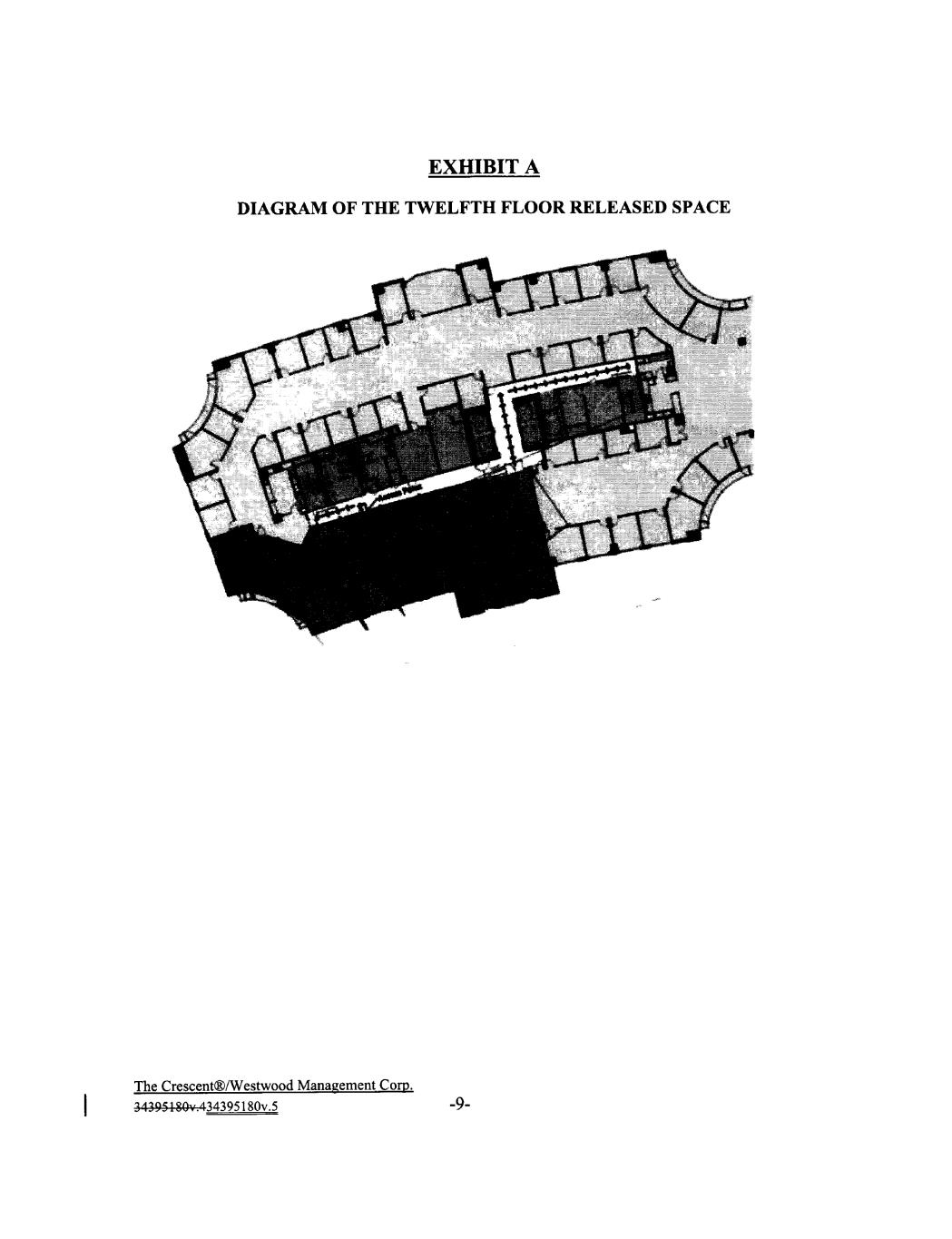
EXHIBIT A DIAGRAM OF THE TWELFTH FLOOR RELEASED SPACE TTheCrescent®/WestwoodManagementCo 31395190`,'.134395180v.5 -9-
Document comparison by Workshare Compare on Tuesday, March 7, 2023 3:49:48 PM Document 1 lDDescription iManage://imanagework.jw.com/jwdocs/34395180/434395180v4<imanagework.jw.com>-SEVENTEENTH AMENDMENT TO OFFICE LEASE -THE CRESCENT - WESTWOOD MANAGEMENT (REDUCTION) Document 2 lD jManage://imanagework.jw.com/jwdocs/34395180/5 Description #34395180v5<imanagework.jw.com> -SEVENTEENTH AMENDMENT TO OFFICE LEASE -THE CRESCENT - WESTWOOD MANAGEMENT (REDUCTION) Rendering set standard Count nsertions 3 Deletions 2 Moved from 0 Moved to 0 Style changes 0 Format changes 0

Total changes
The Crescent®/Westwood Management Corp. -1- EIGHTEENTH MODIFICATION OF OFFICE LEASE THIS EIGHTEENTH MODIFICATION OF OFFICE LEASE (this “Eighteenth Modification”) is entered into as of the _________ day of ________________, 2025 (the “Effective Date”), by and between GPIF TC OWNER LLC, a Delaware limited liability company (“Landlord”), and WESTWOOD MANAGEMENT CORP., a New York corporation (“Tenant”). RECITALS: A. The Crescent, a Texas joint venture, predecessor-in-interest to Landlord, and Tenant executed that certain Office Lease, dated April 9, 1990 (the “Original Lease”), covering certain space therein designated as Suite 1110, containing approximately 1,621 rentable square feet (the “Original Premises”), situated on the eleventh floor of 300 Crescent Court which is part of an office building commonly known as The Crescent®, located at 100, 200 and 300 Crescent Court, Dallas, Texas (the “Office Building”). B. The Original Lease has been amended by (i) that certain First Modification of Office Lease dated September 11, 1991 (the “First Modification”), pursuant to which the Original Premises were expanded to include an additional 1,783 rentable square feet to consist of a total of 3,404 rentable square feet; (ii) that certain Second Modification of Office Lease dated September 27, 1991 (the “Second Modification”), pursuant to which an error in the amount of the monthly installments of Basic Rental was corrected; (iii) that certain Third Modification of Office Lease dated October 5, 1994 (the “Third Modification”), pursuant to which Tenant relocated to Suite 1320, containing approximately 5,322 rentable square feet located in 300 Crescent Court, Dallas, Texas (hereinafter referred to as the “New Premises”); (iv) that certain Letter Agreement dated June 15, 1995 (the “Letter Agreement”), pursuant to which the term of the Original Lease was extended for an additional five (5) years, through and including March 31, 2000; (v) that certain Fourth Modification of Office Lease dated April 26, 1996 (the “Fourth Modification”), pursuant to which the New Premises were expanded to include an additional 2,691 rentable square feet located at 200 Crescent Court, Dallas, Texas (the “First Expansion Space”) and an additional 1,770 rentable square feet located in 300 Crescent Court, Dallas, Texas (the “Second Expansion Space”), and the term of the Original Lease was extended through June 30, 2001; (vi) that certain Fifth Modification of Office Lease dated May 30, 1996 (the “Fifth Modification”), pursuant to which the New Premises were expanded to include an additional 167 rentable square feet located at 200 Crescent Court, Dallas, Texas (the “Third Expansion Space”); (vii) that certain Sixth Modification of Office Lease dated September 18, 1997 (the “Sixth Modification”), pursuant to which the New Premises were expanded to include an additional 1,038 rentable square feet located at 200 Crescent Court, Dallas, Texas (the “Fourth Expansion Space”); (viii) that certain Seventh Modification of Office Lease dated June 24, 1998 (the “Seventh Modification”), pursuant to which the New Premises were reduced by approximately 3,896 rentable square feet of space located at 200 Crescent Court, Dallas, Texas (the “Released Space”) and expanded to include an additional 5,818 rentable square feet located on the thirteenth floor of 200 and 300 Crescent Court, Dallas, Texas (the “Fifth Expansion Space”); (ix) that certain Eighth Modification of Office Lease dated September 21, 1998 (the “Eighth Modification”), pursuant to which the New Premises were expanded to include an additional 665 rentable square feet located on the thirteenth floor of 200 Docusign Envelope ID: 63098854-80F7-47C8-8394-14676310345F 6/24/2025
The Crescent®/Westwood Management Corp. -2- Crescent Court, Dallas, Texas (the “Sixth Expansion Space”); (x) that certain Ninth Modification of Office Lease dated November 25, 2003 (the “Ninth Modification”), pursuant to which the Lease Term was extended and the New Premises, together with the First Expansion Space, the Second Expansion Space, the Third Expansion Space, the Fourth Expansion Space, the Fifth Expansion Space and the Sixth Expansion Space, and as reduced by the Released Space, were substituted with approximately 22,002 rentable square feet located on the 12th floor of 200 Crescent Court (the “Relocated Premises”); (xi) that certain Tenth Modification of Office Lease dated February 24, 2004 (the “Tenth Modification”), pursuant to which the Relocated Premises were redefined to contain 21,587 rentable square feet of space; (xii) that certain Eleventh Modification of Office Lease dated December 9, 2010 (the “Eleventh Modification”), pursuant to which the Lease Term was extended and the Relocated Premises were expanded to include Suite 1300, containing approximately 3,968 rentable square feet, located on the 13th floor of 200 Crescent Court (the “Seventh Expansion Space”); (xiii) that certain Twelfth Modification of Office Lease dated August 17, 2012 (the “Twelfth Modification”), pursuant to which the Relocated Premises were expanded to include additional space located on the 13th floor of 200 Crescent Court containing approximately 2,683 rentable square feet (the “Eighth Expansion Space”); (xiv) that certain Thirteenth Modification of Office Lease dated October 9, 2014 (the “Thirteenth Modification”), pursuant to which the Relocated Premises were expanded to include additional space located on the 13th floor of 200 Crescent Court containing approximately 1,210 rentable square feet (the “Ninth Expansion Space”); (xv) that certain Fourteenth Modification of Office Lease dated February 5, 2015 (the “Fourteenth Modification”), pursuant to which the Relocated Premises were expanded to include additional space located on the 4th floor of 200 Crescent Court containing approximately 4,747 rentable square feet (the “Tenth Expansion Space”); (xvi) that certain Fifteenth Modification of Office Lease dated June 30, 2015 (the “Fifteenth Modification”), pursuant to which the Lease Term was extended, the Relocated Premises were expanded to include additional space located on the 12th floor of 100 Crescent Court containing approximately 17,376 rentable square feet (the “Eleventh Expansion Space”) and the Seventh Expansion Space, Eighth Expansion Space, Ninth Expansion Space and Tenth Expansion Space were released by Tenant; (xx) that certain Sixteenth Modification to Office Lease dated July 5, 2018 (the “Sixteenth Modification”), pursuant to which the Relocated Premises were expanded to include additional space on the 12th floor of 100 Crescent Court containing approximately 4,745 rentable square feet (the “Twelfth Expansion Space”); and (xxi) that certain Seventeenth Modification to Office Lease dated March 22, 2023 (the “Seventeenth Modification”), pursuant to which the Relocated Premises was reduced by approximately 5,411 rentable square feet of space located on the 12th floor of the Office Building (“Second Released Space”). C. The Original Lease, as modified by the First Modification, the Second Modification, the Third Modification, the Letter Agreement, the Fourth Modification, the Fifth Modification, the Sixth Modification, the Seventh Modification, the Eighth Modification, the Ninth Modification, the Tenth Modification, the Eleventh Modification, the Twelfth Modification, the Thirteenth Modification, the Fourteenth Modification, the Fifteenth Modification, the Sixteenth Modification and the Seventeenth Modification, is hereinafter referred to as the “Lease”. The Relocated Premises, as expanded by the Eleventh Expansion Space and the Twelfth Expansion Space and reduced by the Second Released Space, collectively containing approximately 38,297 rentable square feet, are hereinafter referred to as the “Current Premises”. Unless otherwise Docusign Envelope ID: 63098854-80F7-47C8-8394-14676310345F
The Crescent®/Westwood Management Corp. -3- expressly provided herein, capitalized terms used herein shall have the same meanings as designated in the Lease. D. Landlord and Tenant desire to further amend and modify the Lease in certain respects as provided herein. AGREEMENT: In consideration of the sum of Ten Dollars ($10.00), the mutual covenants and agreements contained herein and in the Lease, and for other good and valuable consideration, the receipt and sufficiency of which are hereby acknowledged, Landlord and Tenant hereby further amend and modify the Lease as follows: 1. Lease Term. The parties agree that the Lease Term expires on February 28, 2026 notwithstanding anything to the contrary contained in the Sixteenth Modification. For the avoidance of doubt, Tenant shall continue to pay Rent for the Twelfth Expansion Space for the period commencing January 1, 2026, and continuing through February 28, 2026, and the Basic Rental rate shall be the same Basic Rental rate in effect for the month of December, 2025 pursuant to Paragraph 2 of the Sixteenth Modification. The Lease is hereby amended to extend the Lease Term for a period commencing on the Renewal Commencement Date (hereinafter defined) and continuing through and including the 128th full calendar month following the Renewal Commencement Date (such period being the “Renewal Term”), subject to earlier termination or renewal as provided in the Lease, as modified by this Eighteenth Modification. The parties agree that the Lease shall continue on the same terms and conditions for the period, if any, commencing on March 1, 2026, and continuing until the Renewal Commencement Date, except as modified below. As used herein, the term “Renewal Commencement Date” shall mean the date which is the later of (a) the earlier of (i) the date on which the Landlord Work (defined in Exhibit C attached hereto) is Substantially Complete, as determined pursuant to the Work Letter (defined below), or (ii) the date on which the Landlord Work would have been Substantially Complete but for Tenant Delay, as such term is defined in the Work Letter, or (b) March 1, 2026. 2. Premises Reduction and Remeasurement. Effective as of 11:59 p.m. (Dallas, Texas time) on the day (the “Release Date”) before the earlier of (i) March 1, 2026, or (ii) the Renewal Commencement Date, the Lease is hereby modified and amended to release from the Current Premises approximately 9,885 rentable square feet of space located on the 12th floor of the Building (the “Released Space”) as shown on Exhibit A-2 attached hereto, and neither Tenant nor Landlord shall have any further liabilities or obligations with respect to the Released Space, except as provided herein and except those that expressly survive the expiration or termination of the Lease, as modified by this Eighteenth Modification. From and after the Release Date, the term “Premises” wherever used in the Lease or in this Eighteenth Modification shall mean the Current Premises as reduced by the Released Space, which has been remeasured to contain approximately 29,748 rentable square feet of space, as shown on Exhibit A-1 attached hereto, and neither Tenant nor Landlord shall have any further liabilities or obligations with respect to the Released Space, except as provided herein and except those which expressly survive the expiration or termination of the Lease, as modified by this Eighteenth Modification. Effective as of the Release Date, Tenant’s proportionate share shall be adjusted to reflect the release of the Released Space, and Docusign Envelope ID: 63098854-80F7-47C8-8394-14676310345F
The Crescent®/Westwood Management Corp. -4- shall be 2.466%, which is the 29,748 rentable square feet in the Premises divided by the 1,206,239 rentable square feet in the Building. 3. Surrender. Tenant shall surrender the Released Space to Landlord on or before 11:59 p.m. (Dallas, Texas time) on the Release Date (except that if the Released Space is the Swing Space, Tenant will surrender such space in accordance with Section 8, below), broom clean and in its existing condition, except as provided below. All permanent or built-in fixtures or improvements and all mechanical, electrical and plumbing equipment in the Released Space shall be the property of Landlord upon Tenant’s surrender of the Released Space. All furnishings, equipment, furniture, trade fixtures, removable equipment and other personal property of Tenant located in the Released Space shall remain the property of Tenant and shall be removed by Tenant by the Release Date (or such later date as may be provided in Section 8, below, if the Released Space serves as the Swing Space). Tenant shall, at its expense, repair any damage caused by such removal. Tenant shall have the right to sell or give away the furnishings, equipment, furniture, trade fixtures and other removable equipment to third parties from the Released Space prior to the date that Tenant is required to surrender such space. Title to any furnishings, equipment, furniture, trade fixtures or other removable equipment not removed from the Released Space by the Release Date (or such later date as may be provided in Section 8, below, if the Released Space serves as the Swing Space) shall become the property of Landlord, other than title to any hazardous materials. Except as provided above in this Section 3, Tenant is discharged from surrender obligations under the Lease with respect to the Released Space, including, without limitation, Paragraph 14 of the Original Lease, and Tenant shall have not obligation to remove any improvements or fixtures. 4. Basic Rental. Effective as of the Release Date, Tenant shall no longer be required to pay Rent for the Released Space provided that Tenant timely surrendered the Released Space. Effective as of the Renewal Commencement Date, the Basic Rental due and payable for the Premises (i.e., the Current Premises as reduced by the Released Space) shall be as follows: Lease Period Annual Basic Rental Rate Per Rentable Square Foot Monthly Basic Rental Installment RCD – Lease Month 20 $51.00 $111,350.00†* Lease Month 21 – Lease Month 32 $52.40 $114,406.67† Lease Month 33 – Lease Month 36 $53.84 $117,550.67† Lease Month 37 – Lease Month 44 $53.84 $133,469.36 Lease Month 45 – Lease Month 56 $55.32 $137,138.28 Lease Month 57 – Lease Month 68 $56.84 $140,906.36 Docusign Envelope ID: 63098854-80F7-47C8-8394-14676310345F
The Crescent®/Westwood Management Corp. -5- Lease Period Annual Basic Rental Rate Per Rentable Square Foot Monthly Basic Rental Installment Lease Month 69 – Lease Month 80 $58.40 $144,773.60 Lease Month 81 – Lease Month 92 $60.01 $148,764.79 Lease Month 93 – Lease Month 104 $61.66 $152,855.14 Lease Month 105 – Lease Month 116 $63.36 $157,069.44 Lease Month 117 – Lease Month 128 $65.10 $161,382.90 RCD = Renewal Commencement Date Lease Month = One full calendar month † Calculated based on 26,200 rentable square feet in the Premises *Notwithstanding anything to the contrary contained in the foregoing, Landlord agrees to abate the Basic Rental due and payable for a period of eight (8) full calendar months commencing on the first day of the month after the Renewal Commencement Date (the “Abatement Period”). Tenant shall pay Basic Rental for any partial month in the event the Renewal Commencement Date does not occur on the first day of a calendar month. Except as provided herein, all rent shall be payable in accordance with the terms and provisions of the Lease, as modified by this Eighteenth Modification. 5. Actual Operating Expenses. (a) The Basic Rental rates in Paragraph 4 above have been determined on a “net” lease basis. Accordingly, effective as of the Renewal Commencement Date, Tenant shall pay Tenant’s proportionate share of Actual Operating Expenses with respect to the Premises, without adjustment for a base year or expense stop (subject to the 6% cap on Tenant’s proportionate share of Controllable Expenses as provided in Paragraph 6 of the Ninth Modification). Notwithstanding anything to the contrary contained in the foregoing, Landlord agrees to abate Tenant’s proportionate share of Actual Operating Expenses (but not the electrical costs described in Paragraph 7(b) of the Lease) due with respect to the Premises during the Abatement Period. In addition, during the first 36 months after the Renewal Commencement Date, Tenant’s proportionate share of Actual Operating Expenses and Tenant’s allocable share of electrical costs will be calculated as if the Premises contain 26,200 rentable square feet. (b) Effective as of the Renewal Commencement Date, the following shall be excluded from the definition of Actual Operating Expenses, in addition to the matters excluded under Paragraph 6(c) of the Original Lease and Paragraph 22 of the Ninth Modification: (i) costs and expenses incurred in retaining or relocating existing tenants; Docusign Envelope ID: 63098854-80F7-47C8-8394-14676310345F
The Crescent®/Westwood Management Corp. -6- (ii) costs and expenses incurred in connection with any other financing or re- financing transaction; (iii) costs and expenses associated with any sale or other transfer of the Landlord’s interest in the Building or the Project; (iv) property management fees or compensation in excess of three and one-half percent (3.5%) of collected rent; (v) asset management fees or compensation; (vi) costs and expenses resulting from any violation by Landlord of any mortgage or deed of trust to which the Building or Project is subject, or any other financing of Landlord; (vii) costs or expenses incurred as a result of a violation by Landlord or any other tenant of any covenants, conditions and restrictions, or any reciprocal easements, or any owner’s association now or hereafter affecting the Project; (viii) legal fees incurred in connection with any particular tenant; (ix) repairs, restoration or other work occasioned by fire, wind, the elements, or any other casualty paid by insurance proceeds or which would have been paid had Landlord maintained the insurance required by the Lease; (x) losses or liabilities against which Landlord has agreed to indemnify Tenant, or any cost or expense for which Landlord is responsible to pay under the Lease or this Eighteenth Amendment; (xi) contributions to reserves; (xii) the cost of the Landlord Work; (xiii) costs or expenses related to any building or land, other than the Project, such as centralized accounting costs, unless the allocation is made on a reasonable and consistent basis that fairly reflects the share of costs actually attributable to the Project; (xiv) political or charitable contributions; and (xv) costs and expenses incurred by Landlord resulting from the gross negligence or willful misconduct of Landlord, its employees, agents, representative or contractors. (c) Effective as of the Renewal Commencement Date, Paragraph 6(b) of the Original Lease shall be amended by changing the period at the end of the first sentence to a semicolon and adding the following immediately thereafter: “provided, however, that (i) Landlord will not collect or be entitled to collect Actual Operating Expenses and electrical expenses from all of its tenants of the Building with Docusign Envelope ID: 63098854-80F7-47C8-8394-14676310345F
The Crescent®/Westwood Management Corp. -7- respect to a calendar year in an amount that is in excess of one hundred percent (100%) of the Actual Operating Expenses and electrical expenses, respectively, actually paid or incurred by Landlord in connection with the operation of the Property during that calendar year, and (ii) Landlord will not gross up expenses that do not vary directly with occupancy (e.g., insurance premiums, landscaping costs, property taxes, and building security will not be grossed up; utilities for tenant space may be grossed up but utilities for Common Areas will not be grossed up).” 6. Audit Rights. Tenant shall continue to have the right to audit Landlord’s Actual Operating Expenses (which includes real estate taxes) as well as any other additional rental payable under the Lease (as modified hereby), no more than once per calendar year, in accordance with Paragraph 23 of the Ninth Modification. 7. Condition of Premises; Building and Project. (a) Premises. TENANT ACCEPTS THE PREMISES IN ITS CURRENT “AS IS” CONDITION AND CONFIGURATION, AND ACKNOWLEDGES THAT LANDLORD MAKES NO REPRESENTATIONS OR WARRANTIES WITH RESPECT THERETO, NOR IS TENANT RELYING ON ANY REPRESENTATIONS OR WARRANTIES PURPORTEDLY MADE BY LANDLORD OR LANDLORD’S AGENTS AND EMPLOYEES. Landlord agrees to construct, or cause to be constructed, leasehold improvements in and upon the Premises in accordance with the Work Letter attached hereto as Exhibit C. (b) Building and Project. In addition to performing the Landlord Work, Landlord agrees to update the restrooms located on the 12th floor of 100 Crescent Court with Building standard finishes, at Landlord’s sole cost and expense, and shall cause such restrooms to be in compliance with all applicable Laws (the “Restroom Work”). The Restroom Work shall be completed prior to the Renewal Commencement Date. 8. Swing Space. Tenant shall have the right to use certain Swing Space (hereinafter defined) during the performance of Landlord Work in the Premises as provided herein. The “Swing Space” consists of the Released Space, as shown on Exhibit A-2 attached hereto. Tenant shall have the right to use the Swing Space during the period commencing fifteen (15) days before the date on which Landlord advises Tenant that the Landlord Work will commence (with such date being at Landlord’s discretion) and continuing through and including the date which is fifteen (15) days after the date on which the Landlord Work is Substantially Complete (the “Swing Space Term”). Tenant’s occupancy of the Swing Space shall be subject to all terms and conditions contained in the Lease, as modified by this Eighteenth Modification, except that Tenant shall not be obligated to pay Basic Rental or Tenant’s proportionate share of the Actual Operating Expenses or electrical costs described in Paragraph 7(b) of the Lease for the Swing Space during the Swing Space Term. THE SWING SPACE WILL BE DELIVERED TO TENANT IN ITS “AS IS” CONDITION, AND LANDLORD MAKES NO WARRANTIES OR REPRESENTATIONS WITH RESPECT THERETO, NOR IS TENANT RELYING ON ANY WARRANTIES OR REPRESENTATIONS PURPORTEDLY MADE WITH RESPECT THERETO BY LANDLORD, ITS AGENTS OR EMPLOYEES. Tenant shall be solely responsible for the cost of relocating to and from the Swing Space. Tenant shall surrender the Swing Space to Landlord upon the expiration of the Swing Space Term in the same condition in which it was delivered to Tenant, reasonable wear and tear and damage from casualty excepted. In the event Tenant fails to timely Docusign Envelope ID: 63098854-80F7-47C8-8394-14676310345F
The Crescent®/Westwood Management Corp. -8- surrender the Swing Space to Landlord, Tenant shall be responsible for the payment of rent for the Swing Space (in addition to rent for the Premises) at the same rates and on the same terms and conditions as the Premises, commencing on the day immediately following the expiration of the Swing Space Term (but without the abatement contemplated for the Premises in Paragraph 4 and Paragraph 5 above). However, in no event shall Landlord’s acceptance of rent for the Swing Space be deemed an extension of the Swing Space Term and any such continued occupancy shall be deemed a holdover and Landlord shall have all rights and remedies available under the Lease, at law or in equity. So long as Tenant has surrendered the Swing Space in the condition required herein, neither party shall have any rights, liabilities or obligations under the Lease with respect to the Swing Space after the expiration of the Swing Space Term, except those which, by the provisions of the Lease, as modified by this Eighteenth Modification, expressly survive the expiration or termination of the Lease. 9. Storage Space. During the Renewal Term, Tenant shall have the right to lease from Landlord for storage purposes only, storage space containing approximately 732 rentable square feet of space, located on the 12th floor of 100 Crescent Court, as shown on Exhibit B attached hereto (the “Storage Space”). Tenant agrees to pay as Additional Rental an annual rental for the Storage Space in the amount of Eighteen and No/100 ($18.00) per square foot of Storage Space, plus any sales tax and Tenant’s proportionate share of electrical costs described in Paragraph 7(b) of the Lease (“Storage Rent”), payable in advance, in equal monthly installments, without any set off, abatement, counterclaim, or deduction whatsoever, and payable in the same manner as set forth in the Lease for payment of Basic Rental by Tenant. Tenant shall use the Storage Space for storage of personal property only and for no other purpose. Tenant agrees to keep the Storage Space clean and orderly and not to use the Storage Space for the purpose of storing refuse, trash, garbage and the like. In addition, Tenant shall not store any food or perishable goods, flammable materials, explosives, or any other inherently dangerous material in the Storage Space. Tenant shall accept possession of the Storage Space in “as is” condition and Landlord shall have no obligation whatsoever to furnish, render, or supply any money, work, labor, material, fixture, decoration, or equipment with respect to the Storage Space. Except for elevator service to the floor on which the Storage Space is located and Building Standard lighting, HVAC and electricity in the Storage Space, Tenant acknowledges and agrees that there shall be no other services whatsoever provided to the Storage Space. Tenant agrees and understands that no bailment, deposit of goods for safekeeping, warehouse receipt, bill of lading, or other document of title for the property stored by Tenant is intended or created hereby and Landlord is not engaged in the business of storing goods for hire or in the warehouse business. 10. Parking. Effective as of the Release Date, the Parking Agreement attached to the Ninth Modification as Rider No. 3 (as modified by the Eleventh Modification, the Twelfth Modification, the Thirteenth Modification, the Fourteenth Modification, the Fifteenth Modification, the Sixteenth Modification and the Seventeenth Modification) is hereby modified to reflect that Tenant shall be allocated unreserved parking permits at a ratio of 3:1,000 rentable square feet of the Premises in accordance with the terms and conditions of Rider No. 3 attached to the Ninth Modification (as modified by the Eleventh Modification, the Twelfth Modification, the Thirteenth Modification, the Fourteenth Modification, the Fifteenth Modification, the Sixteenth Modification and the Seventeenth Modification). The monthly rates payable by Tenant for such parking spaces shall be fixed for the Renewal Term at $140.000 for each unreserved Docusign Envelope ID: 63098854-80F7-47C8-8394-14676310345F
The Crescent®/Westwood Management Corp. -9- parking space, plus any taxes thereon, and $280.00 for each reserved parking space, plus any taxes thereon. Notwithstanding anything to the contrary contained in the foregoing, Landlord agrees to abate the cost of one (1) reserved parking space during the Renewal Term. 11. Signage. Landlord agrees that so long as it maintains a program for providing suite identification signage for its tenants, it shall provide building standard suite identification signage at or near the main door accessing the Premises in a location and with the size, color, and other aesthetics determined by Landlord in its sole and absolute discretion (“Suite Signage”). Subject to the foregoing, Landlord will provide Tenant with building standard Suite Signage at Landlord's cost and expense. Additionally, Tenant shall keep and maintain its existing signage in the elevator lobby on the 12th floor of 200 Crescent Court. 12. After-hours HVAC. The current charge for after-hours HVAC use is $40.00 per operating hour per floor. Such rate is subject to change based on increases in Landlord’s costs of providing same in accordance with Paragraph 10 of the Ninth Modification. 13. Business Days. The Lease, as modified by this Eighteenth Modification, is hereby modified to provide that the term “Business Days” means Monday through Friday of each week, exclusive of New Year’s Day, Memorial Day, Independence Day, Labor Day, Thanksgiving Day, the day after Thanksgiving and Christmas Day (“Holidays”). Landlord may designate additional Holidays, provided that the additional Holidays are commonly recognized by other Comparable Buildings. 14. Option to Extend. Rider No. 1 attached to the Eleventh Modification is hereby deleted in its entirety and replaced with Rider No. 1 attached hereto. 15. Right of First Refusal. Tenant shall have a right of first refusal in accordance with Rider No. 2 attached hereto. 16. Early Termination Option. Tenant shall have a one-time option to terminate the Lease, as modified by this Eighteenth Modification, as of the last day of the eighty-fourth (84th) full calendar month after the expiration of the Abatement Period (the “Termination Date”), provided Tenant gives notice thereof to Landlord (the “Termination Notice”) not less than twelve (12) months prior to the Termination Date and provided Tenant is not in default beyond any applicable notice and cure periods under the Lease, as modified by this Eighteenth Modification, at the time of giving such notice. Additionally, Tenant’s right to terminate hereunder is conditioned upon the payment in full by Tenant of (i) the cash sum equal to two (2) times the Basic Rental and Tenant’s proportionate share of Actual Operating Expenses and electrical expenses payable for the month immediately preceding the Termination Date, and (ii) the unamortized cost of all tenant improvement allowances (including, without limitation, the Construction Allowance, Test Fit Allowance and Soft Cost Allowance) and leasing commissions actually paid or provided by Landlord in connection with the Renewal Term (calculated by amortizing such costs over 120 months with interest of 8%) (collectively, the “Termination Payment”). The Termination Payment must be paid in full on or before the Termination Date. After Landlord’s receipt of the full Termination Payment and all rent through and including the Termination Date, neither party shall have any rights, liabilities or obligations under the Lease, as modified by this Eighteenth Docusign Envelope ID: 63098854-80F7-47C8-8394-14676310345F
The Crescent®/Westwood Management Corp. -10- Modification, for the period accruing after the Termination Date, except those which, by the provisions of the Lease, expressly survive the termination of the Lease (including Tenant’s obligations with respect to surrender of the Premises), as modified by this Eighteenth Modification. 17. Option to Expand. Rider No. 3 attached to the Eleventh Modification is hereby deleted in its entirety. 18. Club Membership. Landlord agrees to pay the initiation fee in connection with three (3) memberships to each of The Crescent® Club and The Spa at The Crescent® (collectively, the “Clubs”) on behalf of Tenant, at such time or times as Tenant elects to obtain such memberships. Other than the initiation fees, all monthly dues and charges (including applicable state and local taxes) incurred by Tenant or any other person in connection with the use of such memberships shall be solely the responsibility of Tenant. Use of the foregoing membership shall be subject to the Clubs’ rules and regulations and the continued existence of the Clubs. 19. Hotel. During the first five (5) years of the Renewal Term, Tenant shall be entitled to received fifty (50) nights per year at Hotel Crescent Court (the “Hotel”) at the rate of $289.00 per night, plus any taxes thereon (the “Hotel Discount Rate”). If the Hotel does not honor the Hotel Discount Rate, Landlord will be responsible for any cost above the Hotel Discount Rate, which Landlord may elect to either pay directly to the Hotel or to Tenant, or offset against Tenant’s next rent due and owing under the Lease. Any other charges incurred by Tenant or any other person in connection with the use of the Hotel shall be solely the responsibility of Tenant. 20. Access. Tenant, its permitted subtenants and their employees, licensees and guests, shall have access to the Premises at all times during the Lease Term, as extended hereby, 24 hours per day, every day of the year, subject to access procedures required by Landlord, the Building rules and regulations and other limitations set forth in the Lease, as modified by this Eighteenth Modification. 21. Notices. All notices to Landlord and Tenant under the Lease shall be sent to the following addresses which replace the addresses currently provided in the Lease: Landlord: 200 Crescent Court Suite 250 Dallas, Texas 75201 Attn: Property Manager Phone #: (214) 880-4500 Fax #: (214) 880-4506 Email: jyoung@crescent.com With a copy to: GPIF TC Owner LLC c/o Crescent Real Estate LLC 200 Crescent Court, Suite 250 Dallas, Texas 75201 Attn: Josh Pirtle Email: jpirtle@crescent.com And to: GPIF TC Owner LLC c/o Crescent Real Estate LLC 3230 Camp Bowie Blvd., Suite 500 Fort Worth, Texas 76107 Attn: Legal Department Email: legal@crescent.com 22. Broker. Tenant represents and warrants that no broker or agent has represented Tenant in connection with this Eighteenth Modification, other than Jones Lang LaSalle Brokerage, Inc. (whose commission shall be paid by Landlord pursuant to a separate written agreement). Docusign Envelope ID: 63098854-80F7-47C8-8394-14676310345F
The Crescent®/Westwood Management Corp. -11- TENANT SHALL INDEMNIFY AND DEFEND LANDLORD AGAINST ALL CLAIMS, COSTS, EXPENSES, ATTORNEYS’ FEES, LIENS AND OTHER LIABILITIES FOR REAL ESTATE COMMISSIONS OR FEES IN CONNECTION WITH THIS EIGHTEENTH MODIFICATION MADE BY ANY PARTY CLAIMING BY, THROUGH OR UNDER TENANT, OTHER THAN THE BROKER LISTED ABOVE. 23. Time of the Essence. Time is of the essence with respect to Tenant’s execution and delivery of this Eighteenth Modification to Landlord. If Tenant fails to execute and deliver a signed copy of this Eighteenth Modification to Landlord by 5:00 p.m. (Dallas, Texas time), on July 4, 2025, it shall be deemed null and void and shall have no force or effect, unless otherwise agreed in writing by Landlord. Landlord’s acceptance, execution and return of this document shall constitute Landlord’s agreement to waive Tenant’s failure to meet the foregoing deadline. 24. Miscellaneous. This Eighteenth Modification shall become effective only upon full execution and delivery of this Eighteenth Modification by Landlord and Tenant. This Eighteenth Modification contains the parties’ entire agreement regarding the subject matter covered by this Eighteenth Modification, and supersedes all prior correspondence, negotiations, and agreements, if any, whether oral or written, between the parties concerning such subject matter. There are no contemporaneous oral agreements, and there are no representations or warranties between the parties not contained in this Eighteenth Modification. Except as modified by this Eighteenth Modification, the terms and provisions of the Lease shall remain in full force and effect, and the Lease, as modified by this Eighteenth Modification, shall be binding upon and shall inure to the benefit of the parties hereto, their successors and permitted assigns. In case of a conflict between the Lease and this Eighteenth Modification, the terms of this Eighteenth Modification shall control. 25. Ratification. Landlord and Tenant hereby ratify and confirm their respective obligations under the Lease and each party represents and warrants to the other that to its current actual knowledge, it has no defenses thereto. Additionally, Tenant further confirms and ratifies that, as of the date hereof, (a) the Lease is and remains in good standing and full force and effect, and (b) to its current actual knowledge, Tenant has no claims, counterclaims, set-offs or defenses against Landlord arising out of the Lease or in any way relating thereto. Landlord confirms that, to its current actual knowledge, Tenant is not in default under the Lease. 26. Multiple Counterparts; Electronic Signatures. This Eighteenth Modification may be executed in multiple counterparts, each of which shall be deemed an original but all of which together shall constitute one and the same agreement. The counterparts of this Eighteenth Modification may be executed by electronic signatures and may be delivered electronically by any party to any other party and the receiving party may rely on the receipt of such document so executed and delivered by electronic means as if the original had been received. [Remainder of page intentionally left blank; signatures on following page] Docusign Envelope ID: 63098854-80F7-47C8-8394-14676310345F
The Crescent®/Westwood Management Corp. -12- EXECUTED as of the day and year first above written. LANDLORD: GPIF TC OWNER LLC, a Delaware limited liability company By: Name: Title: TENANT: WESTWOOD MANAGEMENT CORP., a New York corporation By: Name: Title: Docusign Envelope ID: 63098854-80F7-47C8-8394-14676310345F Brian Casey CEOSVP, Asset Management Josh Pirtle
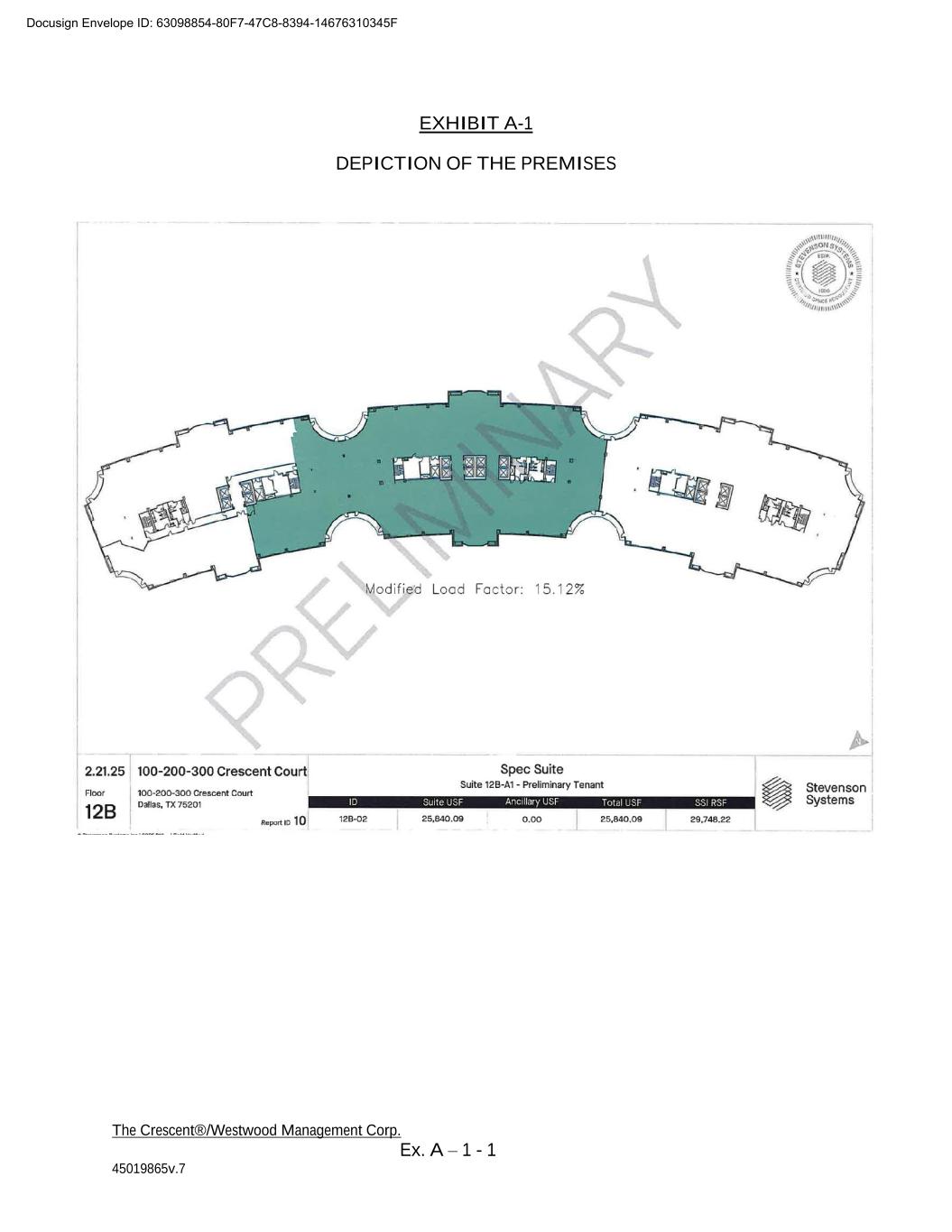
The Crescent®/Westwood Management Corp. Ex. A – 1 - 1 45019865v.7 EXHIBIT A-1 DEPICTION OF THE PREMISES Docusign Envelope ID: 63098854-80F7-47C8-8394-14676310345F
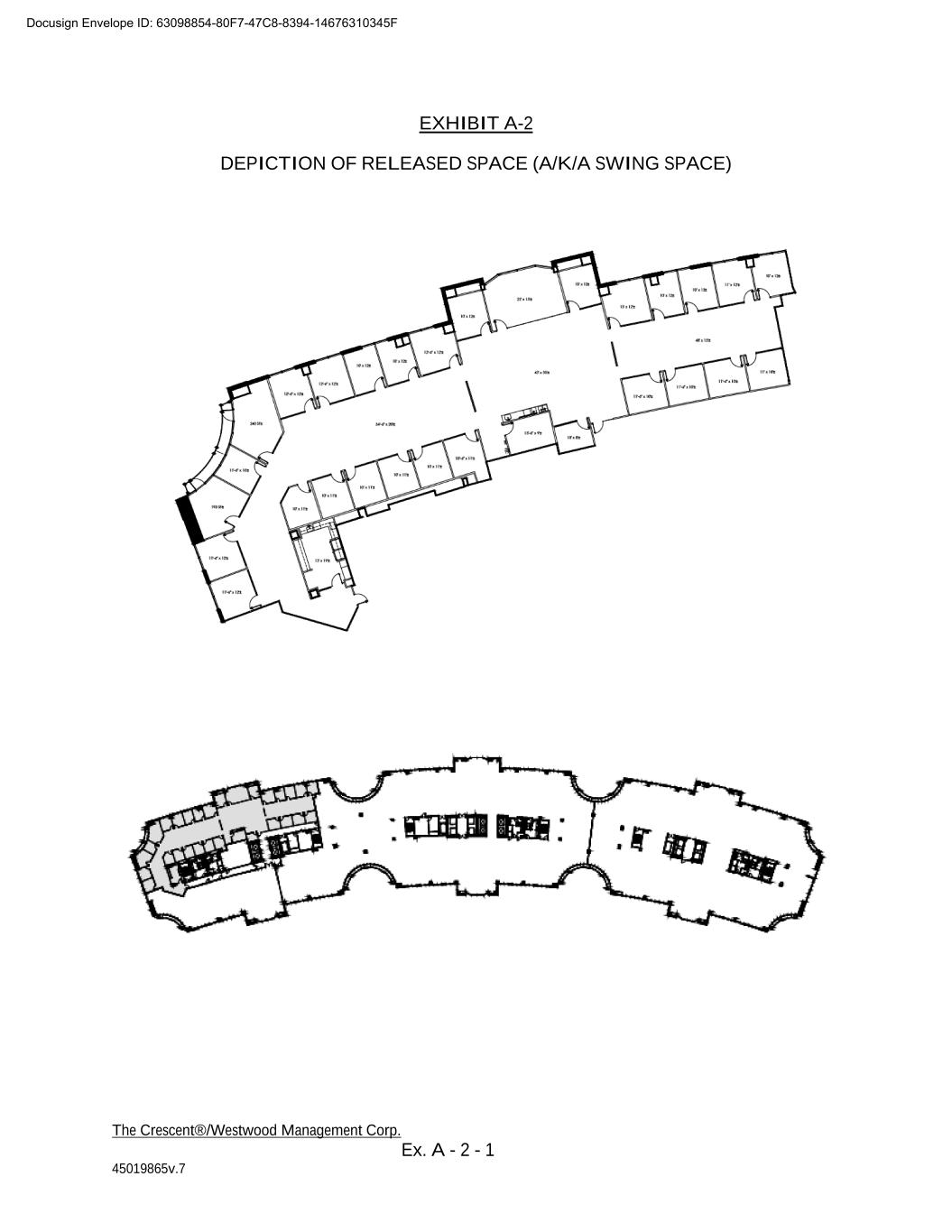
The Crescent®/Westwood Management Corp. Ex. A - 2 - 1 45019865v.7 EXHIBIT A-2 DEPICTION OF RELEASED SPACE (A/K/A SWING SPACE) Docusign Envelope ID: 63098854-80F7-47C8-8394-14676310345F
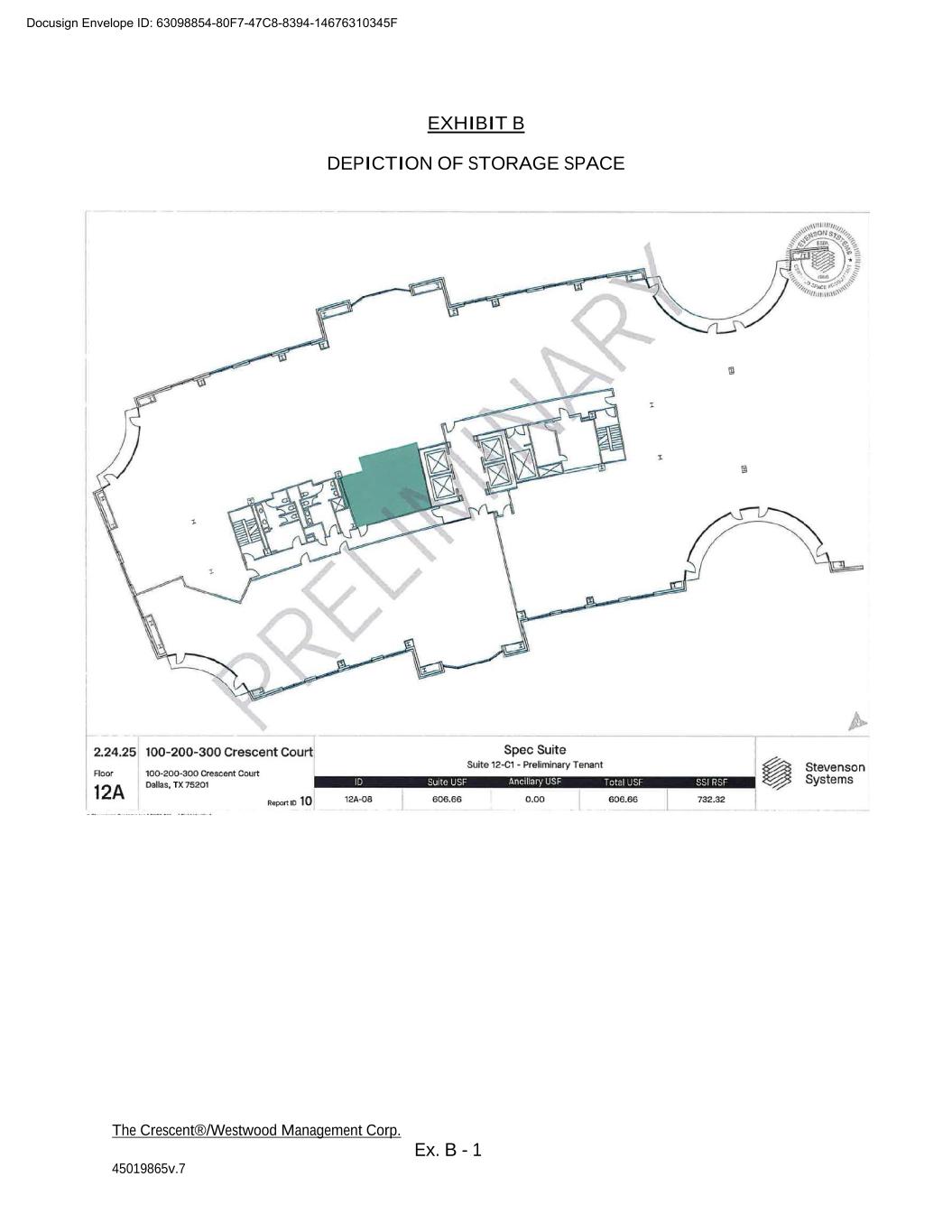
The Crescent®/Westwood Management Corp. Ex. B - 1 45019865v.7 EXHIBIT B DEPICTION OF STORAGE SPACE Docusign Envelope ID: 63098854-80F7-47C8-8394-14676310345F
The Crescent®/Westwood Management Corp. Ex. C - 1 45019865v.7 EXHIBIT C WORK LETTER This Work Letter is attached as an Exhibit to an Eighteenth Modification of Office Lease (the “Eighteenth Modification”) between GPIF TC OWNER LLC, as Landlord, and WESTWOOD MANAGEMENT CORP., as Tenant, for the Premises, containing 29,748 rentable square feet of space, located on the 12th floor of the Building. Unless otherwise specified, all capitalized terms used in this Work Letter shall have the same meanings as in the Lease (as defined in the Eighteenth Modification), as modified by the Eighteenth Modification. In the event of any conflict between the Lease, as modified by the Eighteenth Modification, and this Work Letter, the latter shall control. 1. Approved Construction Documents. (a) Construction Documents. No later than 60 days after the Effective Date, Tenant shall submit to Landlord complete, finished and detailed architectural, mechanical, electrical and plumbing drawings and specifications to include Tenant’s partition and furniture layout, reflected ceiling, telephone and electrical outlets and equipment rooms, doors (including hardware and keying schedule), glass partitions, windows (if any), critical dimensions, structural loading requirements, millwork, finish schedules, air conditioning and heating systems, ductwork and electrical facilities, together with all supporting information and delivery schedules (the “Construction Documents”). The Construction Documents shall be prepared by architects and/or engineers approved by Landlord in writing in advance. Landlord hereby acknowledges its approval of Corgan Associates, Inc. as Tenant’s architect (the “Architect”). The Construction Documents shall comply with Laws and shall be presented in Landlord’s format satisfactory for filing with the appropriate governmental authorities for required permits and licenses. (b) Landlord’s Approval. Following receipt of Tenant’s Construction Documents, Landlord (or its designated architectural and/or engineering firm) shall approve or disapprove such documents in writing. If Landlord disapproves, Landlord shall provide Tenant in writing specific reasons for such disapproval. Tenant shall submit corrected Construction Documents within 10 days of receipt of Landlord’s disapproval notice. Landlord shall approve or disapprove the corrected Construction Documents within 5 additional days from receipt thereof. Upon Landlord’s approval, the Construction Documents shall become the “Approved Construction Documents”. 2. Pricing and Bids. Within fifteen (15) Business Days following receipt of the Approved Construction Documents, Landlord will promptly price the construction of the Landlord Work with at least three (3) mutually approved general contractors from Landlord’s list of approved general contractors in accordance with the Approved Construction Documents and furnish any written price estimates (along with copies of the bid documents) actually received by Landlord to Tenant. For the avoidance of doubt, if any general contractors fail to respond to Landlord’s bid requests within such 15-Business Day period, Landlord shall not be in breach of the foregoing sentence. Upon receipt, Tenant shall promptly review such estimates and complete negotiations with Landlord for any changes or adjustments thereto. Within 5 Business Days after such receipt, Tenant shall return the estimates with written approval to Landlord. If Tenant fails to give its Docusign Envelope ID: 63098854-80F7-47C8-8394-14676310345F
The Crescent®/Westwood Management Corp. Ex. C - 2 45019865v.7 approval within such 5 Business Day period, the lowest competent estimates will be deemed approved by Tenant. 3. Landlord’s Contributions. Landlord will provide a construction allowance not to exceed $90.00 multiplied by the rentable square feet in the Premises (the “Construction Allowance”) toward the cost of designing, constructing and supervising the Landlord Work, and the FF&E Costs as described below. The cost of (a) all space planning, design, consulting or review services and construction drawings (except to the extent covered by the Test Fit Allowance and Soft Cost Allowance), (b) extension of electrical wiring from Landlord’s designated location(s) to the Premises, (c) purchasing and installing all building equipment for the Premises (including any submeters and other above building standard electrical equipment approved by Landlord), (d) required metering, re-circuiting or re-wiring for metering, equipment rental, engineering design services, consulting services, studies, construction services, cost of billing and collections, (e) materials and labor, (f) an asbestos survey of the Premises if required by applicable Law, and (g) Landlord’s Supervisory Fee and the construction management fee (if any) payable by Tenant to Tenant’s construction manager for advising Tenant with respect to, and supervising, on behalf of the Tenant, the construction and installation of the Landlord Work, shall all be included in the cost of the Landlord Work and may be paid out of the Construction Allowance, to the extent sufficient funds are available for such purpose. The cost of the Restroom Work will not be charged against the Construction Allowance. Tenant acknowledges that an asbestos survey will probably be required by applicable Law and that the time required for such asbestos surveys should be incorporated in Tenant’s construction planning. In addition, and provided that there are sufficient funds available in the Construction Allowance, Tenant may utilize a portion of the Construction Allowance, not to exceed 15% of the Construction Allowance, toward the costs of furniture (including freestanding workstations), fixtures and equipment for the Premises (the “FF&E” and such costs therefor the “FF&E Costs”). Subject to the foregoing limitation, in the event that Tenant elects to use the foregoing for the payment of FF&E Costs, Landlord will pay such FF&E Costs within thirty (30) days after receipt from Tenant of third-party invoices therefor. The FF&E shall be considered the property of the Tenant for all purposes, including tax purposes. Notwithstanding the foregoing, upon expiration of the Lease Term, as extended by the Eighteenth Modification, Tenant shall remove any non-standard improvements installed by or on behalf of Tenant in the Premises (which Landlord shall identify in writing at the time of Landlord’s approval of the Construction Documents). Further, Tenant’s wiring and cabling installed in the Premises shall be left in place as of the expiration of the Lease Term, as extended by the Eighteenth Modification and shall be capped and labeled in a manner reasonably acceptable to Landlord and in a manner such that a future tenant of the Premises may use the same. In addition to the Construction Allowance, Landlord will pay up to an amount equal to (i) $0.15 multiplied by the usable square feet in the Premises (the “Test Fit Allowance”) for a test fit of the Premises, with payments being made directly to Tenant’s Architect, and (ii) $1.00 multiplied by the rentable square feet in the Premises (the “Soft Cost Allowance”), which may be applied towards staging, moving and architectural expenses (to the extent not covered by the Construction Allowance or Test Fit Allowance). Construction Allowance, Test Fit Allowance and Soft Cost Allowance made available to Tenant under this Work Letter must be utilized for the intended purposes within twelve (12) months after the Effective Date (or if later, three (3) months after the Renewal Commencement Date), or be forfeited with no further obligation on the part of Landlord. Docusign Envelope ID: 63098854-80F7-47C8-8394-14676310345F
The Crescent®/Westwood Management Corp. Ex. C - 3 45019865v.7 4. Construction. (a) General Terms. Subject to the terms of this Work Letter, Landlord agrees to perform the Restroom Work and cause leasehold improvements to be constructed in the Premises as set forth in the Approved Construction Documents (collectively, the “Landlord Work”) in a good and workmanlike manner in accordance with the Approved Construction Documents. Tenant acknowledges that Landlord is not an architect or engineer, and that the Landlord Work will be designed and performed by independent architects, engineers and contractors. Accordingly, Landlord does not guarantee or warrant that the Approved Construction Documents will comply with Laws or be free from errors or omissions, nor that the Landlord Work will be free from defects, and Landlord will have no liability therefor. In the event of such errors, omissions or defects, and upon Tenant’s written request, Landlord will use commercially reasonable efforts to cooperate with Tenant in enforcing any applicable warranties. In addition, Landlord’s approval of the Construction Documents or the Landlord Work shall not be interpreted to waive or otherwise modify the terms and provisions of the Lease. Except with respect to the economic terms set forth in Paragraph 3 of this Work Letter, the terms and provisions contained in this Work Letter shall survive the completion of the Landlord Work and shall govern in all applicable circumstances arising under the Lease throughout the term of the Lease, including the construction of future improvements in the Premises. Tenant acknowledges that the Approved Construction Documents must comply with (i) the definitions used by Landlord for the electrical terms used in this Work Letter, (ii) the electrical and HVAC design capacities of the Building, (iii) Landlord’s policies concerning communications and fire alarm services, and (iv) Landlord’s policies concerning Tenant’s electrical design parameters, including harmonic distortion. Upon Tenant’s request, Landlord will provide Tenant a written statement outlining items (i) through (iv) above. (b) ADA Compliance. Landlord shall, as an Operating Expense (but subject to the amortization requirements for capital expenditures as set forth in Paragraph 22(5) of the Ninth Modification), be responsible for ADA (and any applicable state accessibility standard) compliance for the core areas of the Building (including elevators, common areas, and service areas), the Project’s parking facilities and all points of access into the Project. Tenant shall, at its expense, be responsible for ADA (and any applicable state accessibility standard) compliance in the Premises, including restrooms on any floor now or hereafter leased or occupied in its entirety by Tenant, its Affiliates or transferees. Landlord shall not be responsible for determining whether Tenant is a public accommodation under ADA or whether the Approved Construction Documents comply with ADA requirements, including submission of the Approved Construction Documents for review by appropriate state agencies. Such determinations, if desired by Tenant, shall be the sole responsibility of Tenant. (c) Substantial Completion. The Landlord Work shall be deemed to be “Substantially Complete” on the date that all Landlord Work (other than any details of construction, mechanical adjustment or any other similar matter, the noncompletion of which does not materially interfere with Tenant’s use or occupancy of the Premises) has been performed. Time is of the essence in connection with the obligations of Landlord and Tenant under this Work Letter. Landlord shall not be liable or responsible for any claims incurred (or alleged) by Tenant due to any delay in achieving Substantial Completion for any reason. Tenant’s sole and exclusive remedy for any delay in achieving Substantial Completion for any reason other than Tenant Delay (defined below) Docusign Envelope ID: 63098854-80F7-47C8-8394-14676310345F
The Crescent®/Westwood Management Corp. Ex. C - 4 45019865v.7 shall be the resulting postponement (if any) of the commencement of rental payments under the Eighteenth Modification. “Tenant Delay” means any act or omission of Tenant or its agents, employees, vendors or contractors that actually delays the Substantial Completion of the Landlord Work, including: (i) Tenant’s failure to furnish information or approvals within any time period specified in the Lease, as modified by the Eighteenth Modification, including the failure to prepare or approve preliminary or final plans by any applicable due date; (ii) Tenant’s selection of non- building standard equipment or materials; (iii) changes requested or made by Tenant to previously approved plans and specifications; or (iv) performance of work in the Premises by Tenant or Tenant’s contractor(s) during the performance of the Landlord Work. 5. Costs. (a) Change Orders and Cost Overruns. Landlord’s approval is required in advance of all changes to, and deviations from, the Approved Construction Documents (each, a “Change Order”), including any (i) omission, removal, alteration or other modification of any portion of the Landlord Work, (ii) additional architectural or engineering services, (iii) changes to materials, whether building standard materials, specially ordered materials, or specially fabricated materials, or (iv) cancellation or modification of supply or fabrication orders. Except as otherwise expressly provided in this Work Letter, all costs of the Landlord Work in excess of the Construction Allowance including Change Orders requested by Tenant and approved by Landlord which increase the cost of the Landlord Work (collectively, “Cost Overruns”) shall be paid by Tenant to Landlord within 10 days of receipt of Landlord’s invoice. Landlord will disburse 100% of the Construction Allowance before Tenant is required to expend any of its own funds for matters that are covered by the Construction Allowance, including Cost Overruns. Landlord will disburse 100% of the Test Fit Allowance before Tenant is required to expend any of its own funds for matters that are covered by the Test Fit Allowance. Landlord will disburse 100% of the Soft Cost Allowance before Tenant is required to expend any of its own funds for matters that are covered by the Soft Cost Allowance. Landlord may stop or decline to commence all or any portion of the Landlord Work until such payment of Cost Overruns is received. On or before the Renewal Commencement Date, Tenant shall pay Landlord the entire amount of all Cost Overruns. Tenant’s failure to pay, when due, any Cost Overruns or the cost of any Change Order shall constitute an event of default under the Lease. (b) Construction Management Fee. Within 10 days following the date of invoice from Landlord, Tenant shall, for supervision and administration of the construction and installation of the Landlord Work, pay Landlord a construction management fee equal to 2.5% of the hard costs (with “hard costs” being defined as all construction costs included in the contract with the general contractor and the scope of work) for the Landlord Work (“Landlord’s Supervisory Fee”), which may be paid from the unused portion of the Construction Allowance (if any). Tenant’s failure to pay such construction management fee when due shall constitute an event of default under the Lease. Docusign Envelope ID: 63098854-80F7-47C8-8394-14676310345F
The Crescent®/Westwood Management Corp. Rider No. 1 - 1 45019865v.7 RIDER NO. 1 OPTION TO EXTEND A. Renewal Period. Tenant may, at its option, extend the Lease Term for two renewal periods of five years each (each a “Renewal Period”) by written notice to Landlord (the “Renewal Notice”) given no earlier than 18 nor later than 12 months prior to the expiration of the Lease Term (or the prior Renewal Period, as applicable), provided that at the time of such notice and at the commencement of such Renewal Period, (i) Tenant and/or any Permitted Transferee remains in occupancy of (i.e., has not abandoned) the Premises, and (ii) no uncured event of default exists under the Lease beyond any applicable notice and cure period. The Basic Rental payable during the Renewal Period shall be at the Market Rental Rate (as defined here) for the Premises. Except as provided in this Rider No. 1, all terms and conditions of the Lease, as modified by this Eighteenth Modification, shall continue to apply during the Renewal Period, except that Tenant shall have no further Option to Extend the Term of the Lease. B. Acceptance. Within 30 days of the Renewal Notice, Landlord shall notify Tenant of the Basic Rental for such Renewal Period (the “Rental Notice”). Tenant may either accept or object to the terms set forth in the Rental Notice by written notice (as applicable, the “Acceptance Notice” or the “Objection Notice”) to Landlord given within 15 Business Days after receipt of the Rental Notice. If Tenant timely delivers an Objection Notice to Landlord, Landlord and Tenant shall negotiate in good faith the Basic Rental rate and other economic terms for the applicable renewal period for a period not to exceed 30 days; however, if following the determination of such Basic Rental rate and other economic terms for the applicable Renewal Period, Tenant determines in its sole and absolute discretion that such rate and terms are unacceptable, Tenant shall have the right to rescind its prior exercise of the option to extend in question by giving Landlord written notice thereof within 10 days after the date of such determination, in which event this Lease shall end at the expiration of the then-current Lease Term. If Tenant timely delivers its Acceptance Notice, Tenant shall, within 15 Business Days after receipt, execute a lease amendment confirming the Basic Rental and other terms applicable during the Renewal Period. If Tenant fails timely (i) to deliver its Acceptance Notice or Objection Notice, or (ii) if applicable, to execute and return the required lease amendment, then this Option to Extend shall automatically expire and be of no further force or effect. In addition, this Option to Extend shall terminate upon assignment of the Lease or subletting of all or any part of the Premises (other than in connection with a Permitted Transfer). C. Market Rental Rate. The “Market Rental Rate” is the rate (or rates) a willing tenant would pay and a willing landlord would accept for a comparable transaction (e.g., renewal, expansion, relocation, etc., as applicable, in comparable space in the Building) as of the commencement date of the applicable term, neither being under any compulsion to lease and both having reasonable knowledge of the relevant facts, considering the highest and most profitable use if offered for lease in the open market with a reasonable period of time in which to consummate a transaction. In calculating the Market Rental Rate, all relevant factors will be taken into account, including the age, location and quality of the Building, lease term, amenities of the Project, condition of the space and any concessions and allowances provided by Landlord for comparable transactions in the Building. The parties agree that the best evidence of the Market Rental Rate Docusign Envelope ID: 63098854-80F7-47C8-8394-14676310345F

The Crescent®/Westwood Management Corp. Rider No. 1 - 2 45019865v.7 will be the rate stated in lease documents executed for comparable transactions in the Building within the 12 months immediately prior to the date of the Rental Notice. Docusign Envelope ID: 63098854-80F7-47C8-8394-14676310345F
The Crescent®/Westwood Management Corp. Rider No. 2 - 1 45019865v.7 RIDER NO. 2 RIGHT OF FIRST REFUSAL Provided the Lease, as modified by this Eighteenth Modification, is then in full force and effect and no event of default shall have occurred that remains uncured after any applicable notice and cure period, Tenant shall have the on-going right of first refusal as hereinafter described to lease that portion of the space to be leased to a prospective tenant (the “Offered Space”) which is all or part of the space (the “Right of First Refusal Space”) contiguous to the Premises on the 12th floor of 100 Crescent Court at such time as Landlord engages in negotiations with a prospective tenant, exercisable at the following times and upon the following conditions: 1. If Landlord enters into negotiations with a prospective tenant (other than the existing tenant of the Offered Space) to lease the Offered Space, Landlord shall notify Tenant of such fact and shall include in such notice the rent, term, and other terms (including, but not limited to, finish out, moving allowances and design fees) at which Landlord is prepared to offer such Offered Space to such prospective tenant. Tenant shall have a period of seven (7) Business Days from the date of delivery of the notice to notify Landlord whether Tenant elects to exercise the right granted hereby to lease the Offered Space. If Tenant elects to lease the Offered Space, Tenant shall lease the entire space covered by Landlord’s offer even if the offer covers space which is not part of the Right of First Refusal Space. If Tenant fails to give any notice to Landlord within the required seven (7) Business Day period, Tenant shall be deemed to have waived its right to lease the Offered Space. 2. If Tenant so waives its right to lease the Offered Space (either by giving written notice thereof or by failing to give any notice), Landlord shall have the right to lease the Offered Space to the prospective tenant and upon the execution of such lease between Landlord and the prospective tenant this Right of First Refusal as to the Offered Space shall thereafter be null, void and of no further force or effect, except as provided below. 3. If Landlord does not enter into a lease with such prospective tenant covering the Offered Space upon economic terms which are not materially less favorable to Landlord within 180 days of Tenant’s waiver (or deemed waiver) of its right to lease the Offered Space, Landlord shall not thereafter engage in other lease negotiations with respect to the Right of First Refusal Space without again complying with the provisions of this Rider No. 2. 4. Upon the exercise by Tenant of its right of first refusal as provided in this Rider No. 2, Landlord and Tenant shall, within fifteen (15) days after Tenant delivers to Landlord notice of its election, enter into an amendment to the Lease incorporating the Offered Space into the Premises for the rent, for the term, and containing such other terms and conditions as Landlord notified Tenant pursuant to Paragraph 1 above. Notwithstanding anything to the contrary contained herein, in the event Tenant exercises its right of first refusal to lease the Offered Space within the first twelve (12) months after the Renewal Commencement Date, the terms applicable to the Offered Space, including the Basic Rental, shall be the same terms applicable to the Premises for the Renewal Term except that any allowances and abatements of Basic Rental and Tenant’s Docusign Envelope ID: 63098854-80F7-47C8-8394-14676310345F
The Crescent®/Westwood Management Corp. Rider No. 2 - 2 45019865v.7 proportionate share of Actual Operating Expenses shall be prorated to account for the difference in the Renewal Term with respect to the Offered Space. 5. Any assignment or the subletting by Tenant of any portion of the Premises (other than in connection with a Permitted Transfer) shall terminate the right of first refusal of Tenant contained herein. The right of first refusal granted herein is personal to Westwood Management Corp. and shall not be assignable to any other person or entity, except a Permitted Transferee. 6. The right of first refusal of Tenant contained herein shall be subject and subordinate to any rights of renewal, expansion, extension or relocation existing under any other tenant leases for the Building as of the Effective Date of this Eighteenth Modification. Docusign Envelope ID: 63098854-80F7-47C8-8394-14676310345F
Exhibit 23.1
CONSENT OF INDEPENDENT REGISTERED PUBLIC ACCOUNTING FIRM
Westwood Holdings Group, Inc.
Dallas, Texas
We hereby consent to the incorporation by reference in the Registration Statements on Form S-8 (Nos. 333-293588, 333-285065, 333-277220, 333-269604, 333-267641, 333-258305, 333-238965, 333-232595, 333-228335, 333-224886, 333-218080, 333-203728, 333-188002, 333-187998, 333-175696, 333-160377, 333-133963, and 333-98841) of Westwood Holdings Group, Inc., of our report dated March 4, 2026, relating to the consolidated financial statements which appears in this Annual Report on Form 10-K.
/s/ BDO USA, P.C.
Dallas, Texas
March 4, 2026
Exhibit 31.1
CERTIFICATION OF CHIEF EXECUTIVE OFFICER
PURSUANT TO
SECURITIES EXCHANGE ACT RULES 13A-14 AND 15D-14
I, Brian O. Casey, certify that:
1.I have reviewed this annual report on Form 10-K of Westwood Holdings Group, Inc.;
2.Based on my knowledge, this report does not contain any untrue statement of a material fact or omit to state a material fact necessary to make the statements made, in light of the circumstances under which such statements were made, not misleading with respect to the period covered by this report;
3.Based on my knowledge, the financial statements, and other financial information included in this report, fairly present in all material respects the financial condition, results of operations and cash flows of the registrant as of, and for, the periods presented in this report;
4.The registrant’s other certifying officer(s) and I are responsible for establishing and maintaining disclosure controls and procedures (as defined in Exchange Act Rules 13a-15(e) and 15d-15(e)) and internal control over financial reporting (as defined in Exchange Act Rules 13a-15(f) and 15d-15(f)) for the registrant and have:
a.Designed such disclosure controls and procedures, or caused such disclosure controls and procedures to be designed under our supervision, to ensure that material information relating to the registrant, including its consolidated subsidiaries, is made known to us by others within those entities, particularly during the period in which this report is being prepared;
b.Designed such internal control over financial reporting, or caused such internal control over financial reporting to be designed under our supervision, to provide reasonable assurance regarding the reliability of financial reporting and the preparation of financial statements for external purposes in accordance with generally accepted accounting principles;
c.Evaluated the effectiveness of the registrant’s disclosure controls and procedures and presented in this report our conclusions about the effectiveness of the disclosure controls and procedures, as of the end of the period covered by this report based on such evaluation; and
d.Disclosed in this report any change in the registrant’s internal control over financial reporting that occurred during the registrant’s most recent fiscal quarter (the registrant’s fourth fiscal quarter in the case of an annual report) that has materially affected, or is reasonably likely to materially affect, the registrant’s internal control over financial reporting; and
5.The registrant’s other certifying officer(s) and I have disclosed, based on our most recent evaluation of internal control over financial reporting, to the registrant’s auditors and the audit committee of the registrant’s board of directors (or persons performing the equivalent functions):
a.All significant deficiencies and material weaknesses in the design or operation of internal control over financial reporting which are reasonably likely to adversely affect the registrant’s ability to record, process, summarize and report financial information; and
b.Any fraud, whether or not material, that involves management or other employees who have a significant role in the registrant’s internal control over financial reporting.
Dated: March 4, 2026
| /s/ Brian O. Casey | |||||
| Brian O. Casey | |||||
| Chief Executive Officer | |||||
Exhibit 31.2
CERTIFICATION OF CHIEF FINANCIAL OFFICER
PURSUANT TO
SECURITIES EXCHANGE ACT RULES 13A-14 AND 15D-14
I, Murray Forbes III, certify that:
1.I have reviewed this annual report on Form 10-K of Westwood Holdings Group, Inc.;
2.Based on my knowledge, this report does not contain any untrue statement of a material fact or omit to state a material fact necessary to make the statements made, in light of the circumstances under which such statements were made, not misleading with respect to the period covered by this report;
3.Based on my knowledge, the financial statements, and other financial information included in this report, fairly present in all material respects the financial condition, results of operations and cash flows of the registrant as of, and for, the periods presented in this report;
4.The registrant’s other certifying officer(s) and I are responsible for establishing and maintaining disclosure controls and procedures (as defined in Exchange Act Rules 13a-15(e) and 15d-15(e)) and internal control over financial reporting (as defined in Exchange Act Rules 13a-15(f) and 15d-15(f)) for the registrant and have:
a.Designed such disclosure controls and procedures, or caused such disclosure controls and procedures to be designed under our supervision, to ensure that material information relating to the registrant, including its consolidated subsidiaries, is made known to us by others within those entities, particularly during the period in which this report is being prepared;
b.Designed such internal control over financial reporting, or caused such internal control over financial reporting to be designed under our supervision, to provide reasonable assurance regarding the reliability of financial reporting and the preparation of financial statements for external purposes in accordance with generally accepted accounting principles;
c.Evaluated the effectiveness of the registrant’s disclosure controls and procedures and presented in this report our conclusions about the effectiveness of the disclosure controls and procedures, as of the end of the period covered by this report based on such evaluation; and
d.Disclosed in this report any change in the registrant’s internal control over financial reporting that occurred during the registrant’s most recent fiscal quarter (the registrant’s fourth fiscal quarter in the case of an annual report) that has materially affected, or is reasonably likely to materially affect, the registrant’s internal control over financial reporting; and
5.The registrant’s other certifying officer(s) and I have disclosed, based on our most recent evaluation of internal control over financial reporting, to the registrant’s auditors and the audit committee of the registrant’s board of directors (or persons performing the equivalent functions):
a.All significant deficiencies and material weaknesses in the design or operation of internal control over financial reporting which are reasonably likely to adversely affect the registrant’s ability to record, process, summarize and report financial information; and
b.Any fraud, whether or not material, that involves management or other employees who have a significant role in the registrant’s internal control over financial reporting.
Dated: March 4, 2026
| /s/ Murray Forbes III | |||||
| Murray Forbes III | |||||
| Chief Financial Officer | |||||
Exhibit 32.1
CERTIFICATION PURSUANT TO
18 U.S.C. SECTION 1350,
AS ADOPTED PURSUANT TO
SECTION 906 OF THE SARBANES-OXLEY ACT OF 2002
In connection with the Annual Report of Westwood Holdings Group, Inc. (the “Company”) on Form 10-K for the year ended December 31, 2025, as filed with the Securities and Exchange Commission on the date hereof (the “Report”), I, Brian O. Casey, President & Chief Executive Officer of the Company, certify, pursuant to 18 U.S.C. § 1350, as adopted pursuant to § 906 of the Sarbanes-Oxley Act of 2002, that, to the best of my knowledge:
(1) The Report fully complies with the requirements of section 13(a) or 15(d) of the Securities Exchange Act of 1934 (15 U.S.C.78m or 78o(d)); and
(2) The information contained in the Report fairly presents, in all material respects, the financial condition and results of operations of the Company.
Dated: March 4, 2026
| /s/ Brian O. Casey | |||||
| Brian O. Casey | |||||
| Chief Executive Officer | |||||
A signed original of this written statement required by Section 906 has been provided to Westwood Holdings Group, Inc. and will be retained by Westwood Holdings Group, Inc. and furnished to the Securities and Exchange Commission or its staff upon request. The foregoing certification is being furnished solely pursuant to 18 U.S.C. Section 1350 and is not being filed as part of the Report or as a separate disclosure document.
Exhibit 32.2
CERTIFICATION PURSUANT TO
18 U.S.C. SECTION 1350,
AS ADOPTED PURSUANT TO
SECTION 906 OF THE SARBANES-OXLEY ACT OF 2002
In connection with the Annual Report of Westwood Holdings Group, Inc. (the “Company”) on Form 10-K for the year ended December 31, 2025, as filed with the Securities and Exchange Commission on the date hereof (the “Report”), I, Murray Forbes III, Chief Financial Officer of the Company, certify, pursuant to 18 U.S.C. § 1350, as adopted pursuant to § 906 of the Sarbanes-Oxley Act of 2002, that, to the best of my knowledge:
(1) The Report fully complies with the requirements of section 13(a) or 15(d) of the Securities Exchange Act of 1934 (15 U.S.C.78m or 78o(d)); and
(2) The information contained in the Report fairly presents, in all material respects, the financial condition and results of operations of the Company.
Dated: March 4, 2026
| /s/ Murray Forbes III | |||||
| Murray Forbes III | |||||
| Chief Financial Officer | |||||
A signed original of this written statement required by Section 906 has been provided to Westwood Holdings Group, Inc. and will be retained by Westwood Holdings Group, Inc. and furnished to the Securities and Exchange Commission or its staff upon request. The foregoing certification is being furnished solely pursuant to 18 U.S.C. Section 1350 and is not being filed as part of the Report or as a separate disclosure document.